1. Planned Reforms

The Children’s Wellbeing and Schools Bill published in November 2024, following on from the Policy Paper: Keeping Children Safe Helping Families Thrive (Department for Education) sets out the government’s planned reforms to education and children’s social care.

The Families First Programme Guide confirms the Department for Education’s expectations of safeguarding partners in implementing reforms in the Bill, including reforms relating to:

  • family help;
  • multi-agency child protection; and
  • making greater use of family group decision making.

The Department’s expectation is that the period until March 2026 will be ongoing business-as-usual service delivery, alongside transformation activity. It also expects that the Families First Programme Guide should be used by safeguarding partners and other relevant agencies and organisations within their local areas to begin planning for transformation activity and implementation,  building on the foundations of what is already in place through the requirements of Working Together to Safeguard Children and the Children’s Social Care National Framework: Statutory Guidance on the Purpose, Principles for Practice and Expected Outcomes of Children’s Social Care 2023.

The Department has also commissioned a Foundations Toolkit from the What Works Centre for Children and Families, which includes:

  • Foundations Guidebook – information about interventions that make a difference to children and families’ outcomes;
  • Practice Guides – recommendations about how to put evidence-based support into action.

The Foundations Practice Guides provide evidence-based recommendations for those commissioning and delivering child and family support at the local level, and the Foundations Guidebook provides evidence-based examples of interventions that put these practices into action.

The Practice Guides set out high quality evidence about how best to achieve the outcomes set out in the Children’s Social Care National Framework and translates this into key principles and recommendations to support local leaders in strengthening family services. The Families First Programme Guide states that local partnerships should look to these Foundations Practice Guides as a key source for guidance on the latest evidence.

The Families First Programme Guide sets out the Department’s expectations for practice and areas of local flexibility to support safeguarding partners to plan their transformation activity for family help, multi-agency child protection and family group decision making.

Expectations include that safeguarding partnerships should:

  • work together to publish a refreshed threshold document by March 2026;
  • update their local protocol for assessment and support;
  • establish the Family Help Lead Practitioner (FHLP) role and develop a multi-agency workforce development plan outlining the training, knowledge and skill levels for the family help workforce including the FHLP role;
  • move towards an integrated front door, where contacts and referrals can be triaged to the right level of service, and implement digital solutions such as a service directory, social media and also roles such as community connectors and service access points which provide accessible opportunities for families to understand and access support;
  • establish expert-led Multi-Agency Child Protection Teams (MACPTs);
  • establish expert social worker Lead Child Protection Practitioners (LCPPs), embedded within MACPTs, who will be responsible for statutory child protection decisions drawing on the expertise and knowledge of the wider multi-agency practitioners in the team;
  • consider and set out chairing arrangements for child protection conferences within the MACPT, whilst ensuring clear ongoing quality assurance, and consider how the team will quality assure child protection plans;
  • develop an evidence-based approach to making greater use of family group decision making;
  • develop appropriate infrastructure for sharing, storing and analysing information and updating case management systems (the Bill provides for a consistent child identification number known as a Single Unique Identifier);
  • secure the participation of education and childcare settings as relevant agencies as well as ensuring that their views are sufficiently included and represented at strategic and operational levels in multi-agency safeguarding arrangements.

2. Implementation in Buckinghamshire

Locally, the Families First programme team, led by the Council’s Service Director for Transformation has established a dedicated programme structure to prepare for the implementation of the Children’s Wellbeing and Schools Bill reforms. This work is being coordinated through a local governance framework overseen by a new Families First Governance Board which will report into the Buckinghamshire Safeguarding Children Partnership (BSCP) board. Key planning activities include:

  • Programme governance and oversight: the Families First programme team is working closely with partner agencies including police and health Families First leads to interpret national guidance and align with local priorities/structures. Governance arrangements have been progressed to ensure accountability and strategic direction for onward transformation activity.
  • Collaborative planning with partners: the team is engaging with safeguarding partners to consider co-design approaches for family help, multi-agency child protection, and family group decision-making. This includes reviewing current practice against the expectations set out in the Families First Programme Guide and potential identifying areas for improvement. Crucially, the first part of this work involves taking stock of our strengths, what is working well and where there are gaps which can be addressed by these reform measures.
  • Workforce development: initial work is underway to engage with staff and scope the requirements for the new proposed structures and roles such as the Family Help Lead Practitioner (FHLP) and Lead Child Protection Practitioner (LCPP) role and to develop a multi-agency workforce development plan. This plan will outline training, knowledge, and skill levels needed to deliver high-quality family help services.
  • Digital and infrastructure planning: the team is exploring options for the implementation of the Single Unique Identifier for children, as required by the Bill.
  • Evidence-based practice: local planning is informed by the Foundations Toolkit and Practice Guides, ensuring that interventions and service models are grounded in the latest evidence about what works for children and families.

These activities are designed to ensure that Buckinghamshire is ready to meet the Department for Education’s expectations by March 2026, balancing business-as-usual service delivery with the transformation required under the new legislative framework.

Was this helpful?
Yes
No
Thanks for your feedback!

Introduction

Expectations for practice for senior leaders, practice supervisors and practitioners in local authorities are set out in the Children’s Social Care National Framework. This includes practice to help keep children safe inside and outside of their homes (Outcome 3). The BSCP expect the children’s workforce as a whole to adopt a strengths-based approach to all assessments and subsequent actions or activities when working with children or young people and their families

The following national multi-agency practice standards for child protection are for all practitioners working in services and settings who come into contact with children who may be suffering or have suffered significant harm within or outside the home. The term practitioner is used throughout the guidance to refer to individuals who work with children and their families in any capacity, including a range of professionals, such as qualified social workers and those who work for the statutory safeguarding partners or in education settings. Section B is specifically targeted at those directly involved in child protection work.

Safeguarding partners in Buckinghamshire need to ensure all practitioners are supported to be able to achieve these child protection standards, including through:

  • an unrelenting focus on protection and the best outcomes for children;
  • creating learning cultures in which practitioners stay up to date as new evidence of best practice emerges;
  • creating an environment in which it is safe to challenge, including assumptions that relate to ethnicity, sex, disability, and sexuality;
  • supporting practitioners with effective supervision as determined by their regulatory body in which they can critically reflect on their findings and strengthen their analysis;
  • helping practitioners to understand the impact of their decisions on the child and family.

A: Recognising Actual or Likely Significant Harm for all Practitioners

See Types of Abuse and Neglect chapter

  • Practitioners are alert to potential indicators of abuse, neglect, and exploitation, and listen carefully to what a child says, how they behave, and observes how they communicate if non-verbal (due to age, special needs and/or disabilities, or if unwilling to communicate). Practitioners will try to understand the child’s personal experiences and observe and record any concerns.
  • Practitioners communicate in a way that is appropriate to the child’s age and level of understanding and use evidence-based practice tools for engaging with children, including those with special educational needs and disabilities.
  • When practitioners have concerns or information about a child that may indicate a child is suffering or likely to suffer significant harm, they share them with relevant practitioners and escalate them if necessary, using the referral or Escalation, Challenge and Conflict Resolution Procedure. They update colleagues when they receive relevant new information.
  • Practitioners never assume that information has already been shared by another professional or family member and always remain open to changing their views about the likelihood of significant harm.

B: Section 47 Enquiries, Child Protection Conferences and Child Protection Plans

See Providing Help, Support and Protection section

  • Practitioners are aware of the limits and strengths of their personal expertise and agency remit. They work collaboratively and proactively with multi-agency practitioners to build an accurate and comprehensive understanding of the daily life of a child and their family to establish the likelihood of significant harm and any ongoing risks. Practitioners respect the opinions, knowledge and skills of multi-agency colleagues and engage constructively in their challenge.
  • Practitioners have an applied understanding of what constitutes a child suffering actual or likely significant harm. They consider the severity, duration and frequency of any abuse, degree of threat, coercion, or cruelty, the significance of others in the child’s world, including all adults and children in contact with the child (this can include those within the immediate and wider family and those in contexts beyond the family, including online), and the cumulative impact of adverse events.
  • Practitioners take care to ensure that children know what is being discussed about them and their family where this is appropriate. They ask children what they would like to happen and what they think would help them and their family to reduce the likelihood of significant harm, including where harm is taking place in contexts beyond the family home. Practitioners listen to what children tell them;
  • Practitioners engage parents and the family network, as appropriate, in the discussions, recognising previous involvement with agencies and services may influence how they engage. Practitioners encourage parents and families to express what support would help them to reduce significant harm.
  • Practitioners thoroughly explore the significance of the adults in contact with the child and their family or individual histories. They should pay particular attention to any serious criminal convictions, previous allegations of child abuse, domestic abuse or impulsive violent behaviour, restrictions on contact with children or involvement with children subject to child protection plans or care proceedings.
  • Practitioners satisfy themselves that conclusions about the likelihood of significant harm give sufficient weight to the views, experiences, and concerns of those who know the child and / or parents well, including relatives who are protective of the child, and other relevant practitioners.
  • Practitioners share their thinking and proposed recommendations with other practitioners who hold relevant information and insight into the child and adults involved with the child. Practitioners comment, challenge, and jointly deliberate, before making a final decision about the likelihood of significant harm.
  • Together with other agencies, practitioners clarify what family help from multi agency partners is necessary to reduce the likelihood of significant harm and maintain reasonable care for the children. They seek assurance that this resource is available and of sufficient skill and intensity.
  • Practitioners explain clearly to parents and the family network the implications of the threshold that has been reached for section 47 enquiries, the initial child protection conference, and any ongoing child protection plan (including that this threshold may lead to pre-proceedings, should the likelihood of significant harm not reduce). Practitioners do everything they can to ensure that parents and the family network understand and can engage purposefully with the enquiries and any protection plan.
  • Practitioners remain alert to changes in circumstances for the child and family and respond as new information comes to light that needs to be reflected in the child protection plan.
  • Practitioners reflect on the proposed protection plan and consider adjustments to strengthen the protection plan. The protection plan is specific, achievable, and relevant to the likelihood of significant harm and the context in which it is occurring.

C: Discharging the Child Protection Plan

See Child Protection Conferences and the Child Protection Plan chapter

  • Practitioners work as part of a multi-agency team to create lasting change for families and ensure the child, parents and family network know that further help and support is available if needed or further concerns arise.
  • Following a decision to discharge a child protection plan, practitioners ensure that appropriate support is in place for the child and family and respond to changing circumstances and new information.
  • Where a child becomes looked after, practitioners ensure that this is well planned and that the child, parents and family network are appropriately supported. Ongoing need is monitored as part of care planning.
Was this helpful?
Yes
No
Thanks for your feedback!

1. Introduction

This chapter outlines the main points of the Equality Act 2010, and also how it relates to safeguarding children. The Act ensures there is consistency in the way organisations provide services. This includes all children who use its services, and their family and friends, as well as other members of the public, staff, volunteers and partner agency staff.

 2. Equality Act 2010

The Equality Act 2010 ensures there is consistency in what an organisation does to provide services in a fair environment and comply with the law. This includes all the people who use its services, their family and friends and other members of the public, staff, volunteers and partner agency staff. See also Section 4.2, Protected characteristics.

The Equality Act references ‘protected characteristics’: all of which must be considered when implementing safeguarding procedures. The Act covers both direct and indirect discrimination against people with these characteristics. These are:

  • age;
  • disability;
  • gender reassignment;
  • race;
  • religion or belief;
  • sex;
  • sexual orientation;
  • marriage and civil partnership;
  • pregnancy and maternity.

An organisation’s commitment to equality and diversity means that every person who is provided support has their individual needs comprehensively addressed. They will be treated equally and without discrimination. This is regardless of any protected characteristics or another aspect that could result in them being discriminated against. Organisations should also be committed to protecting individuals’ human rights. Failure to make reasonable adjustments in the care of a certain group with a protected characteristic (for example, a learning disability) may violate the Equality Act. Public bodies should have a process by which they consider how to promote equality.

 3. Commitment to Equality, Diversity and Human Rights

The organisation should express its commitment to equality and diversity by:

  • respecting the ethnic, cultural and religious practices of people who use the service and making practical provision for them to be observed as appropriate;
  • reassuring people who use the service that their diverse backgrounds enhance the quality of experience of everyone who lives and works in any service provided by it;
  • protecting people’s human rights – treating them and their family and friends, fairly and with respect and dignity;
  • accepting people as individuals;
  • supporting children to express their individuality and to follow their preferred lifestyle, also helping them to celebrate events, anniversaries or festivals which are important to them;
  • showing positive leadership and having management and human resources practices that actively demonstrate a commitment to the principles of equality and diversity;
  • developing an ethos throughout its service that reflects these values and principles;
  • expecting all staff to work to equality and diversity principles and policies and to behave at all times in non-discriminatory ways;
  • provide training, supervision and support to enable staff to do this;
  • having a code of conduct that makes any form of discriminatory behaviour unacceptable. This applies to both staff, people who use services and their family and friends, which is rigorously observed and monitored accordingly.

4. Guidance

4.1 Types of discrimination

All staff involved in the safeguarding process should be familiar with the following types of discrimination.

  • Direct discrimination occurs when a person is treated less favourably than others in similar circumstances on the grounds of race, colour, national or ethnic origins, sex, marital status, sexuality, disability, membership or non-membership of trade union, ‘spent convictions’ of ex-offenders, class, age, political or religious belief.
  • Discrimination by association applies to race, religion or belief, sexual orientation, age, disability, gender reassignment and sex. This is direct discrimination against someone because they associate with another person who possesses a protected characteristic (see Section 4.2, Protected characteristics).
  • Perception discrimination is against an individual because others think they possess a particular protected characteristic. It applies even if the person does not actually possess that characteristic.
  • Indirect discrimination occurs when a condition or requirement is imposed which adversely affects one particular group considerably more than another.
  • Harassment is defined as unwanted, unreciprocated and / or uninvited comments, looks, actions, suggestions or physical contact that is found objectionable and offensive. Harassment is particularly liable to occur as part of sexual or racial discrimination.
  • Victimisation occurs when an employee is treated badly because they have made or supported a complaint or raised a grievance under the Equality Act, or because they are suspected of doing so. People are not protected from victimisation if they have maliciously made or supported an untrue complaint.

4.2 Protected Characteristics

Under the Equality Act 2010, these are as follows.

  • Age: Where this is referred to, it refers to a person belonging to a particular age (for example 32 year olds) or range of ages (for example 18 – 30 year olds).
  • Disability: A person has a disability if they have a physical or mental impairment which has a substantial and long-term adverse effect on that person’s ability to carry out normal day-to-day activities. The Act includes a protection from discrimination arising from disability. This states it is discrimination to treat a disabled person unfavourably because of something connected with their disability.
  • Gender reassignment: A transgender person is someone who proposes to, starts or has completed a process to change their gender. The Act does not require a person to be under medical supervision to be protected – so a woman who decides to live as a man but does not undergo any medical procedures would be covered. It is discrimination to treat transgender people less favourably because they propose to undergo, are undergoing or have undergone gender reassignment than they would be treated if they were ill or injured.
  • Marriage and civil partnership: In England and Wales marriage is not restricted to a union between a man and a woman and includes a marriage between a same-sex couple. Same-sex couples and mixed-sex couples can also have their relationships legally recognised as ‘civil partnerships’. Civil partners must not be treated less favourably than married couples (except where permitted by the Act). The Act protects employees who are married or in a civil partnership against discrimination.
  • Pregnancy and maternity: Pregnancy is the condition of being pregnant or expecting a baby. Maternity refers to the period after the birth. Protection against maternity discrimination is for 26 weeks after giving birth, and this includes treating a woman unfavourably because she is breastfeeding.
  • Race: Race refers to a group of people defined by their race, colour, and nationality (including citizenship) ethnic or national origins.
  • Religion or belief: Religion has the meaning usually given to it but belief includes religious and philosophical beliefs including lack of belief (for example atheism). Generally, a belief should affect life choices or the way a person lives for it to be included in the definition. In the Equality Act, religion includes any religion. It also includes a lack of religion.
  • Sex: Both men and women are protected under the Act.
  • Sexual orientation: Whether a person’s sexual attraction is towards their own sex, the opposite sex or to both sexes. The Act protects bisexual, gay, heterosexual and lesbian people.

 5. Human Rights Legislation

See also Equality and Human Rights Commission 

5.1 Human Rights Act 1998 Overview

The Human Rights Act 1998 (HRA) lays down the fundamental rights and freedoms to which everyone in the UK is entitled. The rights set out in the European Convention on Human Rights (ECHR) are incorporated in the HRA. It sets out people’s human rights in different ‘articles’, which are all taken from the ECHR. They are:

  • Article 2: Right to life;
  • Article 3: Freedom from torture and inhuman or degrading treatment;
  • Article 4: Freedom from slavery and forced labour;
  • Article 5: Right to liberty and security;
  • Article 6: Right to a fair trial;
  • Article 7: No punishment without law;
  • Article 8: Respect for private and family life, home and correspondence;
  • Article 9: Freedom of thought, belief and religion;
  • Article 10: Freedom of expression;
  • Article 11: Freedom of assembly and association;
  • Article 12: Right to marry and start a family;
  • Article 14: Protection from discrimination in respect of these rights and freedoms;
  • Protocol 1, Article 1: Right to peaceful enjoyment of property;
  • Protocol 1, Article 2: Right to education;
  • Protocol 1, Article 3: Right to participate in free elections;
  • Protocol 13, Article 1: Abolition of the death penalty.

Human rights law applies to public bodies and other organisations carrying out functions of a public nature. A number of these articles relate to working with adults with care and support needs, in particular Articles 2; 3; 5; 8.

The HRA can be breached in three ways by public bodies if they:

  • inflict explicit physical abuse or allow neglect of a person;
  • intervene in a person’s life unlawfully and disproportionately;
  • fail to intervene to protect a person from being abused or neglected by other persons.

5.2 Articles 2, 3, 5 and 8

5.2.1 Article 2 Right to Life

Article 2 applies in health and social care situations and requires an independent investigation into some deaths – coroner inquests – and may involve a breach of human rights with the state or public organisations implicated.

5.2.3 Article 3 Inhuman and Degrading Treatment

No one shall be subjected to torture or to inhuman or degrading treatment or punishment.

Degrading treatment would occur if it “humiliates or debases an individual showing a lack of respect for or diminishing his or her human dignity or arouses feelings of fear, anguish, or inferiority capable of breaking and individuals moral and physical resistance.” Pretty -v- UK [2002] 2FC 97

Article 3 is breached most frequently when public bodies carry out or are responsible for abusive care and treatment; that is allowing or ignoring actions when they should not have done so.

There is a positive duty under Article 3 for a public body to intervene when abuse is performed by one private individual against another person.

5.3 Article 5: Deprivation of Liberty

People who lack mental capacity are one of the categories when people can be deprived of their liberty (see Mental Capacity and Consent chapter). Legal procedures are set out in the Mental Capacity Act 2005 (MCA) and the Mental Health Act 1983 and should be followed. If they are not adhered to, it may lead to a breach of Article 5.

5.4 Article 8: Respect for private and family life, home and correspondence

Article 8 protects a person’s right to respect for their private life, their family life, their home and correspondence (for example, letters, telephone calls and emails).

5.4.1 Private life

A person has the right to live their life privately without government interference. This is a broad concept as interpreted by the courts, and covers areas such as:

  • sexual orientation;
  • lifestyle choices;
  • how someone chooses to look and dress;
  • the right for someone to control who sees and touches their body. In health services, for example, staff cannot leave someone undressed in a ward, or take a blood sample without the person’s permission;
  • the right to develop a personal identity;
  • to make friendships and other relationships;
  • a right to participate in essential economic, social, cultural and leisure activities. In some circumstances, public bodies, such as the local authority, may need to help someone enjoy their ability to participate in society;
  • the media and others being prevented from interfering in someone’s life.
  • personal information (including official records, photographs, letters, diaries and medical records) being kept securely and not shared without the person’s permission, except in certain circumstances (see Data Protection chapter).

5.4.2 Family life

People have the right to enjoy family relationships without interference from government. This includes the right to live with their family and, where this is not possible, the right to have regular contact. This includes couples who are not married, between an adopted child and adoptive parent and a foster carer and foster child.

If a local authority makes an unjustified intervention in the life of person lacking mental capacity it may also breach Article 8- London Borough of Hillingdon v Neary [2011] EWHC 1377 (COP)

5.4.3 Home life

Everyone has a right to enjoy their existing home peacefully. Public bodies, therefore, should not stop a person from entering or living in their home without very good reason. They also cannot enter it without the person’s permission.

A right to home life does not mean, however, a right to be given housing.

5.4.4 Restrictions to Article 8

There are times when public bodies can interfere with someone’s right to respect for private and family life, home and correspondence. In such situations, the authority must be able to show that such action is lawful, necessary and proportionate in order to:

  • protect national security;
  • protect public safety;
  • protect the economy;
  • protect health or morals;
  • prevent disorder or crime; or
  • protect the rights and freedoms of other people.

Article 8 is not an absolute right. Interference with private life and family life is legally permissible but must be justified within the terms set out above.

A breach of Article 8 would occur if interventions are taken which are:

  • inconsistent with the relevant law;
  • consistent with the law but disproportionate and therefore unnecessary; or
  • for a purpose other than the criteria listed above.

5.5 Article 10 Freedom of Expression

Article 10 is the freedom to hold opinions and to receive and impart information and ideas without inference from the State. This right is not absolute but subject to several provisos. Restrictions can only be justified if they are for a specific purpose, for example:

  • public safety;
  • the prevention of disorder or crime;
  • the protection of health and morals;
  • the protection of the reputation or rights of others;
  • preventing the disclosure of confidential information.
Was this helpful?
Yes
No
Thanks for your feedback!

1. Introduction: What is Culturally Competent Practice?

To practice in a way which is culturally competent (also called ‘culturally appropriate’ practice), staff and services need to understand and be respectful of the beliefs, practices and cultures of diverse communities. This is very important when working with people from a variety of cultural backgrounds.

Cultural identity covers many different things. For example, it might be based on a person’s ethnicity, country of birth or religion, or it might be about their sexuality or gender identity. Lesbian, gay, bisexual and transgender people have their own cultures, as do Deaf people who use British Sign Language. Cultural identity is an important part of a person’s wellbeing; it can shape a person’s own views and the way they are viewed in society.

Practitioners need to be able to recognise, and respond to, issues linked to the cultural identity of the children and families they are working with. A failure to do this can mean that opportunities to understand a family’s lived experience and views of the world in which they live are lost.

 2. Why is Culturally Competent Practice Important?

Actions taken in response to safeguarding concerns (including referrals, child protection enquiries, assessments and child protection plans) must always take account of issues relating to cultural identity within the lives of children and families.

When people are treated in a way which is respectful to their cultural identity, they are more likely to engage well with staff and services and achieve better outcomes, as they are more likely to feel they are understood.

When people are not supported in a way which recognises their cultural identity, they can:

  • feel marginalised and discriminated against;
  • suffer low self-esteem and low self-confidence;
  • miss out on opportunities to stay safe;
  • have their actions misunderstood;
  • feel stressed and anxious; and
  • experience a loss of rights.

 3. Cultural Competence and Safeguarding

Understanding and communicating well with people from different cultures and belief systems is an important part of providing person-centred care, including safeguarding. Everyone is part of one or more cultures  and people can identify with more than one culture.

A person’s cultural identity can sometimes make it hard for them to ask for help from services or to protect themselves. This can be because they:

  • are worried they will not be believed;
  • do not know how to ask for help;
  • are worried about possible repercussions for them and / or their family;
  • have a lack of trust in statutory services or people in positions of authority;
  • fail to realise that their experience amounts to abuse or neglect;
  • have previously experienced discrimination and mistrust.

Also, if practitioners do not directly ask about possible abuse and neglect it can mean they do not have the opportunity to ask for help.

Factors linked to culture can also increase or reduce the level of risk the child is likely to experience. A failure to consider this can lead to an inaccurate assessment of risk, and safeguarding issues may not be recognised.

Issues of culture and faith can never be used to justify behaviour which constitutes the abuse of a child (see for example the chapters on ‘Honour’ Based AbuseFemale Genital Mutilation and Forced Marriage).

Practice examples

It is important to treat families with respect and ensure interpreters are used where required. Practitioners should ensure names are accurately recorded in terms of spelling and order of names used. Practitioners should be aware the name used on a day-to-day basis may differ from legal names provided.

All cultures have rules about politeness that affect the way people communicate. Be curious and ask questions, sensitively. For example, it is important to address people in the way they prefer.

 4. Role of Practitioners

In providing culturally appropriate care, practitioners should have a respectful and sensitive approach which aims to understand how culture can affect different aspects of people’s lives, including the way they feel, behave and are responded to by other people and organisations.

Practitioners do not need to share the same cultural values as the child to be able to practice in a culturally competent way, nor do they need to be experts on different cultures. However, they do need to be aware of their own cultural values and how these might sometimes be different from the people they are supporting and how that might impact on the child and their family. This will help them understand people better and provide a more appropriate response.

It is important that practitioners do not make assumptions that all people from the same ethnic background or same religion will share the same cultural identity or values.

Practitioners should also think about how their actions – and those of the organisation they work for – could affect people from different cultures, including making it harder for them to seek help or engage with support.

When assessing if someone lacks mental capacity or giving information to support someone to make a decision, you should also take cultural factors into account. Using the Mental Capacity Act 2005 to make a ‘best interests’ decision must include considering the person’s beliefs and values.

 5. Providing Culturally Appropriate Care – Practice Guidance

Often, small changes make a big difference to people. The most important things which practitioners can do include:

  • listening to the child, spend time getting to know them and their families (where appropriate), ask questions about their lives and beliefs;
  • asking about what is important to the person, and what being safe means to them;
  • trying to understand and meet people’s preferences;
  • do not make assumptions, be aware of your own cultural values and beliefs and how that may impact on the child and their family;
  • look at the child’s life and experiences as a whole, including their cultural needs, and experiences of discrimination.

Remember that some people may be put off reporting abuse or neglect or engaging with services because of concerns about their cultural differences. It is also important to remember factors which can make it hard for some people to ask for help: These include:

  • not being able to read or write;
  • not being able to hear;
  • not speaking English as a first language;
  • fear of authority;
  • limited social networks;
  • poor quality / temporary housing / frequent house moves which means their access to services is disrupted;
  • poverty;
  • living in a closed or close-knit community – which can make people worry about bringing shame on their family.

Practice examples

Cultural competence training should be available for staff in all organisations. It is also important to have an open staff culture, so staff can raise any issues with managers and work out solutions together.

It can sometimes be helpful to match staff with children and families from the same culture, for example as a keyworker. However, it is important to ask the child first and not assume it is what they want. You should discuss it both with them and also the staff member. Be aware that some people may not want to share information with someone from their own cultural background, particularly if there are difficult issues for them, as with safeguarding concerns for example.

Was this helpful?
Yes
No
Thanks for your feedback!

1. Capacity and Consent

Practitioners may, at various times, need to assess whether family members they are working with have the mental capacity to give informed consent and / or to make informed decisions.

This may be in relation to children and young people or adults such as their parents / carers. Different considerations apply depending on whether the person is aged 16 or over or is under 16. The Mental Capacity Act 2005 (MCA) and its Code of Practice only apply to people aged 16 or over.

The MCA provides a framework to protect and restore power to those who may lack, or have reduced, mental capacity to make particular decisions at particular times.

Whenever the term ‘a person who lacks capacity’ is used, it means a person who lacks mental capacity to make a particular decision or take a particular action for themselves at the time the decision or action needs to be taken. This reflects the fact that people may lack mental capacity to make some decisions for themselves but will have mental capacity to make other decisions. For example, they may have mental capacity to make small decisions about everyday issues such as what to wear or what to eat but lack mental capacity to make more complex decisions.

It also reflects the fact that a person who lacks mental capacity to make a decision for themselves at a certain time may be able to make that decision at a later date. This may be because they have an illness or condition that means their mental capacity changes. Alternatively, it may be because at the time the decision needs to be made, they are unconscious or barely conscious whether due to an accident or being under anaesthetic or their ability to make a decision may be affected by the influence of alcohol or drugs.

Finally, it reflects the fact that while some people may always lack mental capacity to make some types of decisions – for example, due to a condition or severe learning disability that has affected them from birth – others may learn new skills that enable them to gain capacity and make decisions for themselves (see Mental Capacity Act 2005 Code of Practice: p3).

Where people lack mental capacity to make decisions (whether on a temporary or permanent basis), this means that they are not able to give an informed consent. The requirement is for them to be capable of giving informed consent to the particular decision at the particular time. As their mental capacity can fluctuate, so can their ability to give informed consent. At any particular time they may be able to give informed consent to some decisions but not to others.

2. Mental Capacity of People Aged 16 Years or Over

These provisions apply to children aged 16 or over and to adults such as parents or carers.

See also Learning Difficulties in Parents and Impact of Adults with Mental Illness on Children they Care For chapter.

2.1 Assessing capacity

Assessment may need to be made (on the balance of probabilities, which means – from the evidence presented – it is more likely than not), as to whether the person lacks capacity to make a particular decision, at the time it needs to be made.

2.1.1 Two Stage Test

To help assess if a person lacks mental capacity, the MCA sets out a two stage test:

Stage 1: The functional test

This test looks at whether the person is unable to make a specific decision when they need to.

Stage 2: The diagnostic test

This test looks at whether the person has an impairment of, or a disturbance in the functioning of, their mind or brain.

Examples include:

  • conditions associated with some types of mental illness;
  • dementia;
  • significant learning disabilities;
  • the long-term effects of brain damage;
  • physical or medical conditions that cause confusion, drowsiness or loss of consciousness;
  • delirium;
  • concussion following a head injury; and
  • symptoms of alcohol or drug use.

It is important to determine whether the inability to make the decision is because of this impairment. This is known as the ‘causative nexus’ (PC and NC v City of York Council [2013] EWCA Civ 478). Only where it can be reasonably said that the person cannot make the decision because of the impairment of their mind, can it be said that they lack capacity to make the decision.

If a person does not have such an impairment or disturbance of the mind or brain, they will not lack mental capacity under the MCA.

Inability to make a decision

A person is considered unable to make a decision if they cannot:

  1. understand information about the decision to be made (‘relevant information’);
  2. retain that information in their mind;
  3. use or weigh that information as part of the decision making process; or
  4. communicate their decision (by talking, using sign language or any other means).

If there is evidence that the person cannot do one of these things, it must be due to their specific impairment.

2.2 Assisting decision making

A person should not be treated as unable to make a decision or give consent unless all practicable steps to help them to do so have been taken without success. This might include, for instance, communicating with them or presenting information to them in a different way which might be easier for them to understand.

The Mental Capacity Act 2005 Code of Practice (Office of the Public Guardian) and Quality Standard QS 194: Decision Making and Mental Capacity (NICE) provide further information on supporting decision-making for people aged 16 and over.

Quality Standard QS 194 (NICE) covers decision making in people aged 16 and over, using health and social care services who may lack mental capacity to make their own decisions (now or in the future). It aims to support implementation of the aims and principles of the MCA and relevant Codes of Practice. It is not a substitute for these. It sets out the following Quality Statements:

  • Statement 1 People aged 16 and over who may lack capacity to make decisions are supported with decision making in a way that reflects their individual circumstances and meets their particular needs;
  • Statement 2 People aged 16 and over at risk of losing capacity to make decisions, and those with fluctuating capacity, are given the opportunity to discuss advance care planning at each health and social care review;
  • Statement 3 People aged 16 and over who are assessed as lacking capacity to make a particular decision at the time that decision needs to be made, have a clear record of the reasons why they lack capacity and the practicable steps taken to support them;
  • Statement 4 People aged 16 and over who lack capacity to make a particular decision at the time that decision needs to be made have their wishes, feelings, values and beliefs accounted for in best interests decisions.

3. Mental Capacity of Children Aged Under 16 Years

The MCA does not apply to children under 16 years of age. Instead, practitioners need to assess whether or not a child or young person is ‘Gillick competent’ to make decisions and / or give consent (named after the case of Gillick -v- West Norfolk and Wisbech Area Health Authority 1986).

Where a child is assessed as being Gillick competent to make the particular decision or give the particular consent at the relevant time, they are able to give a valid consent or make a valid decision without the requirement for additional consent by a person with parental responsibility.

3.1 Assessing Gillick competence

There is no set of defined questions to assess Gillick competency. Practitioners need to consider several things when assessing a child’s capacity to consent, including:

  • the child’s age and maturity;
  • their understanding of the issue and what it involves – including advantages, disadvantages and potential long-term impact;
  • their understanding of the risks, implications and consequences that may arise from their decision;
  • how well they understand any advice or information they have been given;
  • their understanding of any alternative options, if available;
  • their ability to explain a rationale around their reasoning and decision making.

Consent is not valid if a young person is being pressured or influenced by someone else.

Children’s capacity to consent may be affected by different factors, for example stress, mental health conditions and the complexities of the decision they are making. The same child may be considered Gillick competent to make one decision but not competent to make a different decision.

Was this helpful?
Yes
No
Thanks for your feedback!

1. Introduction

Some children and their parents / carers, may require the services of an interpreter, signer or another professional who has specific communication skills. This may be as a result of not having sufficient comprehension or command of spoken English or other communication difficulties, as the result of hearing problems or learning or physical disabilities for example.

Children, parents and carers with specific communication needs should be supported to access interpreters, signers and other communicators to ensure their needs are met. This includes children and parents / carers who are involved in the safeguarding process. The use of interpreters, signers or other communication aids (e.g. cue cards) must be considered at the very beginning of the safeguarding process to ensure that the child and their parents/carers are included and involved in the process, as much as possible. They should receive the same level of service as those in the local population who do not have communication needs.

 2. Principles of Communication Services

There are a number of main principles that should be considered when a person has communication needs:

  • family members should not be used as interpreters / communicators;
  • neither should children (within the family or extended network) be used as interpreters / communicators;
  • the person acting as the interpreters / communicator should be acceptable to both the child / parent / carer and the local authority;
  • the child /parent / carer should be consulted in relation to any concerns they may have about an interpreter’s / communicator’s gender and / or religion, and issues of confidentiality and potential conflicts of interest;
  • the interpreter / communicator should declare in advance of providing the service if they have any personal knowledge of the child/parent// carer;
  • the interpreter / communicator should also be asked in advance about any needs they may have themselves, for example disability access, water and so on
  • the importance of confidentiality should be discussed with the interpreter / communicator prior to them first meeting the child / parent / carer. They should be sourced from an agency who is already contracted with the local authority and where there is an existing confidentiality agreement. If this is not possible, they must sign a confidentiality agreement prior to undertaking any work;
  • the role of the interpreter / communicator is to act solely in relation to issues of communication, not as a mediator between the child / parent / carer and the local authority;
  • the interpreter / communicator should be briefed before the meeting. This may include preparing them for possible disclosure and discussion of sensitive or harrowing information. They should also be briefed if an advocate will also be present.

Decisions about the way in which the interpreter / communicator will be used will depend on their skills and training, the needs of the child / parent / carer and the purpose of the meeting.

Staff working with interpreters / communicators should not use them to obtain information about racial, cultural, religious or language issues. This is not a proper use of an interpreter; also their mores and life experiences may not necessarily reflect those of the child / parent / carer.

Was this helpful?
Yes
No
Thanks for your feedback!

1. Introduction

In the context of a child-centred approach, all practitioners should work in partnership with parents and carers as far as possible. Parents and carers need to understand what is happening, what they can expect from the help and support provided, what is expected of them and be supported to say what they think. This is particularly important when there is reasonable cause to suspect that a child is suffering, or is likely to suffer, significant harm, whether the harm is from inside or outside the home including online. Working collaboratively will mean parents and carers have the best chance of making changes, and practitioners can make fair and accurate decisions about how to support children and keep them safe.

While collaborative relationships between practitioners and, parents and carers are important, the wishes and feelings of the child and what is in their best interest remain central to decision-making. Practitioners need to be particularly skilled in engaging and working with parents and carers whom services have found difficult to engage. Some examples may be parents and carers of disabled children, parents, and carers whose children are at risk of, or experiencing, harm from outside the home, fathers, and male carers, and those who are neurodivergent. Practitioners also need to recognise, engage, and work with parents and carers who are unwilling or unable to engage with services.

2. Principles of Working with Parents and Carers

There are four principles which underpin work with parents and carers

2.1 Effective partnership with parents and carers

Effective partnership working with parents and carers happens when practitioners build strong, positive, trusting, and co-operative relationships by:

  • approaching families and their wider family networks and communities with empathy, respect, compassion, and creativity;
  • avoiding reinforcing family shame, suffering, and blaming;
  • using strength-based approaches, working with parents and carers to identify what is working well and how their strengths could support them to effect positive change;
  • ensuring they work sensitively with parents, carers, and children, to identify and understand the impact of adversity and trauma in their lives. Seeking to understand how adversity and trauma might manifest and affect children and parents’ engagement and using their expertise to adapt their response with care and compassion;
  • adapting their responses to meet the diverse needs of parents and carers, including fathers and male carers, and the specific challenges being faced, including parents and carers of disabled children, and where harm is outside the home;
  • ensuring they understand the families’ background, ethnicity, religion, financial situation, ability, education, sex, ages and sexual orientation, and potential barriers these create in seeking and accessing help and support;
  • being alert and recognising where parents or carers may not be acting in the best interest of the child or where children may be experiencing abuse, neglect, and exploitation as a result of actions by parents, carers, or other individuals in their lives. Using their skills and expertise to adapt their response to secure engagement;
  • being mindful of negative stereotypes when making decisions which might lead to false assumptions.

2.2 Communication considerations

Verbal and non-verbal communication should be respectful, non-blaming, clear, inclusive, and adapted to parents and carers needs. Practitioners should ensure that all materials provided to children, parents, carers, and families are jargon-free, developmentally appropriate and in a format that is easily understood. Where appropriate, material provided to children, parents, carers, and families should be made accessible and translated into their first language if necessary. Professional interpreters should be provided where needed. Practitioners should not need to rely on family members or partners for interpretation services, including British Sign Language.

3.3 Involvement in decision-making

Practitioners empower parents and carers to participate in decision-making to help, support and protect children by:

  • creating a culture of ‘no surprises’, for example, making parents and carers aware of who will attend meetings and discussions, if the child will be invited to participate and the format of the meeting or discussion;
  • explaining that parents and carers can bring a family member, a friend or supporter to meetings;
  • giving parents and carers adequate preparation at every stage, relevant information, a safe and appropriate environment for participation and suitable access arrangements;
  • signposting parents and carers to sources of help and support available locally or through the local authority;
  • helping parents and carers to understand what the issues are and how these impact on the child, what decisions could be made, what changes need to be made, why and how, timescales and possible outcomes.

3.4 Co-production

Practitioners involve parents, carers, families, and local communities in designing processes that affect them, including those focused on safeguarding children. They value their contributions, expertise and knowledge reflecting them in service design and continuously seek feedback from parents, carers, family networks, children, and local communities to inform service improvements. Practitioners use feedback from parents and carers to reflect on their own practice.

Was this helpful?
Yes
No
Thanks for your feedback!

1. Introduction

Data protection legislation should not be seen as an obstacle to sharing information, but as a framework of best practice which helps to ensure that when agencies record and share information they do so safely and in a way which is transparent and in line with the law.

Organisations collect, use, store and retain (for specified time periods) information about people they work with. This includes:

  • children and families, including those who no longer in receipt of services;
  • staff; and
  • suppliers.

When processing data in this way, organisations must comply with the requirements of the Data Protection Act (DPA) 2018 and the UK General Data Protection Regulation (UK GDPR).

Organisations must also ensure, through their procedures and working practices, that all employees, contractors, consultants, suppliers and partners who have access to any personal data held by or on behalf of the organisation, are fully aware of and abide by their duties and responsibilities under data protection legislation.

Personal information must be handled and dealt with in accordance with data protection legislation, regardless of how it is collected, recorded, stored and used, and whether it be on paper, on computer or digital records or recorded in any other way.

Organisations may also be required to collect and use information in order to comply with the requirements of central government, such as in the case of a Child Safeguarding Practice Review (see Child Safeguarding Practice Reviews chapter) or Ofsted inspection.

 2. Legislation

2.1 Data Protection Act 2018

The Data Protection Act 2018 aims to ensure that UK data protection legislation keeps pace with technological changes, and the impact these have had on the collection and use of personal data.

2.2 UK General Data Protection Regulation

The UK General Data Protection Regulation (UK GDPR) sets out the key principles, rights and obligations for processing personal data. See also UK GDPR Guidance and Resources, Information Commissioner’s Office)

The UK GDPR:

  • gives individuals greater control of their data by improving consent processes;
  • introduces the ‘right to be forgotten’ which enables a data subject to have their data ‘forgotten’ once it is no longer being used for the purpose which it was collected.

If staff receive a query about the collection or handling of personal data, they should contact their organisation’s Information Governance Lead for advice.

 3. Principles of Data Protection: Article 5 GDPR

Anyone processing personal data must comply with the principles laid down in the DPA and UK GDPR. These are legally enforceable and require that when personal data is processed (see also Section 3.2 What is personal data under Article 4?), it must be:

  • lawful and fair and carried out in a transparent manner in relation to the data subject. (lawfulness, fairness and transparency principle);
  • specified, explicit and legitimate and not further processed for other purposes incompatible with those purposes (purpose limitation principle);
  • adequate, relevant and not excessive to what is necessary in relation to the purposes for which data is processed (the data minimisation principle);
  • accurate and kept up to date (the accuracy principle);
  •  kept for no longer than is necessary for the purposes for which the personal data is processed (the storage limitation principle); and
  • in a way that ensures appropriate security including protection against unauthorised or unlawful processing and accidental loss, destruction or damage, using appropriate technical or organisational measures (the integrity and confidentiality principle and the accountability principle).

3.1 Handling personal data and sensitive personal data

The DPA outlines conditions for the processing of personal data, and makes a distinction between personal data and sensitive personal data.

Personal data is any information relating to a living person who can be identified or who is identifiable, directly from the information in question, or who can be indirectly identified from that information in combination with other information.

3.2 What is personal data under Article 4 GDPR?

Personal data is:

  • any information relating to an identified or identifiable natural person such as;
    • a name;
    • an identification number;
    • location data;
    • an online identifier such as an IP address or cookies; or
    • an email address.

3.3 Special categories of data (sensitive personal data) – GDPR Article 9

Special category data is personal data that needs more protection because it is sensitive, it includes personal data which reveals:

  • racial or ethnic origin;
  • political opinion;
  • religious or other beliefs;
  • trade union membership;
  • physical or mental health or condition;
  • sexual life or sexual orientation,

3.4 Identifying a lawful basis for sharing information

Article 6 of the UK GDPR providers practitioners with a number of lawful bases for sharing information. At least one of these must apply whenever personal data is processed.

Where practitioners need to process and share special category data (sensitive personal data), they need to identify both a lawful basis for processing under Article 6 of the UK GDPR and a special category condition for processing in compliance with Article 9 (see: A guide to lawful basis – Information Commissioner’s Office).

 4. Data Protection Practice

The organisation must:

  • observe fully conditions regarding the fair collection and use of personal information;
  • meet its legal obligations to specify the purpose for which information is used;
  • collect and process appropriate information and only to the extent that it is needed to fulfil operational needs or to comply with any legal requirements;
  • ensure the quality of information used;
  • apply strict checks to determine the length of time information is held;
  • take appropriate technical and organisational security measures to safeguard personal information;
  • ensure that personal information is not transferred abroad without suitable safeguards;
  • ensure that the rights of people about whom the information is held can be fully exercised under data protection legislation. These include:
    • the right to be informed that processing is being undertaken;
    • the right of access to one’s personal information within the statutory timescale;
    • the right to prevent processing in certain circumstances;
    • the right to correct, rectify, block or erase information regarded as wrong information.

In addition, the organisation should ensure that:

  • there is someone with specific responsibility for data protection in the organisation;
  • everyone managing and handling personal information understands that they are contractually responsible for following good data protection practice;
  • everyone managing and handling personal information is appropriately trained to do so;
  • everyone managing and handling personal information is appropriately supervised;
  • anyone wanting to make enquiries about handling personal information, whether a member of staff or a member of the public, knows what to do;
  • queries about handling personal information are promptly and courteously dealt with;
  • methods of handling personal information are regularly assessed and evaluated;
  • performance with handling personal information is regularly assessed and evaluated;
  • data sharing is carried out under a written agreement, setting out the scope and limits of the sharing. Any disclosure of personal data will be in compliance with approved procedures.

All employees should be aware of this policy and of their duties and responsibilities under the DPA.

All managers and staff will take steps to ensure that personal data is kept secure at all times against unauthorised or unlawful loss or disclosure and in particular will ensure that:

  • paper files and other records or documents containing personal / sensitive data are kept in a secure environment;
  • personal data held on computers and computer systems is protected by the use of secure passwords, which where possible have forced changes periodically;
  • individual passwords must not be easily compromised, and must not be shared with others;
  • personal data must only be accessible to team members with appropriate access levels.

All contractors, consultants, suppliers and partners of the organisation must:

  • ensure that they and all of their staff who have access to personal data held or processed for or on behalf of the company, are aware of this policy and are fully trained in and are aware of their duties and responsibilities under the DPA. Any breach of any provision of the DPA will be deemed as being a breach of any contract between the company and that individual, partner or firm (see Report a Breach, Information Commissioner’s Office);
  • allow data protection audits by the company of data held on its behalf (if requested);
  • indemnify the company against any prosecutions, claims, proceedings, actions or payments of compensation or damages, without limitation.

All contractors and suppliers who use personal information supplied by the service will be required to confirm that they abide by the requirements of the DPA in relation to such information supplied by the service.

The organisation must also:

  • ensure data subjects are given greater control of their data by improving consent processes. Consent must be freely given, specific, informed and give a clear indication of their wishes. This must be provided by a statement or clear affirmative action, signifying the individual’s agreement to the processing of their personal data;
  • must ensure that data subjects have the ‘right to be forgotten’ which enables them to have their data ‘forgotten’ once it is no longer being used for the purpose which it was collected;
  • keep a record of data operations (mapping data flow within the organisation) and activities and assess if it has the necessary data processing agreements in place, and take action to remedy if not;
  • carry out data protection impact assessments (DPIAs) on its products and systems;
  • designate a data protection officer (DPO) for the organisation (if applicable);
  • review processes for the collection of personal data;
  • be aware of the duty to notify the Information Commissioner’s Office of a data breach (the relevant supervisory authority);
  • ensure ‘privacy by design’ and ‘privacy by default’ in new products (such as a new case recording system) and assess whether existing products used by the organisation meets the new data protection standards and take action accordingly to ensure compliance.

 5. Redaction of Third Party Data

Before sharing information, organisations must redact (or remove) personal data relating to third parties, to protect their privacy. For example, where case file records include references to other people, such as the child’s family and friends, it is likely some of this information will need to be redacted before the record can be shared.

Under the Data Protection Act, it is for each organisation to weigh up how ‘reasonable’ it is to share another person’s information in each case (for example it may be reasonable to share information about another family members’ health condition if is likely to be hereditary). The Act is clear however that any person who appears in records because they were employed to provide care or received payment for providing a service, or acted in an official capacity, should not be treated as ‘third party’. This means that the names and information of professionals should not be redacted.

 6. Rights of the Data Subject

Any person whose information is being processed by an organisation has the following rights:

  1. to be informed of data processing (for example a privacy notice);
  2.  to be able to access information free of charge (also known as a Subject Access Request) – there is a one month time limit for the organisation to respond to any such request;
  3. to have inaccuracies corrected;
  4. to have information erased (although this is not an absolute right);
  5. to restrict processing;
  6. to have data portability;
  7. intervention in respect of automated decision making;
  8. to be able to withdraw consent;
  9. to complain to the Information Commissioner’s Office (ICO).

6.1 Right to be informed (Section 44 DPA)

A person whose information is being processed under a subject access request should receive a privacy notice, setting out:

  • lawful basis for processing;
  • contact details for the Data Protection Officer (DPO);
  • what information will be processed;
  • who it will be shared with and why;
  • how long it will be held;
  • how to complain.

6.2 Rectification (Section 46 DPA)

A person whose information is being processed has the following rights:

  • to rectify or correct inaccurate information;
  • if information is incomplete it must be completed;
  • rectification or correction can be achieved by the provision of a supplementary statement;
  • where the rectification is of information maintained for the purposes of evidence, instead if rectifying, the processing should be restricted;
  • be informed in writing if request has been granted and if not the reasons for this.

 7. Action if there is a Data Breach

A breach of data security can be either accidental, deliberate or illegal and involves:

  1. destruction;
  2. loss;
  3. alteration;
  4. unauthorised disclosure;
  5. unauthorised access.

A breach covers accidental and deliberate causes and is more than just losing personal data.

7.1 Examples of data breaches

These are commonly occurring breaches:

  1. access by an unauthorised party, including a third party;
  2. deliberate or accidental action (or inaction) by a controller or processor;
  3. sending personal data to an incorrect recipient;
  4. computing devices containing personal data being lost or stolen;
  5. alteration of personal data without permission; and
  6. loss of availability of personal data

7.2 What constitutes a serious data breach?

A serious data breach:

  • is where it is likely to result in a risk to the rights and freedoms of individuals. If unaddressed such a breach is likely to have a significant detrimental effect on individuals – for example, result in discrimination, damage to reputation, risk of physical harm, financial loss, loss of confidentiality or any other significant economic or social disadvantage;
  • must be assessed on a case by case basis;
  • must consider these factors: detriment / nature of data / volume (detriment includes emotional distress as well as both physical and financial damage).

All serious data breaches must be reported to the ICO within 72 hours of becoming aware of the breach. See Report a Breach (Information Commissioner’s Office) for further information:

Was this helpful?
Yes
No
Thanks for your feedback!

SUPPORTING INFORMATION

5 Minute Briefing – Professional Curiosity, BSCP website (opens as PDF)

1. What is Professional Curiosity?

Professional curiosity is about exploring and understanding what is happening in a child’s life, rather than accepting things at face value. It involves observing, listening, asking direct questions and sometimes having difficult conversations with children, families and other people involved with the child. It is also known as ‘respectful uncertainty’.

Practitioners need to be vigilant about a child’s presentation and behaviour as this may be an indication of factors impacting a child or young persons lived experience.

Professional curiosity is about practitioners making sure that – when working with children and their families / carers– that they keep an open mind, ask questions, dig deeper and challenge their own assumptions as well as those of other practitioners.

Professional curiosity and challenge are essential part of  practice, with the aim of safeguarding children and promoting their welfare. Child Safeguarding Practice Reviews have often found that practitioners have not been curious enough, have not asked enough probing questions and have too easily accepted situations as they have been presented to them.

The risks of abuse or neglect that a child may face are not always immediately obvious, especially if their family / carers do not want practitioners to know what is really happening. This may be more likely if a child is being abused or neglected by their parents or carers or there are other types of criminality in the home. Being more curious as practitioners and digging deeper into areas of a child’s life or circumstances, can help inform assessments and empower staff to influence key moments of decision-making and therefore help to safeguard children and promote their welfare.

Professional curiosity can help practitioners:

  • understand the full picture;
  • make sure they have all the necessary information;
  • improve outcomes for children and families with whom they are working;
  • help safeguard children and promote their welfare;
  • identify disguised compliance (see Section 4, Disguised Compliance);
  • support other professionals working with the child and their parents / carers, including those from partner agencies.

Whilst this information focuses on practitioners working with children, it also applies when working with adults with care and support needs who may be immediate members of the child’s family.

2. Professionally Curious Practice

Professional curiosity requires practitioners to:

  • think ‘outside the box’ and consider a child’s circumstances as a whole, including other how their life is affected by other family members;
  • engage with children and their families / carers in a way that helps them understand the child’s lived experiences. This should include taking a person-centred approach and providing culturally appropriate practice to the children and families with whom they are working (see Principles for Working with Children and Culturally Appropriate Practice chapters).

Children may often not disclose information about abuse and / or neglect directly to practitioners, particularly when they first meet. This can make identifying children who are suffering, or at risk of, abuse or neglect more challenging. Being professionally curious is, therefore, key to being able to identify possible abuse and acting promptly to safeguard children and promote their welfare.

It can also mean considering issues which may be outside of their usual professional role. In such circumstances, discussions should take place with line managers and staff from other agencies to clarify roles and responsibilities, to ensure all relevant support is in place for the child/ren.

There are different ways of being professionally curious. These include observing, asking, listening and clarifying. Practitioners should spend time engaging with children and their families / carers on visits, using these approaches as required.

It is imperative that practitioners are mindful that they do not become ‘groomed’ by parents and carers and lose sight of the lived experience of the child or young person. Local reviews have highlighted practitioners have inadvertently become more focused on the needs of the parents, carers or adults  in the household to the detriment of the child or young person.

3.1 Observing

  • Do you see or observe anything, when you meet with the child / their family / carers, that makes you feel uncomfortable?
  • Do you observe behaviours which indicate abuse or neglect, including domestic abuse (see Domestic Abuse chapter)?
  • Does what you observe either contradict or support what you are being told by the child, their family /carers or other practitioners who are involved?
  • How do the child and their parents / carers interact and communicate with each other, and with you?
  • Do you want to ask further questions as a result of what you have seen?

3.2 Asking

  • Do not assume you know what is happening in the child/ren’s home environment – ask questions and seek clarity if you feel you are not sure.
  • Do not be afraid to ask questions of everyone involved, including any visitors to the home. Be open in the way you ask questions, so that people know it is about being able to achieve the best outcomes for the child/ren – you are not judging or criticising them. Be clear about why you are asking certain questions.
  • Be open to accepting new or unexpected information that may not support your initial assumptions about the situation. Incorporate this into your assessment and child protection plan as necessary (see Assessment and Child Protection Conferences and the Child Protection Plan chapter

3.3 Listening

  • Are you being told anything that you think you needs further clarification (see Section 3.4 Clarifying)?
  • Do you feel the child/ren, family member or carer is trying to tell you something, either verbally or through non-verbal cues, for example you pick up in their body language or what they are not saying?
  • Is there anything that concerns you about how family members or friends interact with the child/ren and what they say?
  • It is essential that you have the time and space to have a private conversation with the child, to give them the opportunity to say anything they want without family / carers listening or speaking for them. This should not just be a one-off conversation but as often as possible, as it may take time for the child to build up a trusting relationship with you.

3.4 Clarifying

  • Are practitioners from other agencies involved? If so, what information do they have, and how does this support your assessment and understanding of the family situation / context?
  • Are other practitioners being told the same things by the child/ren / family / carers as you, or are they being given different accounts of the same situation?
  • Are other practitioners concerned about the child/ren, and if so what are their concerns?
  • Would a multi-disciplinary discussion be useful / required?
  • What action has been taken so far? Is there anything else which could or should be done by you or someone else to support the child/ren?

Sharing relevant information with relevant practitioners from other agencies is key to safeguarding children and promoting their welfare. See Tier 1 – Children Safeguarding Data Sharing Agreement (DSA)

4. Disguised Compliance

Some children, family members or carers may display a behaviour called ‘disguised compliance’. This is when people give the appearance of co-operating with agencies in order to deflect practitioner concerns and avoid raising suspicions.

People will often want to show their ‘best side’ when interacting with practitioners; this can be quite normal behaviour. To a small degree, disguised compliance can be seen in many people. However, there is a difference between this and someone who is being superficially cooperative in order to keep abuse or neglect of the child/ren hidden and practitioners away. In such cases, the child/ren, parent or carer plans this compliance, to make it look like they are cooperating, when in reality they are not.

There is a risk that practitioners who are not professionally curious may delay or avoid taking action, due to disguised compliance.

5. Professional Challenge

Practitioners may experience differences of opinion, concerns and issues both with colleagues in their own organisation and with those from other agencies. In such circumstances it is vital these are resolved as effectively and swiftly as possible.

Working with different professional perspectives is a key part of a healthy and well-functioning partnership, and differences of opinion can usually be resolved by discussion and negotiation between the practitioners concerned. It is essential however, that where differences of opinion arise they are resolved in a constructive and timely manner, so they do not adversely affect the outcomes for children and their families / carers.

If there is a difference of opinion between practitioners, remember:

  • the process of resolving professional differences and disagreements can help find better ways to improve outcomes for children and their families / carers;
  • each practitioner is responsible for their own cases and their actions in relation to individual children;
  • differences and disagreements should be resolved as simply and quickly as possible by individual practitioners and / or their line managers;
  • everyone should respect the views of others, whatever the level of their experience;
  • discussions about disagreements should always be respectful and courteous and remain professional at all times;
  • challenging more senior or experienced practitioners can be difficult, so practitioners may need support to do so when necessary;
  • practitioners should expect to be challenged and not take it personally – working together effectively depends on open and honest relationships between agencies.

The likelihood of professional differences is reduced by everyone being clear about their roles and responsibilities and ensuring that they do what has been agreed as well as the ability to discuss and share problems.

See Escalation, Challenge and Conflict Resolution Procedure for further information.

6. Supervision

Regular supervision helps improve practitioner decision-making, accountability, and supports professional development. It is also an opportunity to question and explore an understanding of a case.

Group supervision and reflective practice can also be effective in promoting professional curiosity, as practitioners can use these spaces to think about their own judgments and observations and discuss them with colleagues in a safe space. It allows practitioners to learn from each other’s experiences, especially as the issues considered may be similar to other cases.

Was this helpful?
Yes
No
Thanks for your feedback!

1. Planned Reforms

The Children’s Wellbeing and Schools Bill published in November 2024, following on from the Policy Paper: Keeping Children Safe Helping Families Thrive (Department for Education) sets out the government’s planned reforms to education and children’s social care.

The Families First Programme Guide confirms the Department for Education’s expectations of safeguarding partners in implementing reforms in the Bill, including reforms relating to:

  • family help;
  • multi-agency child protection; and
  • making greater use of family group decision making.

The Department’s expectation is that the period until March 2026 will be ongoing business-as-usual service delivery, alongside transformation activity. It also expects that the Families First Programme Guide should be used by safeguarding partners and other relevant agencies and organisations within their local areas to begin planning for transformation activity and implementation,  building on the foundations of what is already in place through the requirements of Working Together to Safeguard Children and the Children’s Social Care National Framework: Statutory Guidance on the Purpose, Principles for Practice and Expected Outcomes of Children’s Social Care 2023.

The Department has also commissioned a Foundations Toolkit from the What Works Centre for Children and Families, which includes:

  • Foundations Guidebook – information about interventions that make a difference to children and families’ outcomes;
  • Practice Guides – recommendations about how to put evidence-based support into action.

The Foundations Practice Guides provide evidence-based recommendations for those commissioning and delivering child and family support at the local level, and the Foundations Guidebook provides evidence-based examples of interventions that put these practices into action.

The Practice Guides set out high quality evidence about how best to achieve the outcomes set out in the Children’s Social Care National Framework and translates this into key principles and recommendations to support local leaders in strengthening family services. The Families First Programme Guide states that local partnerships should look to these Foundations Practice Guides as a key source for guidance on the latest evidence.

The Families First Programme Guide sets out the Department’s expectations for practice and areas of local flexibility to support safeguarding partners to plan their transformation activity for family help, multi-agency child protection and family group decision making.

Expectations include that safeguarding partnerships should:

  • work together to publish a refreshed threshold document by March 2026;
  • update their local protocol for assessment and support;
  • establish the Family Help Lead Practitioner (FHLP) role and develop a multi-agency workforce development plan outlining the training, knowledge and skill levels for the family help workforce including the FHLP role;
  • move towards an integrated front door, where contacts and referrals can be triaged to the right level of service, and implement digital solutions such as a service directory, social media and also roles such as community connectors and service access points which provide accessible opportunities for families to understand and access support;
  • establish expert-led Multi-Agency Child Protection Teams (MACPTs);
  • establish expert social worker Lead Child Protection Practitioners (LCPPs), embedded within MACPTs, who will be responsible for statutory child protection decisions drawing on the expertise and knowledge of the wider multi-agency practitioners in the team;
  • consider and set out chairing arrangements for child protection conferences within the MACPT, whilst ensuring clear ongoing quality assurance, and consider how the team will quality assure child protection plans;
  • develop an evidence-based approach to making greater use of family group decision making;
  • develop appropriate infrastructure for sharing, storing and analysing information and updating case management systems (the Bill provides for a consistent child identification number known as a Single Unique Identifier);
  • secure the participation of education and childcare settings as relevant agencies as well as ensuring that their views are sufficiently included and represented at strategic and operational levels in multi-agency safeguarding arrangements.

2. Implementation in Buckinghamshire

Locally, the Families First programme team, led by the Council’s Service Director for Transformation has established a dedicated programme structure to prepare for the implementation of the Children’s Wellbeing and Schools Bill reforms. This work is being coordinated through a local governance framework overseen by a new Families First Governance Board which will report into the Buckinghamshire Safeguarding Children Partnership (BSCP) board. Key planning activities include:

  • Programme governance and oversight: the Families First programme team is working closely with partner agencies including police and health Families First leads to interpret national guidance and align with local priorities/structures. Governance arrangements have been progressed to ensure accountability and strategic direction for onward transformation activity.
  • Collaborative planning with partners: the team is engaging with safeguarding partners to consider co-design approaches for family help, multi-agency child protection, and family group decision-making. This includes reviewing current practice against the expectations set out in the Families First Programme Guide and potential identifying areas for improvement. Crucially, the first part of this work involves taking stock of our strengths, what is working well and where there are gaps which can be addressed by these reform measures.
  • Workforce development: initial work is underway to engage with staff and scope the requirements for the new proposed structures and roles such as the Family Help Lead Practitioner (FHLP) and Lead Child Protection Practitioner (LCPP) role and to develop a multi-agency workforce development plan. This plan will outline training, knowledge, and skill levels needed to deliver high-quality family help services.
  • Digital and infrastructure planning: the team is exploring options for the implementation of the Single Unique Identifier for children, as required by the Bill.
  • Evidence-based practice: local planning is informed by the Foundations Toolkit and Practice Guides, ensuring that interventions and service models are grounded in the latest evidence about what works for children and families.

These activities are designed to ensure that Buckinghamshire is ready to meet the Department for Education’s expectations by March 2026, balancing business-as-usual service delivery with the transformation required under the new legislative framework.

Was this helpful?
Yes
No
Thanks for your feedback!

1. Organisational Responsibilities

A range of individual organisations and agencies working with children and families have specific statutory duties to promote the welfare of children and ensure they are protected from harm. These duties, as applied to individual organisations and agencies, are set out in this chapter.

Section 11 of the Children Act 2004 places duties on a range of organisations, agencies, and individuals to ensure their functions, and any services that they contract out to others, are discharged having regard to the need to safeguard and promote the welfare of children.

Section 11 places a duty on:

  • local authorities and district councils that provide children’s and other types of services, including children’s and adult social care, public health, housing, sport, culture and leisure services, licensing authorities and youth services;
  • NHS organisations and agencies and the independent sector, including NHS England, ICBs, NHS Trusts, NHS Foundation Trusts and general practitioners;
  • the police, including Police and Crime Commissioners and the chief officer of each police force in England and the Mayor’s Office for Policing and Crime where they exist;
  • the British Transport Police;
  • the Probation Service;
  • governors or directors of prisons and young offender institutions (YOIs);
  • directors of secure training centres (STCs);
  • youth offending teams (YOTs).

These organisations and agencies should have in place arrangements that reflect the importance of safeguarding and promoting the welfare of children, including:

  • a clear line of accountability for the commissioning and / or provision of services designed to safeguard and promote the welfare of children;
  • a senior board level lead with the required knowledge, skills, and expertise or sufficiently qualified and experienced to take leadership responsibility for the organisation’s or agency’s safeguarding arrangements;
  • a culture of listening to children and taking account of their wishes and feelings, both in individual decisions and the development of services;
  • clear whistleblowing procedures, which reflect the principles in Sir Robert Francis’ Freedom to Speak Up Review and are suitably referenced in staff training and codes of conduct, and a culture that enables issues about safeguarding and promoting the welfare of children to be addressed;
  • clear escalation policies for staff to follow when their child safeguarding concerns are not being addressed within their organisation or by other agencies;
  • arrangements which set out clearly the processes for sharing information, with other practitioners and with safeguarding partners;
  • a designated practitioner (or, for health provider organisations / agencies, named practitioners; please see Section 2.3.1, Health practitioners with specific duties for more detail) for child safeguarding. Their role is to support other practitioners in their organisations and agencies to recognise the needs of children, including protection from possible abuse or neglect. Designated practitioner roles should always be explicitly defined in job descriptions. Practitioners should be given sufficient time, funding, supervision, and support to fulfil their child welfare and safeguarding responsibilities effectively;
  • safe recruitment practices and ongoing safe working practices for individuals whom the organisation or agency permit to work regularly with children, including policies on when to obtain a criminal record check;
  • appropriate supervision and support for staff, including undertaking safeguarding training;
  • creating a culture of safety, equality, and protection within the services they provide.

In addition:

  • employers are responsible for ensuring that their staff are competent to carry out their responsibilities for safeguarding and promoting the welfare of children and creating an environment where staff feel able to raise concerns and feel supported in their safeguarding role;
  • staff should be given a mandatory induction, which includes familiarisation with child protection responsibilities and the procedures to be followed if anyone has any concerns about a child’s safety or welfare;
  • all practitioners should have regular reviews of their own practice to ensure they have knowledge, skills and expertise that improve over time.

2. Individual Organisational Responsibilities

In addition to these section 11 duties, which apply to a number of named organisations and agencies, further safeguarding duties are also placed on individual organisations and agencies through other statutes. The key duties that fall on each individual organisation are set out below.

2.1 Schools, colleges and other educational providers

The following have duties in relation to safeguarding and promoting the welfare of children:

  • governing bodies of maintained schools (including maintained nursery schools), and colleges which includes providers of post 16 Education as set out in the Apprenticeships, Skills, Children and Learning Act 2009: 16-19 Academies, Special Post-16 institutions and Independent Training Providers;
  • proprietors of independent schools, (including academies, free schools, and alternative provision academies) and non-maintained special schools. In the case of academies, free schools and alternative provision academies, the proprietor will be the academy trust;
  • management committees of pupil referral units (PRUs);
  • senior leadership teams.

This guidance applies in its entirety to all schools.

Schools, colleges, and other educational settings must also have regard to statutory guidance Keeping Children Safe in Education (Department for Education), which provides further guidance as to how they should fulfil their duties in respect of safeguarding and promoting the welfare of children in their care.

2.2 Early years and childcare

Early years providers have a duty under section 40 of the Childcare Act 2006 to comply with the welfare requirements of the early years foundation stage (EYFS). Early years providers must ensure that:

  • they are alert to any issues of concern in the child’s life;
  • they implement policies and procedures to safeguard children. This must include an explanation of the action to be taken when there are safeguarding concerns about a child and in the event of an allegation being made against a member of staff. The policy must also cover the use of mobile phones and cameras in the setting, that staff complete safeguarding training that enables them to understand their safeguarding policy and procedures, have up-to-date knowledge of safeguarding issues, and recognise signs of potential abuse and neglect;
  • they have a practitioner who is designated to take lead responsibility for safeguarding children within each early years setting and who must liaise with local statutory children’s services as appropriate. This lead must also complete child protection training.

2.3 Health

ICBs are one of the three statutory safeguarding partners. NHS organisations and agencies are subject to the section 11 duties set out in this chapter. Health practitioners are in a strong position to identify welfare needs or safeguarding concerns regarding individual children and, where appropriate, provide support. This includes understanding risk factors, communicating and sharing information effectively with children and families, liaising with other organisations and agencies, assessing needs and capacity, responding to those needs, and contributing to multi agency assessments and reviews.

A wide range of health practitioners have a critical role to play in safeguarding and promoting the welfare of children, including: GPs, primary care practitioners, paediatricians, nurses, health visitors, midwives, public health school nurses, allied health practitioners, those working in maternity, children and young people’s mental health, youth custody establishments, adult mental health, sexual, alcohol and drug services for both adults and children, unscheduled and emergency care settings, highly specialised services, and secondary and tertiary care.

All staff working in healthcare settings, including those who predominantly treat adults, should receive training to ensure they attain the competences appropriate to their role and follow the relevant professional guidance.

Within the NHS:

  • NHS England is responsible for ensuring that the health commissioning system as a whole is working effectively to safeguard and promote the welfare of children. It is accountable for the services it directly commissions or delegates, including healthcare services in the under 18 secure estate (for police custody settings see Section 2.4, Police. NHS England also leads and defines improvement in safeguarding practice and outcomes and should also ensure that there are effective mechanisms for safeguarding partners to raise concerns about the engagement and leadership of the local NHS. Each NHSE region should have a safeguarding lead to ensure regional collaboration and assurance through convening safeguarding forums;
  • ICBs are one of the statutory safeguarding partners and the major commissioners of local health services. They are responsible for the provision of effective clinical, professional, and strategic leadership to child safeguarding, including the quality assurance of safeguarding through their contractual arrangements with all provider organisations and agencies, including from independent providers.

2.3.1 Health practitioners with specific duties

Detailed descriptions of roles and competencies for health practitioners with specific duties are set out in the intercollegiate document Safeguarding Children and Young People: Roles and Competencies for Healthcare Staff.

2.3.2 Designated health practitioners

ICBs should employ, or have in place, a contractual agreement to secure the expertise of designated practitioners, such as dedicated designated doctors and nurses for safeguarding children, and dedicated designated doctors and nurses for looked after children (and designated doctor or paediatrician for unexpected deaths in childhood).  In some areas, where the ICB has more than one local authority in its footprint, they may consider ‘lead’ or ‘hosting’ arrangements for their designated health professionals, or a clinical network arrangement with the number of designated doctors and nurses for child safeguarding equating to the size and complexity of the child population. Designated doctors and nurses, as senior professionals, clinical experts, and strategic leaders, are a vital source of safeguarding advice and expertise for all relevant organisations and agencies but particularly the ICB, NHS England, and the local authority, and for advice and support to other health practitioners across the health economy. The NHS commissioners and providers should ensure that designated professionals are given sufficient time to be fully engaged, involved, and included in the new safeguarding arrangements.

2.3.3 Named health practitioners

All providers of NHS funded health services, including NHS Trusts and NHS Foundation Trusts, should identify a dedicated named doctor and a named nurse (and a named midwife if the organisation or agency provides maternity services) for safeguarding children. In the case of ambulance trusts and independent providers, this should be a named practitioner. Named practitioners have a key role in promoting good professional practice within their organisation and agency, providing advice and expertise for fellow practitioners, and ensuring safeguarding training is in place. They should work closely with their organisation’s or agency’s safeguarding lead on the executive board, designated health professionals for the health economy and other statutory safeguarding partners.

ICBs should employ named GPs for safeguarding children to advise and support GP practice safeguarding leads. GP practices should have a lead and deputy lead for safeguarding, who should work closely with the named GP.

2.3.4 Other organisations providing NHS services

Other public, voluntary, and independent sector organisations, agencies and social enterprises providing NHS services to children and families should ensure that they follow this guidance.

2.4 Police

The police are one of the three statutory safeguarding partners and are subject to the section 11 duties set out in this chapter. Under section 1(8)(h) of the Police Reform and Social Responsibility Act 2011, the Police and Crime Commissioner (PCC) must hold the Chief Constable to account for the exercise of the latter’s duties in relation to safeguarding children under sections 10 and 11 of the Children Act 2004.

All police officers and other police employees, such as Police Community Support Officers, are well placed to identify early when a child’s welfare is at risk and when a child may need protection from harm. Children have the right to the full protection offered by criminal law. In addition to identifying when a child may be a victim of a crime, police officers should be aware of the effect of other incidents which might pose safeguarding risks to children and where officers should pay particular attention. Harm may be indirect and non-physical as, for example, in the case of some domestic abuse which may involve controlling or coercive behaviour, or economic abuse. An officer attending a domestic abuse incident should be aware of the effect of such behaviour on any children in the household and recognise that children who see, hear, or experience the effects of domestic abuse are victims in their own right.

Children who are encountered as offenders, or alleged offenders, are entitled to the same safeguards and protection as any other child and due regard should be given to their safety and welfare at all times. These children are often victims of harm, for example, children who are apprehended in possession of Class A drugs may be victims of exploitation through county lines drug dealing. Consideration should be given to the potential impact an arrest or seizure of items may have upon a child’s immediate and ongoing safety and whether there is actual or likely significant harm. This might include self-harm, threats, or violence from criminal gangs to the child and their family following loss of money and/or drugs and a “debt” can be created which is also known as debt bondage.

The police will hold important information about children who may be suffering, or likely to suffer, significant harm, as well as those who cause such harm. They should always share this information with other organisations and agencies where this is necessary to protect children. Similarly, they can expect other organisations and agencies to share information to enable the police to carry out their duties. All police forces should have officers trained in child abuse investigation and safeguarding responsibilities. Officers making decisions about whether children are referred into children’s social care should be confident in understanding and applying the local threshold document.

The police have a power to remove a child to suitable accommodation under section 46 of the Children Act 1989, if they have reasonable cause to believe that the child would otherwise be likely to suffer significant harm. Statutory powers to enter premises can be used with this section 46 power, and in circumstances to ensure the child’s immediate protection. Police powers can help in emergency situations, but should be used only when necessary and, wherever possible, the decision to remove a child from a parent or carer should be made by a court. This can include circumstances where the significant harm is from outside the home.

Restrictions and safeguards exist in relation to the circumstances and periods for which children may be taken to or held in police stations. PCCs are responsible for health commissioning in police custody settings and should always ensure that this meets the needs of individual children.

Using Civil Orders powers available to police and partners can be an effective tool to disrupt those who are targeting children for criminal purposes. The Child Exploitation Disruption Toolkit (Home Office) lists a range of useful tools available to frontline professionals in disrupting child criminal exploitation activity. For example, Slavery and Trafficking Risk Orders, and Slavery and Trafficking Prevention Orders can place prohibitions on the offender in order to disrupt child criminal exploitation activity.

2.5 Adult social care services

Local authorities provide services to adults who are themselves responsible for children who may be in need. These services are subject to the section 11 duties set out in this chapter. When staff are providing services to adults, they should ask whether there are children in the family and take actions to respond if the children need help or protection from harm. Additional parenting support could be particularly needed where the adults have mental health problems, misuse drugs or alcohol, are in a violent relationship, have complex needs or have learning difficulties.

Local authority services to adults must consider whether any children are providing care to the adult and whether the young carers are in need of support. In such cases, or when requested by a parent or the young carer, the authority is under a duty to conduct a young carers’ needs assessment under section 17ZA of the Children Act 1989.

Adults with parental responsibilities for disabled children have a right to a separate parent carer’s needs assessment under section 17ZD of the Children Act 1989. Adults who do not have parental responsibility, but are caring for a disabled child, are entitled to an assessment on their ability to provide, or to continue to provide, care for that disabled child under the Carers (Recognition and Services) Act 1995. That assessment must also consider whether the carer works or wishes to work, or whether they wish to engage in any education, training, or recreation activities.

Adult social care services should liaise with children’s social care services to ensure that there is a joined-up approach when both carrying out such assessments and in the provision of support to families where there are young carers or parent carers.

2.6 Housing services

Housing and homelessness services in local authorities and others, such as environmental health organisations, are subject to the section 11 duties set out in this chapter. Practitioners working in these services may become aware of conditions that could have or are having an adverse impact on children. Under Part 1 of the Housing Act 2004, authorities must take account of the impact of health and safety hazards in housing on vulnerable occupants, including children, when deciding on the action to be taken by landlords to improve conditions. Housing authorities also have an important role to play in safeguarding vulnerable young people, including young people who are pregnant, leaving care or a secure establishment.

2.6.1 Homelessness Duty

The Homelessness Reduction Act 2017 significantly reformed England’s homelessness legislation by placing duties on local authorities to intervene at earlier stages to prevent homelessness in their areas.

It added section 213B into the Housing Act 1996, which is a duty on certain public authorities to refer to a housing authority service users they consider are or may be homeless or threatened with homelessness (meaning it is likely they will become homeless within 56 days).

The duty to refer applies to all social services functions, including early help, leaving care and child protection, and is intended to increase early identification and intervention, which is critical for safeguarding against homelessness. Earlier intervention can help prevent children becoming homeless, and the possibility of them being considered ‘intentionally homeless’ and so not owed a long-term housing duty.  Before making a referral, a public authority must:

  • have the individual’s consent to the referral (although referrals without consent may be made in order to safeguard children or vulnerable adults, in accordance with local procedures);
  • allow the individual to identify the housing authority in England which they would like the notification to be made to;
  • have consent from the individual that their contact details can be supplied so the housing authority can contact them regarding the referral.

The referral to a housing authority must include the individual’s name, contact details, and the agreed reason for referral (for example, that the individual is homeless or at risk of homelessness). Further referral information may include:

  • whether an individual is already homeless, and if not when they are likely to become homeless;
  • whether the individual is at risk of rough sleeping on the date the referral is made and if so whether this is imminent;
  • risk assessment information, considering risks to the individual and to others;
  • key medical information where relevant.

Full guidance can be found in the Homelessness Code of Guidance (Department for Levelling Up, Housing and Communities). Further guidance on how social care and housing authorities should work together to prevent those aged 16 and 17 from becoming homeless, and how the duty to refer should operate in this context, can be found in the Provision of Accommodation for 16 and 17 year old Young People who may be Homeless and / or Require Accommodation (gov.uk).

2.7 British Transport Police

The British Transport Police (BTP) is subject to the section 11 duties set out in this chapter. In its role as the national police for the railways, the BTP can provide a useful insight beyond the geographical footprint of local authority areas. They also play an important role in safeguarding and promoting the welfare of children, especially in identifying and supporting children who have run away, who are missing, at risk of suicide, sexual abuse or who are being exploited by criminal gangs, such as the movement of drugs through county lines drug dealing.

The BTP should carry out its duties in accordance with its legislative powers, working closely with safeguarding partners. This includes investigating offences perpetrated against children, such as through the Modern Slavery Act 2015 where children have been exploited, removing a child to a suitable place using their police protection powers under the Children Act 1989, and the protection of children who are truanting from school using powers under the Crime and Disorder Act 1998.

2.8 The Prison Service

The Prison Service, including privately managed prisons, is subject to the section 11 duties set out in this chapter. Prison staff have a responsibility to initiate or follow up a child safeguarding enquiry with children’s services at the earliest opportunity for all newly sentenced prisoners. If circumstances for the prisoner have changed, prison staff must make a new child safeguarding enquiry.

The Prison Service have a responsibility to identify prisoners who present an ongoing risk to children from within custody and are assessed as a potential or confirmed ‘person posing a risk to children’ (PPRC). Where an individual has been identified as a PPRC, the relevant prison establishment should:

  • inform the local authority children’s social care service (in the prisoner’s home area and the home area of any identified child at risk where this is different) of the prisoner’s reception to prison, subsequent transfers, release on temporary licence, and release date and address of the offender;
  • consult with children’s social care about any significant change in circumstances, including if the PPRC initiates a request to change their name;
  • notify the relevant Probation Service or youth offending team of the offender’s PPRC status. Alert the police to the release date and address;
  • decide on the level of contact, if any, to be allowed between the PPRC and children based on the prison’s child contact risk assessment and prevent or restrict a prisoner’s contact with children where necessary. The prison’s decision should take into account any risk information provided by other relevant agencies, this may include the police, probation, health, and children’s social care;
  • make referrals to the relevant children’s social care department where the child is not known and there are concerns about prisoner contact;
  • record information children’s social care have shared as required in assessments and case notes.

The primary carer of a child may contact the prison to request a restriction on contact between the prisoner and child. Requests can be made to the HMPPS Unwanted Prisoner Contact Team, contact details are:

A prison can monitor a prisoner’s communication (including letters and telephone calls) to protect children where it is proportionate and necessary to the risk presented.

Prison governors should ensure there is a clear process for children’s social care practitioners to engage prisoners who are involved in safeguarding or child protection procedures. This may be via face-to-face visits or virtual conferencing. All prisons have an Offender Management Unit (OMU) with a telephone or functional mailbox which can be found at Prisons in England and Wales (gov.uk) this should be the first point of contact for agencies who need to contact a prisoner or OMU. Agencies or organisations who need to find a prisoner should follow the instructions outlined at Find a prisoner(gov.uk).

Each prison should have arrangements in place that take account of the needs of children who have parents in prison. During a prisoner’s first night induction, they will be supported to make suitable care arrangements for any dependent children. Prisons can work with children’s social care services and other agencies to contribute to improved outcomes for children who are impacted by parental imprisonment. The Prison Service should:

  • provide facilities for children to play whilst visiting a prisoner;
  • ensure the visitors’ area caters for the needs of children and promotes a positive and safe experience;
  • ask all prisoners during their initial custody screening process whether they have caring responsibilities for any children under the age of 18;
  • review who is looking after the dependent children of prisoners, and inform children’s social care services if they have concerns about a child’s safety or wellbeing.

Prison staff may also use the National Information Centre on Children of Offenders (NICCO) website to find local services who can support children who are impacted by parental imprisonment. Further support for families can be found at Support for Families and Friends of Prisoners.

Prisons should encourage and assist prisoners to maintain relationships with their families, including children, to support their social rehabilitation wherever it is appropriate and safe to do so.

2.9 Mother and baby units in prisons

See Supporting Children in Mother and Baby Units chapter

Mother and baby units (MBUs) are discrete specialist accommodation, within some prisons, for female prisoners with children up to age of 18 months or above, where appropriate. Governors or Directors of prisons which have MBUs have a duty of care to the child. When a woman applies for a place on a MBU, the referral for assessment must be sent to children’s social care in the mother’s home area at the earliest opportunity and must include information on MBU provision and policy.

The prison should actively engage children’s social care to ensure the relevant input into processes and individual cases. Practitioners should be provided with information on the purpose, facilities and support available on the MBU. Opportunities for practitioners to visit the MBU should be offered and encouraged.

Prisons must consult children’s social care on all MBU Board decisions, including decisions relating to a change in placement, and any other matters relevant to promoting the welfare and safeguarding a child.

2.10 The Probation Service

The Probation Service is a statutory criminal justice agency that supervises adult offenders serving community sentences, or who are subject to licensed supervision following release from custody. Probation staff also deliver resettlement work in prisons, undertake pre-sentence assessments, provide advice to courts, deliver targeted interventions and work with victims. The purpose of the Probation Service is to protect the public by reducing reoffending and improve offender rehabilitation. During the course of their duties, probation practitioners will come into contact with individuals who:

  • have offended against a child;
  • pose a risk of harm to children even though they have not been convicted of an offence against a child;
  • are parents or carers of children;
  • have regular contact with a child for whom they do not have caring responsibility.

The timely communication of safeguarding concerns between the Probation Service, children’s social care and other agencies is an important part of safeguarding and promoting the welfare of a child. On the day an offender is being sentenced, the courts may ask the Probation Service to provide sentencing advice and an assessment of the offender’s risk. Probation staff will make child safeguarding enquiries with children’s social care about whether they have information about children which may impact on the safety of different sentencing options (for example, the use of an electronically monitored curfew at the home address). They may request a response on the same day. Probation staff should incorporate considerations about the potential impact on children of any proposal they make to the court so that they are safe and appropriate. Probation staff working in prisons and in community teams may also undertake child safeguarding enquiries and should request a quick response if there are concerns about an offender having contact with a child.

Probation staff should make child safeguarding enquiries and share information with children’s social care to inform sentencing advice and ongoing management of offenders, including the impact any offender may have on the safety or wellbeing of a child. Probation will send child safeguarding enquiries to the local authority in which the child and offender live. Each Probation Delivery Unit (PDU) should have arrangements in place with children’s social care for exchanging information. This includes responding to information sharing requests from local authorities regarding prospective foster carers and adoptive parents. If an offender who poses a risk to an identified child moves to another address which is in a different local authority, the probation practitioner should ensure the local authority where the offender lives is made aware. Probation should share the details of the offender and the identified child at risk.

The Probation Service ensures every offender undergoes a thorough risk assessment to understand the risk they pose, and the factors related to their offending. Where appropriate this assessment will be informed by a range of agencies, which may include children’s social care, police, healthcare services, housing, and other voluntary organisations. Probation practitioners will develop a sentence plan and where necessary a risk management plan (RMP) which contains any specific measures required to manage and reduce the risk of harm to children. When appropriate, the Probation Service should share risk assessments and RMPs with other organisations and agencies involved in the management of the offender’s risk. Probation practitioners will also work with children’s social care to ensure that RMPs align with child protection and child in need plans.

The sentence plan includes specific child safeguarding objectives for those offenders who pose a risk of serious harm to children or where there are child safeguarding concerns. Probation practitioners will also consider how a planned intervention might affect the offender’s caring or parental responsibilities or contribute to improved outcomes for children known to be in an existing relationship with the offender.

Probation practitioners are experienced in working with offenders and assessing risk. Suitably qualified probation practitioners will attend child protection conferences, core group meetings and other child safeguarding meetings where required. They will provide an assessment of the offender’s risk and will assess how the offender’s behaviour might impact the wellbeing of children. Probation practitioners should prepare and submit reports in a timely way.

The Probation Service may hold valuable information on the parents of a child who is known to children’s social care and other agencies. The probation caseload is predominantly male and includes men who pose a risk to children, and men who may play a nurturing role, and have a positive impact on a child’s wellbeing. These men can often go unseen by agencies who do not ordinarily come into contact with men in the criminal justice system. This puts the Prison and Probation Service in a unique position to contribute to safeguarding work other agencies undertake with children and families.

2.11 Multi-agency Public Protection Arrangements

See Multi-Agency Public Protection Arrangements chapter

Multi-Agency Public Protection Arrangements (MAPPA) is the set of arrangements through which the Police, Probation and Prison Services (known as the Responsible Authority) work together with other agencies to manage the risks posed by violent, sexual and terrorism offenders living in the community to protect the public.

MAPPA is not a statutory body but is a mechanism through which agencies can better discharge their statutory responsibilities and protect the public in a co-ordinated manner. Agencies retain their full statutory responsibilities and obligations.

Section 325(3) of the Criminal Justice Act 2003 requires the Responsible Authority (RA) to co-operate with certain agencies, such as local authorities, including Children’s Social Care. They are known as Duty to Co-operate Agencies (DTC agencies). This is a reciprocal duty, the Criminal Justice Act 2003 obliges DTC agencies to cooperate with the RA in establishing arrangements and includes co-operating with other DTC agencies. DTC agencies are required to co-operate as far as they can, consistent with the exercise of their statutory functions.

Representatives from other agencies or individuals that do not have a statutory Duty to Cooperate under MAPPA (Associate Agencies) may be included in MAPPA on a case-by-case basis where that agency or individual can contribute to the risk assessment and management of a MAPPA offender. Potential Associate Agencies covered by Working Together include:

  • independent schools, academies, and free and maintained schools;
  • early years and childcare;
  • private sector healthcare;
  • designated health professionals;
  • the Children and Family Court Advisory and Support Service;
  • voluntary, charity, social enterprise, faith-based organisations, and private sectors;
  • sports clubs / organisations;
  • youth services and youth work organisations.

Whenever a child is discussed at a MAPPA meeting, the meeting must ensure that it considers its responsibilities to safeguard and promote the welfare of that child and how their life may be impacted by the behaviour of an offender. Where a child is managed under MAPPA the risk of harm the child presents to others must be addressed but children convicted of an offence or who are alleged to have engaged in offending behaviour are entitled to the same safeguards and protection as any other child and due regard should be given to their welfare at all times.

The purpose of sharing information about individuals (data subjects) under MAPPA is to enable the relevant agencies to work together more effectively in assessing risks and considering how to manage them in order to protect the public. Agencies should share all relevant information, so that public protection is not compromised, while respecting the rights of data subjects, which may limit what can be shared. These rights are set out in Part 3 of the Data Protection Act 2018 and Article 8 of the European Convention on  Human Rights. In summary, the principles derived require that information sharing is lawful, necessary, and proportionate.

Section 325(4) of the Criminal Justice Act 2003 provides a lawful basis for sharing information between RA and DTC agencies. It also states that all DTC agencies qualify as competent authorities when fulfilling their obligations under MAPPA. This means that all information sharing under MAPPA is governed by Part 3 of the Data Protection Act 2018, rather than UK GDPR.

2.12 Serious Violence Duty

See Serious Violence Duty chapter

The Serious Violence Duty was introduced as part of the Police Crime Sentencing and Courts Act 2022 and requires specified authorities namely police, Justice (Probation and YOTs), Fire and Rescue Service, Health (ICBs) in England, and Local Health Boards in Wales, and local authorities to work together to prevent and reduce serious violence. This includes identifying the kinds of serious violence that occur in the area, the causes of that violence (so far as it is possible to do so), and to prepare and implement a strategy for preventing, and reducing serious violence in the area.

The Duty also requires the specified authorities to consult relevant authorities, namely educational, prison and youth custody authorities for the area in the preparation of their strategy. The Duty takes a multi-agency approach to understand the causes and consequences of serious violence, focusing on prevention and early intervention, and informed by evidence. It does not require new multi-agency structures and encourages the use of existing local structures and partnerships to prevent and reduce serious violence and ultimately improve community safety and safeguarding.

The Duty provisions commenced on 31 January 2023; local partners had to publish their first serious violence strategy by 31 January 2024 and then review it as appropriate. Statutory guidance: Serious Violence Duty (Home Office) supports authorities in meeting the Duty requirements.

2.13 Children’s homes

The registered person of a children’s home, including Secure Children’s Homes must have regard to the Guide to the Children’s Homes Regulations176, including the quality standards, in interpreting and meeting the Regulations. The Guide covers the quality standards for children’s homes, which set out the aspirational and positive outcomes that the government expect homes to achieve, including the standard for the protection of children. The registered person is responsible for ensuring that staff continually and actively assess the risks to each child and the arrangements in place to protect them. Where there are safeguarding concerns for a child, their placement plan, agreed between the home and their placing authority, must include details of the steps the home will take to manage any assessed risks on a day-to-day basis.

In addition to the requirements of this standard, the registered person has specific responsibilities under regulation 34 of the Children’s Homes Regulations to prepare and implement policies setting out:

  • arrangements for the safeguarding of children from abuse, neglect, and exploitation;
  • clear procedures for referring child protection concerns to the placing authority or local authority where the home is situated if appropriate;
  • specific procedures to prevent children going missing and take action if they do.

Each home should work with their local safeguarding partners to agree how they will work together, and with the placing authority, to make sure that the needs of the individual children are met.

2.14  Secure estate for children

Governors, managers, directors and principals of the following secure establishments are subject to the section 11 duties set out in this chapter:

  • secure training centres;
  • young offender institutions.

Each centre holding those aged under 18 should have in place an annually reviewed safeguarding children policy. The policy is designed to promote and safeguard the welfare of children and should cover all relevant operational areas as well as key supporting processes, which would include issues such as child protection, risk of harm, restraint, separation, staff recruitment and information sharing. A manager should be appointed and will be responsible for implementation of this policy.

Each centre should work with their local safeguarding partners to agree how they will work together, and with the relevant YOT and placing authority (the Youth Custody Service), to make sure that the needs of individual children are met.

2.15 Youth Offending Teams

Youth Offending Teams (YOTs) are subject to the section 11 duties set out in this chapter. YOTs are multi-agency teams responsible for the supervision of children subject to pre-court interventions and statutory court disposals. They are therefore well placed to identify children known to relevant organisations and agencies as being most at risk of offending and the contexts in which they may be vulnerable to abuse, and to undertake work to prevent them offending or protect them from harm. YOTs should have a lead officer responsible for ensuring safeguarding is embedded in their practice.

Under section 38 of the Crime and Disorder Act 1998, local authorities must, within the delivery of youth justice services, ensure the “provision of persons to act as appropriate adults to safeguard the interests of children detained or questioned by police officers”.

2.16 UK Visas and Immigration, Immigration Enforcement and the Border Force

Section 55 of the Borders, Citizenship and Immigration Act 2009 places upon the Secretary of State a duty to make arrangements to take account of the need to safeguard and promote the welfare of children in discharging functions relating to immigration, asylum, nationality and customs. These functions are discharged on behalf of the Secretary of State by UK Visas and Immigration, Immigration Enforcement and the Border Force, which are part of the Home Office. The statutory guidance Every Child Matters: arrangements to safeguard and promote the welfare of children and other guidance relevant to the discharge of specific immigration functions set out these arrangements.

2.17 Children and Family Court Advisory and Support Service

The responsibility of the Children and Family Court Advisory and Support Service (Cafcass), as set out in the Children Act 1989, is to safeguard and promote the welfare of individual children who are the subject of family court proceedings. This is through the provision of independent social work advice to the court.

A Cafcass officer has a statutory right in public law cases to access local authority records relating to the child concerned and any application under the Children Act 1989. That power also extends to other records that relate to the child and the wider functions of the local authority, or records held by an authorised organisation that relate to that child.

Where a Cafcass officer has been appointed by the court as a child’s guardian and the matter before the court relates to specified proceedings, they should be invited to all formal planning meetings convened by the local authority in respect of the child. This includes statutory reviews of children who are accommodated or looked after, child protection conferences and relevant adoption panel meetings.

2.18 The Armed Services

Local authorities have the statutory responsibility for safeguarding and promoting the welfare of the children of service families in the UK, in discharging these responsibilities:

  • where a local authority requires input from the Ministry of Defence (MoD) in relation to safeguarding reviews or have been informed of an allegation against a serving person of a safeguarding nature that requires Local Authority Designated Officer (LADO) or equivalent involvement, they should notify the MoD184 to promote timely information sharing;
  • local authorities should ensure that the MoD is made aware of any service child who is the subject of a child in need or child protection plan and whose family is about to move overseas;
  • each local authority with a United States (US) base in its area should establish liaison arrangements with the base commander and relevant staff. The requirements of English child welfare legislation should be explained clearly to the US authorities, so that the local authority can fulfil its statutory duties.

2.19 Channel Panels

The Counter-Terrorism and Security Act 2015 contains a duty on specified authorities in England, Wales, and Scotland to have due regard to the need to prevent people from being drawn into terrorism.

Children can be vulnerable to the influences of extremism which could lead to radicalisation. Channel panels, established under the Counter-Terrorism and Security Act 2015, arrange for support for individuals who have been assessed as vulnerable to being drawn into terrorism.

The Children Act 1989 promotes the view that all children and their parents should be considered as individuals and that family structures, culture, religion, ethnic origins, and other characteristics should be respected.

When providing support to an individual on the Channel programme, local authorities and their partners should consider how best to align assessments under the Children Act 1989 to safeguard and promote the welfare of the child.

Links should be established between Channel panels and other statutory partners, including safeguarding partners and YOTs.

2.20 Voluntary, charity, social enterprise, faith-based organisations and private sectors

Voluntary, charity, social enterprise (VCSE) and private sector organisations and agencies play an important role in safeguarding children through the services they deliver. Some of these will work with particular communities, with different races and faith communities, and deliver via health, adult social care, housing, and Prison and Probation Services. They may, as part of their work, provide a wide range of activities for children and have an important role in safeguarding children and supporting families and communities.

Like other organisations and agencies who work with children, they should have appropriate arrangements in place to safeguard and protect children from harm. Many of these organisations and agencies as well as many schools, children’s centres, early years, and childcare organisations, will be subject to charity law and regulated either by the Charity Commission and / or other ‘principal’ regulators. Charity trustees are responsible for ensuring that those benefiting from, or working with, their charity, are not harmed in any way through contact with it. The Charity Commission for England and Wales provides guidance on charity compliance which should be followed.

Some of these organisations and agencies are large national charities whilst others will have a much smaller local reach. Some will be delivering statutory services and may be run by volunteers, such as library services. This important group of organisations includes youth services not delivered by local authorities or district councils.

All practitioners working in these organisations and agencies who are working with children and their families are subject to the same safeguarding responsibilities, whether paid or a volunteer.

Every VCSE, faith-based organisation and private sector organisation or agency should have policies in place to safeguard and protect children from harm. These should be followed, and systems should be in place to ensure compliance in this. Individual practitioners, whether paid or volunteer, should be aware of their responsibilities for safeguarding and protecting children from harm, how they should respond to child protection concerns and how to make a referral to local authority children’s social care or the police, if necessary.

Every VCSE, faith-based organisation and private sector organisation or agency should have in place the arrangements described in this chapter. They should be aware of how they need to work with the safeguarding partners in a local area. Charities (within the meaning of section 1 Charities Act 2011), religious organisations (regulation 34 and schedule 3 to School Admissions) and any person involved in the provision, supervision or oversight of sport or leisure are included within the Relevant Agency Regulations. This means if the safeguarding partners name them as a relevant partner they must cooperate. Other VCSE, faith-based and private sector organisations not on the list of relevant agencies can also be asked to co-operate as part of the local arrangements and should do so.

2.21 Sports clubs / organisations

There are many sports clubs and organisations, including voluntary and private sector providers that deliver a wide range of sporting activities to children. Some of these will be community amateur sports clubs, some will be charities. All should have the arrangements described in this chapter in place and should collaborate to work effectively with the safeguarding partners as required by any local safeguarding arrangements. Paid and volunteer staff need to be aware of their responsibilities for safeguarding and promoting the welfare of children, how they should respond to child protection concerns and how to make a referral to local authority children’s social care or the police if necessary. All national governing bodies of sport that receive funding from either Sport England or UK Sport should aim to meet the Standards for Safeguarding and Protecting Children in Sport.

Was this helpful?
Yes
No
Thanks for your feedback!

1. Introduction

Children and young people, especially those assessed to be in need or at risk, are likely to be even more vulnerable as a consequence of homelessness and the dislocation that can occur as a result of moving between local authority areas. Relationships with relatives, friends, schools and statutory services are likely to be fractured as a result of such moves; furthermore, those seeking to avoid the intrusion of statutory services may welcome the opportunity to sever trusted relationships with those that have begun to understand them.

Families may move for a variety of reasons. Failure to comply with the terms of their tenancy, eviction, homelessness and victimisation as a result of involvement in gangs or anti-social behaviour can all be reasons why families move between local authority areas. Government policy, and the pressure on the housing market, can also lead to the movement of vulnerable children and their families between local authority areas. Increasingly, homeless families are placed for extended periods in other local authority areas; sometimes they may choose to continue to access some universal services within their originating authority (e.g. education). However, this does NOT determine responsibilities under the Children Act 1989 for safeguarding and promoting the welfare of the children of such families.

All reasonable efforts should be made to house children who are subject of a Child Protection Plan or to a child protection enquiry within the county unless a move is part of the Child Protection Plan. This applies to both temporary and permanent housing provision. In most cases, this will minimise the disruption likely to occur and mean that professional networks can be maintained.

Regardless of the reasons for, or circumstances in which families move between local authority areas, the Children Act 1989 is clear about where the responsibility for safeguarding and promoting the welfare of such children lies (Section 17 and Section 47):

it is with the local authority responsible for the area in which the child is to be “found”, i.e. where they are at the time that a concern may arise, which will normally be where they are living.

When children and families move between areas, there are legal responsibilities which can assist in determining where jurisdiction for the family lies. However, we must consider what is in the best interests of the family, as often decisions about jurisdiction and responsibility can cause delay to services. It is imperative that good practice is considered and safeguarding needs are not hindered by challenges regarding responsible areas.

2. Definitions

The term ‘originating authority refers to the local authority in which the child previously lived.

The term ‘receiving authority’ refers to the local authority to which the child has moved.

3. Children Subject to a Child Protection Plan

When a family with children subject to a Child Protection Plan moves from one local authority area (the originating authority) to another local authority area (the receiving authority), responsibility for the monitoring, supervision and updating of that plan must transfer from the originating authority to the receiving authority. In order that the vulnerability of such children is not compromised, such case transfers should take place in a timely manner. During the period prior to the formal transfer of case responsibility, the originating authority should continue to monitor the Child Protection Plan.

When a family with children subject to a Child Protection Plan moves to another local authority area, the originating authority should notify the receiving authority at the earliest opportunity. The originating authority should provide the receiving authority with the following documentation:

  • Copies of an up to date assessment of each of the children in the family which clearly identifies the risk(s) to each child
  • Copies of the minutes of all of the Child Protection Conferences and Child Protection Plans relating to the current period for which the children have been subject to a Child Protection Plan
  • A copy of the current Child Protection Plan
  • An up to date case summary setting out both the current situation and all relevant background information about the children.

Within 15 days of receipt of the documentation referred to above, the receiving authority should arrange a transfer Child Protection Conference. The receiving authority will be responsible for undertaking checks on any other residents at the new address as appropriate. At the transfer Child Protection Conference, the receiving authority will formally accept case responsibility. The conference should determine whether or not the children will remain subject to a Child Protection Plan and agree the contents of that plan.

It is the responsibility of the originating authority to ensure that all other agencies working with a child subject to a Child Protection Plan are notified that the child has moved to another area. It is the responsibility of each agency in the originating authority to notify their counterparts in the receiving area that that the child has moved to their area and to transfer relevant documentation as soon as possible. Where a child of school age has moved to another area and is not registered for a school place, then it will be the responsibility of the receiving authority to treat that child as if they are missing from education and to seek to ensure that their parents or carers register that child for a school place as soon as possible.

Following the transfer Child Protection Conference, the originating authority should end their Child Protection Plan and notify relevant agencies accordingly.

Where the originating authority has been providing or funding services for the children, they should continue to do so for the period of time originally envisaged by the Child Protection Plan. Where the originating authority is funding the housing costs of the family, they should continue to do so until such point as the family are able to claim benefits or pay for the housing costs themselves. For families receiving financial support because they have no recourse to public funds, the financial support should continue to be provided by the originating authority until such time as the family’s immigration status is resolved although all other responsibilities for services under Section 17 or Section 47 Children Act 1989 will transfer to the receiving Authority.

The only reasons why case responsibility for children subject to a Child Protection Plan should not transfer from the originating authority to the receiving authority are:

  • If the child is looked after by the originating authority or the subject of a statutory order to the originating authority
  • If the child has been temporarily placed by the originating authority in the area for the purposes of assessment, treatment (psychological or medical) or education, with or without their parents and will be returning to the originating authority
  • If the child has been remanded into custody or received a custodial sentence
  • If the child is temporarily living with relatives or friends in the area but will be returning to the care of a parent in the originating area
  • If the child and their family have been placed in temporary accommodation in the receiving authority for a specified period of time, which is less than 4 weeks, after which they will be located elsewhere

If the child is ‘placed with’ the relative or friend by the originating authority, then the originating authority will be responsible for the assessment and approval of the relative or friend as required by private fostering regulations.

Where the originating authority is dealing with a child through the public law outline, and a legal planning meeting has agreed that the threshold has been met but proceedings have not been initiated pending further assessments, then case responsibility should transfer to the receiving authority unless:

  • There is evidence of immediate or increased risk resulting from the move; or
  • There is evidence that the family have only moved to avoid legal proceedings

In such circumstances the originating authority should instigate legal proceedings immediately.

Even if the originating authority is not transferring case responsibility for any of these reasons, they should still notify the receiving authority that the child has moved into their area. The receiving authority should maintain a ‘List’ of children subject to Child Protection Plan with another authority but resident in their area and ensure that other agencies are notified of the circumstances of those children.

The nature and / or tenure of the housing provided for a family in the receiving authority is not a factor that determines cases responsibility.

Where a child and their family have moved or are likely to move repeatedly (more than twice) between local authority areas for short periods of time (less than 4 weeks), the originating authority should assess the suitability of the accommodation and other residents living in accommodation to ascertain whether there is a risk to the child. If an immediate risk is identified, then the originating authority should  consider what action to take to safeguard the child. It would be good practice for the originating authority to retain case responsibility until that child and family have settled i.e. have been placed in housing for a period that will exceed 4 weeks. This is to ensure some continuity in the arrangements for the protection of that child. If either the originating authority or the receiving authority identifies that a family are, or have been, moving repeatedly between areas for short periods of time, then they may discuss and agree such an exceptional arrangement.

The receiving authority may delay the date of the transfer Child Protection Conference if it considers that the documentation provided by the originating authority is incomplete or not of a sufficient standard. Any disagreements about the quality of the documentation should be resolved between managers in the respective services and escalated to the senior manager responsible for safeguarding services in each authority in the event of a disagreement. Any disagreements should be resolved within 10 working days from the point of receipt of the documentation. For more information see Escalation, Challenge and Conflict Resolution Procedure.

For the avoidance of doubt, the originating authority should ensure that other agencies within its area are aware that the child / family have moved to another area and that those agencies will notify their counterparts in the receiving area that this move has occurred.

These procedures relate to duties arising out of the Children Act 1989 and related legislation, regulations and guidance to provide services for children who are suffering or likely to suffer significant harm and subject to a Child Protection Plan. The transfer of case responsibility from the originating authority to the receiving authority may not always mean that all of the responsibilities of the originating authority for the completion of an assessment of need  also come to an end. Whilst this is not a reason to delay the transfer of case responsibility for a Child Protection Plan, the originating authority should seek legal advice to ensure that any duties arising out of other sections of the Children Act 1989 or other legislation have also been fulfilled.

4. Children in Need

If a family moves whilst subject to Child Protection Enquires under Section 47 Children Act 1989 or an assessment of need under Section 17 Children Act 1989, those assessments should be concluded before transfer of case responsibility takes place. This ensures that services are working together to limit the extent to which children and families are exposed to having to repeat their stories and repeat work to overcome safeguarding and child protection concerns. However, where a family has only been resident in the originating authority for a short period of time, then the respective authorities should consider who is best placed to undertake the assessment. This is especially important for those families who have moved frequently between authorities thereby preventing any Authority or professional network from getting to know them.

If a family with children subject to a Child in Need plan moves to another area, then the originating authority should notify the receiving authority that the family have moved and provide copies of relevant documentation:

  • Copies of the most recent assessments of the children
  • Copies of the Child in Need plan
  • A case summary and, if the case summary is not up to date, a social work report identifying the needs of each of the children
  • If the children have previously been the subject of a Child Protection Plan, then the originating authority should ensure that the risks and protective factors are clearly described in the case summary.

Where the originating authority has been providing or funding services for the children, they should continue to do so for the period of time originally envisaged by the Child in Need plan. Where the originating authority is funding the housing costs of the family, they should continue to do so until such point as the family are able to claim benefits or pay for the housing costs themselves. For families receiving financial support because they have No Recourse to Public Funds (NRPF), the financial support should continue to be provided by the originating authority until such time as the family’s immigration status is resolved although all other responsibilities for services under Section 17 or Section 47 will transfer to the receiving authority.

Although there is no formal requirement to hold a meeting to discuss the transfer of a Child in Need plan, it would be good practice for the receiving authority to hold such a meeting, especially where the family situation is complex, or the children have previously been the subject of a Child Protection Plan.

The arrangements set out above for the transfer of information about children in need between authorities are subject to the consent of the family. Information about safeguarding children or child protection concerns or a concern that a child may be missing education may be transferred without consent.

Was this helpful?
Yes
No
Thanks for your feedback!
The Continuum of Need, incorporating Threshold Guidance (previously referred to as the Safeguarding Children’s Threshold) is a means of providing needs-led appropriate access to services in compliance with statutory duties.

The Continuum of Need Windscreen (click on the image above to enlarge it) demonstrates the levels of need children, young people and their families can move between when considering the type of support needed.

To see the Continuum and all associated documents, please see the Buckinghamshire Safeguarding Children Partnership website.


Was this helpful?
Yes
No
Thanks for your feedback!

1. Introduction

Early help is support for children of all ages that improves a family’s resilience and outcomes or reduces the chance of a problem getting worse. It is not an individual service, but a system of support delivered by local authorities and their partners working together and taking collective responsibility to provide the right provision in their area. Some early help is provided through ‘universal services’ such as education, family centres and health services. They are universal services because they are available to all families, regardless of their needs. Other early help services are coordinated by a local authority and / or their partners to address specific concerns within a family and can be described as targeted early help. Examples of these include parenting support, mental health support, youth services, youth offending teams and housing and employment services. Early help may be appropriate for children and families who have several needs, or whose circumstances might make them more vulnerable. It is a voluntary approach, requiring the family’s consent to receive support and services offered. These may be provided before and/or after statutory intervention.

Effective provision relies upon local organisations and agencies working together, and may include:

  • identifying children and families who would benefit from early help;
  • undertaking an assessment of the need for early help which considers the needs of all members of the family;
  • promoting good ongoing communication, for example, through regular meetings between practitioners who are working with the family;
  • co-ordination and / or providing support as part of a plan to improve outcomes. This plan will be developed together with the child and family, and updated as and when the child and family needs change;
  • effective engagement with families and their family network, making use of family group decision-making, such as family group conferences, to help meet the needs of the child;
  • promote and raise awareness of the Family Hub Network which provides advice and guidance through numerous community-based locations

Where appropriate, a lead practitioner should co-ordinate the activity around the family, ensure the assessment and the family plan responds to all needs identified, and lead on ensuring the family co-produce the plan.

2. Identifying Children and Families who Would Benefit from Help

Local organisations and agencies should have in place effective ways to identify emerging problems and potential unmet needs of individual children and families. Local authorities should work with organisations and agencies to develop joined-up early help services. In Buckinghamshire, the Family Hub Network brings together early help providers. to support communities, based on a clear understanding of local needs supported by the Joint Strategic Needs Assessment (JSNA) and Early Help Partnership to inform their partnership early help offer.

Multi-agency and multi-disciplinary training will be important in supporting this collective understanding of the demographics and needs of the local community, the local practice framework, and the services available to support children. All practitioners working with children and families, including those in universal services and those providing services to adults with children, need to understand their role in identifying emerging problems and work together to prevent things from getting worse. They need appropriate training so that they:

  • know when to share information with other practitioners and what action to take to support early identification and assessment;
  • are able to identify and recognise all forms of abuse, neglect, and exploitation;
  • have an understanding of domestic and sexual abuse, including controlling and coercive behaviour as well as parental conflict that is frequent, intense, and unresolved;
  • are aware of new and emerging threats, including online harm, grooming, sexual exploitation, criminal exploitation, radicalisation, and the role of technology and social media in presenting harm;
  • are aware that a child and their family may be experiencing multiple needs at the same time.

Practitioners should be alert to the potential need for early help for a child who:

  • is disabled;
  • has special educational needs (whether or not they have a statutory education, health and care (EHC) plan);
  • is a young carer;
  • is bereaved;
  • is showing signs of being drawn into anti-social or criminal behaviour, including being affected by gangs and county lines and organised crime groups and / or serious violence, including knife crime;
  • is frequently missing / goes missing from care or from home;
  • is at risk of modern slavery, trafficking, sexual and / or criminal exploitation;
  • is at risk of being radicalised;
  • is viewing problematic and / or inappropriate online content (for example, linked to violence), or developing inappropriate relationships online;
  • is in a family circumstance presenting challenges for the child, such as drug and alcohol misuse, adult mental health issues and domestic abuse;
  • is misusing drugs or alcohol themselves;
  • is suffering from mental ill health;
  • has returned home to their family from care;
  • is a privately fostered child;
  • has a parent or carer in custody;
  • is missing education, or persistently absent from school, or not in receipt of full time education;
  • has experienced multiple suspensions and is at risk of, or has been permanently excluded.

The Early Help Partnership promotes a shared approach to practitioner training and development, through shared access to a wide range of early help training.

3. The Role of Education and Childcare Settings

All children aged 5 to 16 are legally entitled to a full-time education, suitable to any special educational need. Education is essential for children’s progress, wellbeing and wider development and being in school is a protective factor against wider harms, including exploitation. Where children are not receiving education, either because they are persistently missing school, or are not registered at a school and not receiving a suitable education otherwise, this could be a possible indicator of neglect, abuse or exploitation or could in itself constitute neglect in severe and sustained cases.

Young people aged 16 and 17, including those with special and educational needs and disabilities, are required to participate in education or training until they reach their 18th birthday. They are entitled to an offer of a suitable place in education or training under the September Guarantee. Local authorities are therefore expected to identify and pay particular attention to young people who are not in education, employment or training or whose current activity is not known.

Local authorities also have a statutory duty to secure sufficient suitable education and training provision for all young people aged 16 to 19 and for those up to age 25 with a learning difficulty assessment or, EHC plan, in their area. They should make available to young people aged 13 to 19 and to those up to the age of 25 with a learning difficulty assessment or EHC plan, support that will encourage, enable or assist them to participate in education or training.

As education and childcare settings have daily contact with most children and families, they are uniquely placed to identify concerns and, with partners as appropriate, address them early. Safeguarding professionals, including safeguarding partners and their delegates, should work closely with education and childcare settings to ensure information about children is shared effectively, risks of harm are correctly identified and understood, and children and families receive the services they need. This includes, but is not limited to, information, such as increased absence or mental health problems, which may be indicators that a child has suffered or is at risk of suffering neglect, abuse, and exploitation.

Those working in education and childcare settings need to be aware of how children’s experiences can impact on their mental health, behaviour, attendance and progress at nursery, school, or college. Where children have suffered abuse, neglect and exploitation, or other potentially traumatic adverse childhood experiences, this can have a lasting impact throughout childhood, adolescence and into adulthood.

It is important where children are home educated that relevant information is shared between local authorities, schools, colleges, and other relevant partners. Parents have a right to educate their children at home providing the education is suitable. When a child of school age is not a registered pupil at a school and is not receiving suitable education at home, this could be an indicator of neglect, abuse, or exploitation. Schools must notify the local authority of a child’s removal from the school roll at a non-standard transition point, and they should also share information on a child’s circumstances, especially if already known to children’s social care or if they have an EHC plan.

4. Effective Assessment of the Need for Early Help

Where a child and family would benefit from co-ordinated support from more than one organisation or agency (for example, education, health, housing) there should be a multi-agency assessment. These assessments should:

  • be undertaken with the agreement of the child and their parents or carers, involving the child and family as well as all the practitioners who are working with them;
  • take account of the child’s wishes and feelings wherever possible which could include providing advocacy support where this is needed to enable a child to share their views, for example, if the child has communication difficulties due to a disability;
  • take account of the child’s age, family circumstances and extra-familial contexts and whether these factors are contributing to or preventing good outcomes;
  • take account of the needs of all members of the family as individuals and consider how their needs impact on one another which includes considering needs relating to education, early years development, mental health and physical health, substance misuse, financial stability, housing, family relationships, domestic abuse and crime. Practitioners should be aware of situations where there has been a breakdown in relationship between the child and their family and engaging the whole family may not be appropriate;
  • cover both presenting needs and any underlying issues with the understanding that a family’s needs can change overtime, for example, when a child moves up to secondary school;
  • be based on facts, and explore and build on strengths;
  • be clear about the action to be taken and services to be provided;
  • identify what help the child and family require to prevent needs escalating;
  • provide the basis for any future assessments if they are needed, for example, under sections 17 and 47 of the Children Act 1989.

Practitioners should have consideration for specific needs, including, but not exclusive to, family members who may have learning difficulties / disabilities or those whose first language is not English, are care experienced, young parents, fathers or male carers, and parents who identify as LGBT.

If a family does not consent to an early help assessment, practitioners should seek to understand why this is the case, so that they can provide reassurance to the family about their concerns. They should ensure the family has understood the consensual nature of support, and range of services available to meet their needs. The practitioner should consider how the needs of the child could otherwise be met, for example, through provision by universal services that the family already engages with. Practitioners should still inform individuals that their data will be recorded and shared, and the purpose of this explained to them. If a family has chosen not to engage with support in the past, this should not act as a barrier to them accessing support in the future. If at any time it is considered that the child may be a child in need, as defined in the Children Act 1989, a referral should be made to children’s social care. Practitioners should ensure that the family has understood that the support and services provided under section 17 of the Children Act 1989 and are consensual. If there are concerns that the child has suffered significant harm or is likely to do so, a referral should be made immediately to local authority children’s social care.

5. Provision of Effective Services to Help Families

Good practice should ensure effective join up between specific local early help services and universal services to ensure families can seamlessly transition from universal to more specialist support should a specific need be identified. The Family Hub Network provides a wide range of universal and Level 2 support for children, young people and families and provides a pathway into higher tier services where required. There should be an explicit link to the local area’s offer of short breaks for disabled children, as well as suitably adjusted services to support parents. Evidence should be collated to show their impact, including on those with a particular protected characteristic.

Specific local early help services typically include family and parenting programmes, assistance with school attendance, assistance with health issues including mental health, enabling financial stability, supporting secure housing, responses to emerging concerns in extra-familial contexts, responding to a parent in custody, and help for emerging problems relating to domestic abuse, drug or alcohol misuse. In Buckinghamshire, the Family Hub Network brings together early help providers to support communities as a place-based way of joining-up the planning and delivery of family support services, offering a universal access points for children and families.

Early help services may also focus on improving family functioning and building the family’s own capability to establish positive routines and solve problems. This should be done within a structured, evidence-based practice framework, which is shared across the early help partnership and involves regular review to ensure that real progress is being made. Where family networks are supporting the child and parents, it might be appropriate to use family group decision-making to support work with the family. Some of these services may be delivered directly to parents but should always be evaluated to demonstrate the impact they are having on the outcomes for the child.

Was this helpful?
Yes
No
Thanks for your feedback!

1. Introduction

Each child who has been referred to Children’s Social Care, where the threshold is met for statutory intervention, will have an individual assessment to identify the support needs required. If the referral meets threshold for Early Help intervention, a family assessment will be completed.

All agencies and professionals involved with the child, and the family, have a responsibility to contribute to the assessment process. This might take the form of providing information in a timely manner and/or direct or joint work.

The assessment will involve drawing together and analysing available information from a range of sources, including any previous history with services, existing records, obtaining information from professionals in relevant agencies and others in contact with the child and family. Where an Early Help Assessment has already been completed this information should be used to inform the assessment. The child and family’s lived experience, and history should be understood to inform support offered.

Where a child is involved in other assessment processes, it is important that these are coordinated so that the child does not become lost between the different agencies involved and the different procedures. Where there are multiple plans, these should be joined up and developed together so that the child and family experience a single assessment and planning process, which shares a focus on the outcomes for the child.

The Local Assessment Protocol published by Buckinghamshire County Council which sets out local arrangements for how a child’s needs will be managed once a child is referred to Children’s Social Care. This should be referenced alongside these procedures.

2. Assessments under the Children Act 1989

Under the Children Act 1989, local authorities have a duty to undertake assessments of the needs of individual children to determine what services to provide and action to take.

2.1 Section 17

A Child in Need is defined under the Children Act 1989 as:

a child who is unlikely to achieve or maintain a satisfactory level of health or development, or their health and development will be significantly impaired, without the provision of services; or a child who is disabled.

In these cases, assessments by a social worker are carried out under Section 17 of the Children Act 1989. Children in Need may be assessed under Section 17 of the Children Act 1989, in relation to their Special Educational Needs, disabilities, or as a carer, or because they have committed a crime. The process for assessment should also be used for children whose parents are in prison and for asylum seeking children.

When assessing Children in Need and providing services, specialist assessments may be required. Where possible, this should be coordinated so that the child and family experience a coherent process and a single plan of action.

2.2 Section 47

Concerns about maltreatment may be the reason for a referral to local authority children’s social care or concerns may arise during the course of providing services to the child and family. In these circumstances, local authority Children’s Social Care must initiate enquiries to find out what is happening to the child and whether protective action is required.

Local authorities, with the help of other organisations as appropriate, also have a duty to make enquiries under Section 47 of the Children Act 1989 if they have reasonable cause to suspect that a child is suffering, or is likely to suffer, significant harm to enable them to decide whether they should take any action to safeguard and promote the child’s welfare. There may be a need for immediate protection whilst the assessment is carried out.

2.2 Section 20

Some Children in Need may require accommodation because there is no one who has Parental Responsibility for them, or because they are alone or abandoned. Under Section 20 of the Children Act 1989, the local authority has a duty to accommodate such Children in Need in their area. Following an application under Section 31A, where a child is the subject of a Care Order, the Local authority, as a Corporate Parent, must assess the child’s needs and draw up a Care Plan which sets out the services which will be provided to meet the child’s identified needs.

3. Purpose of Assessment

Whatever legislation the child is assessed under, the purpose of the assessment is always:

  • To gather important information about a child and family;
  • To analyse their needs and/or the nature and level of any risk and harm being suffered by the child including any factors that may indicate that the child is or has been trafficked or a victim of compulsory labour, servitude and slavery;
  • To decide whether the child is a Child in Need (Section 17) and/or is suffering or likely to suffer Significant Harm (Section 47);
  • To provide support to address those needs to improve the child’s outcomes to make them safe.

4. Process of Assessment

The assessment should be led by a qualified and experienced social worker supervised by a experienced and qualified social work manager.

The date of the commencement of the assessment will be recorded in the electronic database; Liquidlogic Children’s System (LCS).

The qualified social worker should carefully plan that the following are carried out:

  • See/interview the child;
  • Interview the parents and any other relevant family members;
  • Consider whether to see the child with the parents;
  • The child should be seen by the lead social worker without their caregivers when appropriate and this should be recorded in the assessment record;
  • Determine what the parents should be told of any concerns;
  • Consult with and consider contributions from all relevant agencies, including agencies covering previous addresses in the UK and abroad.

If it is determined that a child should not be seen as part of the assessment, this should be recorded by the manager with the reasons.

The parent’s consent should usually be sought, before discussing a referral about them with other agencies, unless this may place the child at risk of significant harm, in which case the manager should authorise the discussion of the referral with other agencies without parental knowledge or consent. The authorisation should be recorded with reasons.

If during the course of the assessment, it is discovered that a school age child is not attending an educational establishment, the social worker should contact the Local Education service to establish a reason for this.

If there is suspicion that a crime may have been committed including sexual or physical assault or neglect of the child, the Police must be notified immediately.

5. Communication

In planning the assessment and in providing the parent and child with feedback, the social worker will need to consider and address any communication issues, for example language or impairment.

Where a child or parent speaks a language other than that spoken by the social worker, an interpreter should be provided. Any decision not to use an interpreter in such circumstances must be approved by the Team Manager and recorded.

Where a child or parent with disabilities has communication difficulties it may be necessary to use alternatives to speech. In communicating with a child with such an impairment, it may be particularly useful to involve a person who knows the child well and is familiar with the child’s communication methods. However, caution should be given in using family members to facilitate communication. Where the child has had a communication assessment, its conclusions and recommendations should be observed.

6. Focus on the Child

Children should be seen and listened to and included throughout the assessment process. Their ways of communicating should be understood in the context of their lived experiences within their family, community as well as their behaviour and developmental stage.

All professionals should be aware that children may not feel ready or know how to tell someone that they are being abused, exploited, or neglected, and/or they may not recognise their experiences as harmful. For example, children may feel embarrassed, humiliated, or being threatened.

Assessments, service provision and decision making should regularly review the impact of the assessment process and the services provided on the child so that the best outcomes for the child can be achieved. Any services provided should be based on a clear analysis of the child’s needs, and the changes that are required to improve the outcomes for the child.

Children should be actively involved in all parts of the process based upon their age, developmental stage and identity. Direct work with the child and family should include observations of the interactions between the child and the parents/care givers.

All agencies involved with the child, the parents and the wider family have a duty to collaborate and share information to safeguard and promote the welfare of the child.

7. Planning

All assessments should be planned and coordinated by a social worker and the purpose of the assessment should be transparent, understood and agreed by all participants. There should be an agreed statement setting out the aims of the assessment process.

Planning should identify the different elements of the assessment including who should be involved. It is good practice to hold a planning meeting to clarify roles and timescales as well as services to be provided during the assessment where there are a number of family members and agencies likely to play a part in the process.

Questions to be considered in planning assessments include:

  • Who will undertake the assessment and what resources will be needed?
  • Who in the family will be included and how will they be involved (including absent or wider family and others significant to the child)?
  • In what grouping will the child and family members be seen and in what order and where?
  • What services are to be provided during the assessment?
  • Are there communication needs? If so, what are the specific needs and how they will be met?
  • How will the assessment take into account the particular issues faced by black and minority ethnic children and their families, and disabled children and their families?
  • What method of collecting information will be used? Are there any tools / questionnaires available?
  • What information is already available?
  • What other sources of knowledge about the child and family are available and how will other agencies and professionals who know the family be informed and involved?
  • How will the consent of family members be obtained?
  • What will be the timescales?
  • How will the information be recorded?
  • How will it be analysed and who will be involved?
  • When will the outcomes be discussed and service planning take place.

The assessment process can be summarised as follows:

  • Gathering relevant information;
  • Analysing the information and reaching professional conclusions;
  • Making decisions and planning interventions;
  • Intervening, service delivery and/or further assessment;
  • Evaluating and reviewing progress.

Assessment should be a dynamic process, which analyses and responds to the changing nature and level of need and/or risk faced by the child. A good assessment will monitor and record the impact of any services delivered to the child and family and review the help being delivered. Whilst services may be delivered to a parent or carer, the assessment should be focused on the needs of the child and on the impact any services are having on the child.

8. Developing a Clear Analysis

Research has demonstrated that taking a systematic approach to assessments using a conceptual model is the best way to deliver a comprehensive analysis. A good assessment is one which investigates the three domains; set out in the assessment Framework Triangle. The interaction of these domains requires careful investigation during the assessment. The aim is to reach an informed decision about the nature and level of needs and/or risks that the child may be facing within their family.

An assessment should establish:

  • The nature of the concern and the impact this has had on the child
  • An analysis of their needs and/or the nature and level of any risk and harm being suffered by the child
  • How and why the concerns have arisen
  • What the child’s and the family’s needs appear to be and whether the child is a Child in Need
  • Whether the concern involves abuse or neglect
  • Whether there is any need for any urgent action to protect the child, or any other children in the household or community.

The assessment will involve drawing together and analysing available information from a range of sources, including existing records, and involving and obtaining relevant information from professionals in relevant agencies and others in contact with the child and family. Where an Early Help Assessment has already been completed this information should be used to inform the assessment. The child and family’s history and lived experiences should be sought and understood.

Where a child is involved in other assessment processes, it is important that these are coordinated so that the child does not become lost between the different agencies involved and their different procedures. All plans for the child developed by the various agencies and individual professionals should be joined up so that the child and family experience a single assessment and planning process, which shares a focus on the outcomes for the child.

The social worker should analyse all the information gathered from the enquiry stage of the assessment to decide the nature and level of the child’s needs and the level of risk, if any, they may be facing. The social work manager should provide regular supervision, space for reflection and challenge any assumptions with the social worker as part of this process. An informed decision should be taken on the nature of any action required and which services should be provided. Social workers, their managers and other professionals should be mindful of the requirement to understand the level of need and risk in a family from the child’s perspective and ensure action or commission services which will have maximum positive impact on the child’s life.

When new information comes to light or circumstances change the child’s needs, any previous conclusions should be updated and critically reviewed to ensure that the child is not overlooked as noted in many lessons from Child Safeguarding Practice Reviews.

9. Contribution of the Child and Family

9.1 The child

The child should participate and contribute directly to the assessment process based upon their age, understanding and identity. They should be seen alone and if this is not possible or in their best interest, the reason should be recorded. The social worker should work directly with the child in order to understand their views and wishes, including the way in which they behave both with their care givers and in other settings. The agreed local assessment framework should make a range of age appropriate tools available to professionals to assist them in this work.

The pace of the assessment needs to acknowledge the pace at which the child can contribute. However, this should not be a reason for delay in taking protective action. It is important to understand the resilience of the individual child in their family and community context when planning appropriate services.

Every assessment should be child centred. Where there is a conflict between the needs of the child and their parents/carers, decisions should always be made in the child’s best interests. The parents should be involved at the earliest opportunity unless to do so would prejudice the safety of the child.

9.2 The parents

The parents’ involvement in the assessment will be central to its success. At the outset they need to understand how they can contribute to the process and what  change is expected of them in order to improve the outcomes for the child. The assessment process must be open and transparent with the parents. However, the process should also challenge parents’ statements and behaviour where it is evidenced that there are inconsistencies, questions or obstacles to progress. All parents or care givers should be involved equally in the assessment and should be supported to participate whilst the welfare of the child must not be overshadowed by parental needs. There may be exceptions to the involvement in cases of sexual abuse or domestic abuse for example, where the plan for the assessment must consider the safety of an adult as well as that of the child.

10. Contribution of Agencies Involved with the Child and Family

All agencies and professionals involved with the child, and the family, have a responsibility to contribute to the assessment process. This might take the form of providing information in a timely manner and direct or joint work. Differences of opinion between professionals should be resolved speedily but where this is not possible, the local arrangements for resolving professional disagreements should be implemented (see Escalation Challenge and Conflict Resolution Procedure).

It is possible that professionals have different experiences of the child and family and understanding these differences will actively contribute to the understanding of the child / family.

The professionals should be involved from the outset and through the agreed, regular process of review.

The social worker’s supervisor will have a key role in supporting the practitioner to ensure all relevant agencies are involved.

Agencies providing services to adults, who are parents, carers or who have regular contact with children must consider the impact on the child of the particular needs of the adult in question.

11. Actions and Outcomes

Every assessment should be focused on outcomes, deciding which services and support to provide to deliver improved welfare for the child and reflect the child’s best interests. In the course of the assessment, the social worker and the social work manager should determine:

  • Is this a Child in Need? (Section 17 Children Act 1989)
  • Is there reasonable cause to suspect that this child is suffering, or is likely to suffer, Significant Harm? (Section 47 Children Act 1989)
  • Is this a child in need of accommodation? (Section 20 or Section 31A Children Act 1989)

The possible outcomes of the assessment should be decided on by the social worker and the social work manager, who should agree a plan of action setting out the services to be delivered how and by whom in discussion with the child and family and the professionals involved.

The outcomes may be as follows:

  • No Further Action (NFA)
  • Additional support which can be provided through universal services and single service provision; Family Support Service
  • The development of a multi-agency Child in Need plan for the provision of Child in Need services to promote the child’s health and development
  • Specialist assessment for a more in-depth understanding of the child’s needs and circumstances
  • Undertaking a Strategy Discussion/Meeting, a Section 47 child protection enquiry
  • Emergency action to protect a child.

12. Timescales

The maximum time frame for the assessment to conclude, such that it is possible to reach a decision on next steps, should be no longer than 45 working days from the point of referral. No assessment should be open longer than 30 days without the permission of the Locality Service Manager or Head of Service. If, in discussion with a child and their family and other professionals, an assessment exceeds 45 working days, the social worker and professionals involved should record the reasons for exceeding the time limit on the child’s file.

13. Regular Review

The assessment plan must set out timescales for the actions to be met and stages of the assessment to progress, which should include regular points to review the assessment. The work with the child and family should ensure that the agreed points are achieved through regular reviews. Where delays or obstacles occur these must be acted on and the assessment plan must be reviewed if any circumstances change for the child.

The social worker’s line manager (or other nominated Team Manager) must review the assessment plan regularly with the social worker and ensure that actions such as those below have been met:

  • There has been direct communication with the child alone and their views and wishes have been recorded and taken into account when providing services
  • All the children in the household have been seen and their needs considered
  • The child’s home address has been visited and the child’s bedroom has been seen
  • The parents have been seen and their views and wishes have been recorded and taken into account
  • The analysis and evaluation has been completed
  • The assessment provides clear evidence for decisions on what types of services are needed to provide good outcomes for the child and family.

A useful comment from ‘Working Together to Safeguard Children 2023’ to bear in mind for all professionals when reviewing progress:

“The plan should be reviewed regularly to analyse whether sufficient progress has been made to meet the child’s needs. This will be important for neglect cases where parents and carers can make small improvements. In such cases, the test should be whether any improvements in adult behaviour are sufficient and sustained. Practitioners should consider the need for further action and record their decisions. The review points should be agreed with other practitioners supporting the child.”

14. Recording

Recording by all professionals should include information on the child’s development so that progress can be monitored to ensure their outcomes are improving. This is particularly significant in circumstances where neglect is an issue.

Records should be kept of the progress of the assessment on the individual child’s record and in their Chronology to monitor any patterns of concerns.

Assessment plans and action points arising from plans and meetings should be circulated to the participants including the child, if appropriate, and the parents.

The recording should be such that a child, requesting to access their records, could easily understand the process taking place and the reasons for decisions and actions taken.

Supervision records should clearly reflect the reasoning for decisions and actions taken.

15. Principles for a Good Assessment

The assessment triangle in Working Together to Safeguard Children 2023 provides a model, which should be used to examine how the different aspects of the child’s life and context interact and impact on the child. It notes that quality assessments should:

  • Be child-centred and responsive to the voice of the child. This means decisions should be made in the child’s best interests, rooted in child development, age-appropriate, sensitive to the impact of adversity and trauma and informed by evidence
  • Be focused on action and outcomes for children
  • Be multi-agency and multi-disciplinary, based on information gathered from relevant practitioners and agencies, and drawing in the relevant expertise
  • Be discussed with the child and their parents or carers, as appropriate
  • Build a full picture of all aspects of a child’s and their family’s life, including their strengths and interests as well as any previous referrals and interventions
  • Be holistic in approach and address presenting and underlying issues and each of the child’s needs, giving sufficient recognition and priority to the specific needs of disabled children and young carers and to any risks the child faces within or outside the home, including online
  • Explore the needs of all members of the family as individuals and consider how their needs impact on one another as well as how the family network could support and help de-escalate issues
  • Be a dynamic process, not an event, analysing and responding to the changing nature and level of need and/or risk faced by the child from within and outside their family
  • Recognise and respect the individual and protected characteristics of families, including the ways in which these can overlap and intersect, ensuring support reflects their diversity of needs and experiences
  • Lead to action, including the provision of services, the impact of which is reviewed on an ongoing basis
  • Recognise a child’s entitlement to a full-time education and the positive impact attendance at school has on personal development and attainment
  • Should consider how a child’s experience within their family and networks, including their friends and peer groups, and extra-familial contexts, such as the places and spaces where they spend their time, interplay with the risk of harm outside of the home.

Figure 1: Assessment Framework (click on the image to enlarge it).Diagram of the Assessment Framework triangle from Working Together to Safeguard Children

16. Assessing Family Abroad

An increasing number of cases involve families from abroad, necessitating assessments of family members in other countries. However, the Court of Appeal has pointed out that it might not be professional, permissible or lawful for a social worker to undertake an assessment in another jurisdiction. CFAB advise that enquiries should be made as to whether the assessment can be undertaken by the authorities in the overseas jurisdiction. UK social workers should not routinely travel overseas to undertake assessments in countries where they have no knowledge of legislative frameworks, cultural expectations or resources available to a child placed there.

17. Assessment of Disabled Children and their Carers

When undertaking an assessment of a disabled child, it must also be considered whether it is necessary to provide support under Section 2 of the Chronically Sick and Disabled Persons Act (CSDPA) 1970, and that support must be provided where necessary.

When assessing the needs of a disabled child, it may also be necessary to undertake an assessment of the ability of their carer to provide care for the child.

If a parent carer of a disabled child has support needs, an assessment must be carried out under section 17ZD of the Children Act 1989. Such an assessment must consider whether it is appropriate for the parent carer to provide, or continue to provide, care for the disabled child, in light of the parent carer’s needs and wishes.

18. Assessment of Young Carers

If a young carer has support needs, an assessment under section 17ZA of the Children Act 1989 should be carried out.

Such an assessment must consider whether it is appropriate or excessive for the young carer to provide care for the person in question, in light of the young carer’s needs and wishes. The Young Carers’ (Needs Assessment) Regulations 2015 require Local Authorities to look at the needs of the whole family when carrying out a young carer’s needs assessment.

Young carers’ assessments can be combined with assessments of adults in the household, with the agreement of the young carer and adults concerned.

19. Assessment of Children in Secure Youth Establishments

Any assessment of children in secure youth establishments should take account of their specific needs. In all cases, the local authority in which a secure youth establishment is located is responsible for the safety and welfare of the children in that establishment.

The host local authority should work with the governor, director, manager or principal of the secure youth establishment and the child’s home local authority, their relevant Youth Offending Team and, where appropriate, the Youth Custody Service to ensure that the child has a single, comprehensive support plan.

Where a child becomes looked-after, as a result of being remanded to Youth Detention Accommodation (YDA), the child’s needs must be assessed before taking a decision. This information must be used to prepare a Detention Placement Plan (DPP), which must set out how the YDA and other practitioners will meet the child’s needs whilst the child remains remanded. The DPP must be reviewed in the same way as a care plan for any other looked-after child.

20. Supporting Children at Risk of, or Experiencing, Harm Outside the Home

Working Together to Safeguard Children 2023 also details the support required for children that may be experiencing abuse and exploitation outside the family home. This is often referred to as “extra-familial harm”

Forms of extra-familial harm include exploitation by criminal and organised crime groups and individuals (such as county lines and financial exploitation), serious violence, modern slavery and trafficking, online harm, sexual exploitation, teenage relationship abuse, and the influences of extremism which could lead to radicalisation.

Working Together to Safeguard Children 2023 outlines where children may be experiencing extra-familial harm, Children’s Social Care assessments should determine whether a child is in need under section 17 of the Children Act 1989 or whether to make enquires under Section 47 of the same Act, following concerns that the child is suffering or likely to suffer significant harm.

Working Together to Safeguard Children 2023 outlines that a good assessment where extra-familial harm is identified should:

  • Build an understanding of the child’s strengths, interests, identity, and culture
  • Respond to each of the vulnerabilities and/or challenges that the child may be facing, including any within the home
  • Gather information on past experiences of trauma and how this may impact on the child’s current experience of harm and on how they interact with practitioners
  • Explore how the child’s experiences within their families and networks, including their friends and peer groups, interplay with the risk of harm outside of the home and identify what needs to change
  • Support parents, carers, and family networks to understand what is happening to the child, working with them to ensure they can best meet the child’s needs and play an active part in the solutions and processes to help create safety for the child
  • Understand the risk of extra-familial harm for siblings, for example, where older children are exploited, younger siblings may also be at risk of being targeted.

Where there are concerns that more than one child may be experiencing harm in an extra-familial context, practitioners should consider the individual needs of each child as well as work with the group. Practitioners will need to build an understanding of the context in which the harm is occurring and draw on relevant knowledge and information from the children and wider partners in order to decide on the most appropriate interventions.

Practitioners should consider the influence of groups or individuals perpetrating harm, including where this takes place online, and identify patterns of harm, risk and protective factors in these contexts. This may include working across safeguarding and community safety partnerships to agree a plan for keeping children safe.

Was this helpful?
Yes
No
Thanks for your feedback!

1. Overview

Where there is a risk to the life of a child or a likelihood of serious immediate harm, whether from inside or outside the home, the local authority, the police (including British Transport Police) or NSPCC should use their statutory child protection powers to act immediately to secure the safety of the child, as set out in Section 46 of Children Act 1989.

If it is necessary to remove a child from their home, a local authority must, wherever possible and unless a child’s safety is otherwise at immediate risk, apply for an Emergency Protection Order (EPO). Police powers to remove a child in an emergency should be used only in exceptional circumstances where there is insufficient time to seek an EPO or for reasons relating to the immediate safety of the child.

An EPO, made by the court, gives authority to remove a child, or prevent a child being removed from a hospital or other place the child is being accommodated, and places them under the protection of the applicant.

When considering whether emergency action is necessary, the local authority or the police should always consider the needs of other children in the same household or in the household of an alleged perpetrator.

The local authority in whose area a child is found in circumstances that require emergency action (the first authority) is responsible for taking emergency action. If the child is looked after by, or the subject of a child protection plan in another authority, the first authority must consult the authority responsible for the child. Only when the second local authority explicitly accepts responsibility (to be followed up in writing) is the first authority relieved of its responsibility to take emergency action.

2. Multi-Agency Working

Planned emergency action will normally take place following an immediate strategy discussion (see Strategy Discussions chapter). Social workers, the police or NSPCC should:

  • initiate a strategy discussion to discuss planned emergency action. Where a single agency has to act immediately, a strategy discussion should take place as soon as possible after action has been taken;
  • see the child (this should be done by a practitioner from the agency taking the emergency action) to decide how best to protect them and whether to seek an EPO;
  • wherever possible, obtain legal advice before initiating legal action, in particular when an EPO is being sought.

3. Emergency Protection Orders

An Emergency Protection Order (EPO) enables the child to be removed from where they are, or to be kept where they are, if this is necessary to provide immediate short-term protection. Any person may apply for an EPO, although in practice the vast majority of applications are made by local authorities.

On receipt of an application, the court can only make an EPO if it is satisfied that there is reasonable cause to believe that the child is likely to suffer significant harm if they:

  • are not removed to accommodation provided by the applicant; or
  • do not remain in the place in which the child is then being accommodated.

Where the applicant is the local authority or the NSPCC, an emergency protection order may also be made if enquiries (in the case of local authorities, made under section 47) are being frustrated by unreasonable refusal of access to the child, and the applicant has reasonable cause to believe that access is needed as a matter of urgency.

If there is a need for further investigation of the child’s health and development but they are not considered to be in immediate danger, then the local authority should apply for a child assessment order.

An EPO gives authority to the local authority to remove a child to accommodation provided by or on behalf of the applicant. It also confers upon the person in whose favour it is made (usually the local authority) limited parental responsibility for the child. That parental responsibility must only be exercised to the extent that is necessary to safeguard the child’s welfare. Applications for an EPO are a very serious step and the court must be satisfied that the EPO is both necessary and proportionate and that there is ‘no less radical form of order available’.

Its duration is limited to a maximum period of eight days, with a possible extension of up to a further seven days, to a maximum of 15 days. Applications to extend can be made by the original applicant, with the court being able to grant an extension if it has reasonable cause to believe that the child concerned is likely to suffer significant harm if the order is not extended. During the order the child must be permitted to have reasonable contact with their parents and other significant individuals, unless the court directs otherwise. The court may also give specific directions with regard to contact, and about medical or psychiatric examination or other assessment of the child.

The court can attach an exclusion requirement to an EPO which can exclude the relevant person from the home, and from a designated area around the home. A power of arrest can be attached to the exclusion requirement.

The court has the power to grant orders without notice being given to parents or on short notice, but will only consider applications without notice in high risk cases where the child’s safety would be endangered if the parents knew of the application, or for other reasons it is not possible to notify them.

When an EPO is in force and the applicant has removed the child, the applicant is under a duty to return the child to the care of their parents as soon as it is safe to do so, even if the order is still in force.

3.1 Powers to assist in discovery of children who may be in need of emergency protection

In situations where those looking after the child do not readily agree to hand the child over, the EPO provides a formal direction to any person who is in a position to do so to comply with any request to produce the child to the applicant. If the applicant for an EPO does not know the whereabouts of a child, but that information is held by another person, the court may order that person to disclose the information when requested to do so by the applicant.  This provision is intended to ensure that access to the child is not frustrated by information being withheld from the applicant.

The Act also gives the courts power to authorise an applicant to enter and search specified premises for a child who is the subject of an EPO.

If the applicant believes there may be another child on the premises which is to be searched, who ought also to be the subject of an EPO, they should always seek an order authorising them to search for that child as well. Where the applicant cannot name the child, they should be described as clearly as possible in the order.

If a second child is found on the premises and the applicant is satisfied that there are sufficient grounds for making an EPO, the order authorising the search for the second child has effect as if it were an EPO. The authorised person must report the result of the search to the court and, what action was taken and/or is planned as a result. The court should also be told whether the order providing the power to search for the child is deemed to have the effect of an EPO, on the basis that the applicant is satisfied that the grounds for making an EPO exist in respect of that second child.

If an authorised person is, or is likely to be, obstructed from exercising their powers under the EPO the court can issue a warrant authorising any police officer to assist the authorised person in entering and searching the named premises. The warrant will authorise the police officer to use reasonable force if necessary in order to assist the applicant in the exercise of their powers to enter and search the premises for the child. If an applicant gains access and finds the child is not harmed and is not likely to suffer significant harm they should not remove the child. The power to remove the child would persist if the circumstances changed and the order was still in force.

There is no right of appeal against an EPO, however the child, a parent of the child, any person who is not a parent but who has parental responsibility for them, or any person with whom they were living immediately before the making of the EPO, may apply to the court for an EPO to be discharged: This right to apply to discharge an EPO is limited to those who did not receive notice of the EPO and were not present at the hearing.

4. Police Powers

The police have specific powers to protect children under Part V of the Children Act 1989. These should only be used in exceptional circumstances where there is insufficient time to apply for an Emergency Protection Order, or for reasons relating to the immediate safety of the child.

Where a police officer has reasonable cause to believe that a child would otherwise be likely to suffer significant harm they may remove the child to suitable accommodation and keep them there. Alternatively, they may take such steps as are reasonable to ensure that the child’s removal from hospital, or other place in which they are being accommodated, is prevented.

When a police officer has exercised this power the child is held to be in police protection. No child may be kept in police protection for more than 72 hours.

As soon as is practicable after taking the child into police protection, the case should be inquired into by a designated officer (an officer designated for the purposes of section 46 Children Act 1989 by the chief officer of the police area concerned). On completing the inquiry, the designated officer must release the child from police protection, unless they consider that there is still reasonable cause to believe that the child would be likely to suffer significant harm if released.

Upon taking the child into police protection, the police office concerned (rather than the designated officer) must inform the relevant local authority, and where possible inform the child of the steps that have been taken, the reasons for taking them and of any further steps that may be taken. The officer should also take steps to enable the child to be moved to accommodation provided by the local authority. The officer should also take such steps as are reasonably practicable to inform the child’s parents and those with parental responsibility.

The local authority has concurrent duties to make enquiries about whether it should take any action to safeguard or promote the child’s welfare. One such course of action is for the local authority to ask the police to apply for an EPO.

The designated officer has a number of additional responsibilities. They may apply, on behalf of the local authority in whose area the child is ordinarily resident, for an emergency protection order to be made in respect of the child. The EPO application may be made whether or not the authority knows of it or agrees to it being made.

Neither the officer concerned, the designated officer (nor the local authority) acquires parental responsibility for the child. The designated officer must nevertheless do what is reasonable in all the circumstances to promote the child’s welfare.

The designated officer must allow the following persons to have such contact with the child as, in their opinion, is both reasonable and in the child’s best interests:

  • the child’s parents;
  • anyone else who has parental responsibility for the child or with whom the child was living immediately before they were taken into police protection;
  • a person who has in their favour an order relating to contact with the child or any person acting on behalf of any of the above.

5. Child Assessment Orders

A child assessment order enables an assessment of the child’s health or development, or of the way in which they have been treated, to be carried out where significant harm is suspected. Its use is most relevant in circumstances where the child is not thought to be at immediate risk, to the extent that removal from their parents’ care is required, but where parents have refused to cooperate with attempts to assess the child. This may be where the suspected harm to the child appears to be longer-term and cumulative rather than sudden and severe.

It can only be made if the court is satisfied:

  • that there is reason to suspect that the child is suffering or is likely to suffer significant harm;
  • that an assessment is required; and
  • that it is unlikely that an assessment would be made in the absence of an order

A child assessment order may be appropriate where insufficient information is available to justify an application for a care or supervision order and an assessment is needed to help establish facts about the child’s condition.

Before making an application to the court, the local authority should always make enquiries into the child’s circumstances. The nature of the case will dictate the manner in which enquiries should be carried out and the degree of urgency. If possible, before an application is made, the child should have been seen by someone who is competent to form a judgement about the child’s welfare and development. When considering an application for any order, the court will expect to be given details of the enquiries made including, in particular, details of the extent to which, if at all, the enquiries have been frustrated by the failure or refusal of the parents to co-operate.

A child assessment order must specify the date by which the assessment is to begin and will have effect for a specified period, not exceeding 7 days from that date. The local authority should make arrangements in advance of the application, so that any necessary multi-disciplinary consideration of the child’s needs can be completed within the specified period.

The order requires any person who is in a position to do so (usually a parent) to produce the child to the person named in the order, and comply with any directions relating to the assessment included in the order. It does not confer on the local authority parental responsibility for the child, and a child of sufficient understanding to make an informed decision may refuse to consent to the assessment.

When making a child assessment order, the court may make directions about related matters, for example as to whether the assessment should be limited to a medical examination or cover other aspects of the child’s health and development. It also has the power to direct that the child should be kept away from home for a specified period if it is necessary for the purpose of the assessment. In these circumstances it must also give directions as it thinks fit about the contact the child must be allowed with other persons during this period.

If, upon considering an application for a child assessment order, the court is satisfied that there are grounds for making an Emergency Protection Order (EPO), then it should make an EPO instead of a child assessment order. Deliberate refusal by the persons responsible for the child to comply with a child assessment order is very likely to add to concern for the child’s welfare and would probably justify an application by the relevant local authority for an EPO (or a care order) or a request to the police that their police protection powers be exercised.

Was this helpful?
Yes
No
Thanks for your feedback!

1. Initiating Section 47 Enquiries

Where information gathered following a referral being received, or as part of completing an assessment result in the social worker suspecting that the child is suffering or likely to suffer significant harm, a Strategy Discussion/Meeting should be held. This meeting is usually held within 24 hours, unless a carefully planned response is needed, in which case it should take place within 15 working days and always led by the seriousness of the case. The purpose of a strategy meeting is to decide whether to initiate enquiries under Section 47 of the Children Act 1989. Where such a decision is made the Section 47 Enquiry must be completed within 15 working days.

A multi-agency assessment is the means by which Section 47 Enquiries are carried out. The Child and Family assessment will have commenced at the point of referral and must continue whenever threshold for Section 47 Enquiries are satisfied. Whilst the maximum timescale for a Child and Family assessment to be completed is 45 working days (this can be extended with management authorisation for complex cases), the outcome of enquiries under Section 47 must be available in time for an Initial Child Protection Conference (ICPC). If an ICPC is required, this must be convened within 15 working days of the Strategy Discussion/Meeting when the enquiries were initiated.

A Section 47 Enquiry is carried out whilst continuing with a Child and Family assessment in accordance with the guidance set out in this chapter and following the principles and parameters of a good assessment as set out in the Assessment Procedure. There will need to be a particular emphasis on the issues of concern, the analysis of risk and what needs to be put in place to reduce the risk of harm to the child/children.

Local authority social workers have a statutory duty to lead Section 47 Enquiries. The Police, Health professionals, Teachers and other relevant professionals should support the local authority in undertaking its enquiries. The Children’s Social Care manager has responsibility for authorising a Section 47 Enquiry following a Strategy Discussion.

The Section 47 Enquiry and Child and Family assessment must be led by a qualified social worker from Children’s Social Care, who is responsible for its coordination and completion. The social worker must consult with all other agencies involved with the child and family to obtain a holistic picture of the lived experiences of all children in the household, identifying parenting strengths and protective factors, and any risk factors (unknown and unknown). Enquiries may also need to cover children in other households with whom the alleged offender may have had contact. All agencies consulted are responsible for providing any information known to assist.

2. Purpose of Section 47 Enquiries

A Section 47 Enquiry is initiated to decide whether and what type of action is required to safeguard and promote the welfare of a child who is suspected of, or likely to be, suffering significant harm. The enquiry is carried out by undertaking or continuing with a Child and Family assessment in accordance with the guidelines set out in this chapter and following the principles and parameters of a good assessment (see Assessment Procedure for further details).

3. Conducting Section 47 Enquiries

3.1 Social workers and their managers should:

  • Lead the assessment in accordance with this guidance
  • Carry out enquiries in a way that minimises distress for the child and family
  • See the child (alone, unless it is contrary to the child’s interests) who is the subject of concern to ascertain their wishes and feelings, assess their understanding of their situation and assess their relationships and lived experiences in further detail.
  • Interview parents and/or caregivers and determine the wider social and environmental factors that might impact on them and their child
  • Systematically gather information about the child’s and family’s history to understand the family’s lived experiences and any emerging themes
  • Analyse the findings of the assessment and evidence what interventions are likely to be most effective with other relevant professionals to determine the child’s needs ,and the level of risk of harm faced by the child to inform what help should be provided and act to provide that help
  • Follow the guidance in Achieving Best Evidence in Criminal Proceedings (Ministry of Justice), which covers interviewing victims and witnesses, and guidance on using special measures, where a decision has been made to undertake a joint interview of the child as part of any criminal investigation.

The social worker, when conducting a Section 47 Enquiry, must assess the potential needs and safety of any other child in the household of the child in question. In addition, Section 47 Enquiries may be required concerning any children in other households with whom the alleged abuser may have contact.

In determining which professionals should be involved in a Section 47 Enquiry, consideration could include who are the family most likely to cooperate with. In all cases where there is evidence of a known propensity to violence within the family household, consideration should be given to the strategy to be adopted, with Police advice or assistance if appropriate, about how to reduce the risks before any visits take place.

The child must always be seen and communicated with alone in the course of a Section 47 Enquiry by the lead social worker, unless it is contrary to his or her interests to do so. The Strategy Discussion Meeting will plan any interview with the child. The record of Section 47 Enquiry and reports to Child Protection Conferences should include the date(s) when the child was seen alone by the lead social worker and, if not seen alone, who was present and the reasons for their presence.

Before a child is seen or interviewed parental permission must be gained unless there are exceptional circumstances that demonstrate that it would not be in the child’s interests and to do so may jeopardise the child’s safety and welfare. Relevant exceptional circumstances would include:

  • The possibility that a child would be threatened or otherwise coerced into silence
  • A strong likelihood that important evidence would be destroyed, or

That the child in question did not wish the parent to be involved at that stage and is competent to take that decision.

In such circumstances, the social worker must take legal advice about how to proceed and whether legal action may be required, for example through an application for an Emergency Protection Order or a Child Assessment Order.

3.2 The Police should

  • Help other agencies understand the reasons for concerns about the child’s safety and welfare
  • Decide whether or not police investigations reveal grounds for instigating criminal proceedings
  • Make available to other professionals any evidence gathered to inform discussions about the child’s welfare
  • Follow the guidance in Achieving Best Evidence in Criminal Proceedings (Ministry of Justice), which covers interviewing victims and witnesses, and guidance on using special measures, where a decision has been made to undertake a joint interview of the child as part of any criminal investigation.

3.3 Health professionals should

  • Undertake appropriate medical tests, examinations or observations, to determine how the child’s health or development may be being impaired
  • Provide any of a range of specialist assessments, for example, physiotherapists, occupational therapists, speech and language therapists and child psychologists may be involved in specific assessments relating to the child’s developmental progress. The lead Health practitioner (probably a Consultant Paediatrician, or possibly the child’s GP) may need to request and coordinate these assessments
  • Ensure appropriate treatment and follow up health concerns.

3.4 All involved professionals should

  • Contribute to the assessment as required, providing information about the child and family
  • Consider whether a joint enquiry or investigation team may need to speak to a child without the knowledge of the parent or caregiver.

4. Outcomes of a Section 47 Enquiry

Local authority social workers are responsible for deciding what action to take and how to proceed following Section 47 Enquiries. The outcome of a Section 47 Enquiry must be endorsed by a Team Manager.

A Section 47 Enquiry may conclude that the original concerns are:

  • Not substantiated – consideration should be given however as to whether the child may need services as a Child in Need
  • Substantiated – the child is assessed to be suffering, or likely to suffer, significant harm and an Initial Child Protection Conference should be convened.

4.1 Concerns not substantiated

4.1.1 Social workers and their managers should:

  • Discuss the case with the child, parents and other professionals
  • Determine whether support from any services may be helpful and help secure this for the child
  • Consider whether the child’s health and development should be re-assessed regularly against specific objectives and decide who has responsibility for doing this.

4.1.2 All involved professionals should:

  • Participate in further discussions as necessary
  • Contribute to the development of any Plan as appropriate
  • Provide services as specified in the Plan for the child
  • Review the impact of services delivered as agreed in the Plan.

4.1.3 Outcomes may be:

  • No Further Action:

Enquiries have revealed that there are no causes for concern. The child may be a Child in Need; however the family do not wish for services to be provided, in which case the case will be closed.

  • Family Support to be provided:

Enquiries have revealed that there is no evidence that the child is suffering, or is likely to suffer, significant harm but there are support needs identified that could be met by the provision of services either under Section 17 of the Children Act 1989 or by signposting the family to another agency. The family are willing for a package of support to be provided or continue to be provided.

Where services are to be provided under Section 17 of the Children Act 1989, the social worker or their Team Manager should convene a Child in Need Meeting within 7 working days to agree a Child in Need Plan.

4.2 Concerns of significant harm are substantiated, and the child is judged to be suffering, or likely to suffer, significant harm

(Where immediate protective action is required, the advice of Legal Services should be sought)

4.2.1 Social workers with their managers should:

  • Convene an Initial Child Protection Conference (see Child Protection Conferences and the Child Protection Plan). The timing of this conference should depend on the urgency of the case and respond to the needs of the child and the nature and severity of the harm they may be facing. It should take place within 15 working days of a Strategy Discussion Meeting, or the Strategy Discussion Meeting at which Section 47 Enquiries were initiated if more than one has been held. The request to convene the Initial Child Protection Conference must be supported by a Team Manager
  • Consider whether any professionals with specialist knowledge should be invited to participate
  • Ensure that the child and their parents understand the purpose of the Conference and who will attend
  • Help prepare the child if they are attending or making representations through a third party to the Conference. Provide information about advocacy agencies and explain that the family may bring an Advocate, friend or supporter.

4.2.2 All involved professionals should:

  • Contribute to the information their agency provides ahead of the Conference, setting out the nature of the agency’s involvement with the child and family
  • Consider, in conjunction with the Police and the appointed Conference Chair, whether the report can and should be shared with the parents and if so when
  • Attend the Conference and take part in decision-making when invited.

5. Recording of Section 47 Enquiries

The social worker should record the information gathered and actions during the course of the enquiry and its outcomes on a Record of Section 47 Enquiries, which should be approved by the Team Manager.

6. Dispute Resolution

If the local authority decides not to proceed with a Child Protection Conference then other professionals involved with the child and family have the right to request that a Conference be convened, if they have serious concerns that a child’s welfare may not be adequately safeguarded. In the event of a continued difference of opinion, the Escalation, Challenge and Conflict Resolution Procedure should be followed.

7.Joint Working Protocol for Minimum Standards in Inter-agency Working in Relation to Section 47 enquiries

The primary focus of this Protocol is to ensure that referrals in respect of children who are suffering or who are likely to suffer significant harm are seen as paramount and that agencies work together with a co-ordinated approach to ensure the safety and well- being of the child.

The Protocol sets out the agreement between Buckinghamshire County Council Children’s Social Care (also covering Buckinghamshire County Council) and Thames Valley Police and Partner agencies. The document aims to clarify key practice expectations around good practice in Section 47 Enquiries and is based on principles within Working Together to Safeguard Children 2023.

7.1 Referral process

When a referral is received by Children’s Social Care indicating that a child has suffered or is likely to suffer significant harm partner agencies should be informed of this and their attendance at a Strategy Meeting requested. Children’s Social Care will decide on which agencies are invited to attend/contribute and will consider suggestions from other agencies.

7.2 Strategy Discussions / Meetings

A Strategy Meeting/Discussions should be convened. For urgent referrals this should take place at the earliest possible point. Good practice indicates this is done within 4 hours from point of referral and no later than 24 hours, unless the referral is complex, i.e. Child Sexual Exploitation (CSE), Fabricated or Induced illness (FII), and this should be done within 72 hours unless the risk is more imminent.

7.3 Membership

As a minimum, Strategy Meetings/Discussions will involve a Children’s Social Care Manager, Police representative (normally a Sergeant) and an appropriate Health representative.

When strategy meetings are held in the MASH, representatives co-located in the MASH are responsible for identifying the appropriate person from their agency and informing them of the time of the Strategy Meeting/Discussion.

Meetings in the MASH will be held in person and if this is not possible arrangements will be made for participants to contribute by tele-conferencing or MS Teams.

Where necessary a representative from the Thames Valley Police Child Abuse Investigation Unit (CAIU) and the receiving Locality Team should either attend or contribute to the meeting by tele-conference or MS Teams.

A Strategy Meeting/Discussion will be held using the principles above and chaired by a Children’s Social Care Manager mirroring the above process. Police attendance will be either in person if possible, by tele-conference or MS Teams. Health are also required to contribute (as a minimum Children’s Service Care/Health and Police must be present).

7.4 Process and recording

The record of the Strategy Meeting/Discussion will be recorded on the Children’s Social Care case management system: Liquidlogic Children’s System (LCS) at the time of the meeting by Children’s Social Care. A copy of the minutes will be given to all attendees at the end of the meeting.

A record of the information provided by partner agencies either involved in the Strategy Meeting/Discussion or otherwise will be kept on LCS.

7.5 Content

The Strategy Meeting/Discussion should be the process for agreeing between the involved agencies that based on the referral information, there is reasonable cause to believe that a child is suffering or is likely to suffer significant harm.

Meeting structure:

  • The meeting will be chaired by a Children’s Social Care Manager
  • The meeting will follow a proforma to focus discussion on the following aspects:
    • Information shared by each agency
    • Immediate actions to safeguard the child
    • Risk factors
    • Protective factors
    • Decision on the threshold for Section 47
    • Agree actions and outcomes and timescales
    • Joint or Single Agency investigation
    • Whether or not a Child Protection Medical is required. (see attached protocol for making these arrangements)
    • When the allegation is of a sexual nature the Sexual Assault Referral Centre (SARC) Doctor and SARC procedures should be followed (see attached protocol)
    • When concern surrounds Fabricated or Induced Illness (FII) the BSCP FII protocol should be followed.
    • Strategy Meetings/Discussions are not designed to be a full assessment gathering opportunity and should focus on the risks identified. The Meeting/Discussion should not take longer than 30-45 minutes unless for complex situations/multiple victims.
    • The Strategy Meeting/Discussion will agree the following:
      • If a review strategy meeting is required
      • What additional information is still required
      • What actions will be undertaken by which agency with clear timescales.

7.6 Information sharing

In all cases the strategy meeting will include the sharing of all information within the knowledge of those agencies represented, relevant to the assessment of significant harm to the child/children concerned. Any gaps in information should be identified and arrangements on how to gain this information should be considered and included as actions were required.

Information shared should include the age, level of understanding, cultural and communication needs of the child/children. These factors are to be considered and addressed in the plan for the investigation.

7.7 Information and other evidence

The Strategy Meeting/Discussion should consider, identify and record the decision in relation how any interview of the victim(s) will be carried out; by whom and within what timescale.

Police and Children’s Social Care must follow the guidance set out in Achieving Best Evidence in Criminal Proceedings (Ministry of Justice), which covers interviewing victims and witnesses, and guidance on using special measures, where a decision has been made to undertake a joint interview of the child as part of the criminal investigations.

There is an expectation that where children are to be interviewed in relation to reasonably suspected criminal offence, the approach to those children will be joint (Police and Children’s Social Care) from the outset, unless there are exceptional circumstances which prevent this. Social Workers should as a minimum observe evidential interviews of children, and where their training and experience is to the required standard, may be materially involved in the process of interviewing children alongside Police.

Any delay in interviewing any of the above (particularly a child who is suspected to be the victim of abuse) should be explained and recorded as being in the best interests of the child.

The extent to which supportive adults/parents will be involved in the process of investigating safeguarding issues should be addressed and agreed upon at the Strategy Meeting/Discussion.

The Police will arrange for the involvement of an Intermediary in cases of a particularly young child or one who has significant communication difficulties.

The Strategy Meeting/Discussion should agree and record whether any specialist assessment (for example forensic or paediatric medical examination) will be required, within what timescales and by whom that will be arranged and facilitated.

7.8 Immediate safety

Consideration should be given to concerns about any immediate safety issues for the child/children involved and plans for necessary protective action made and recorded. For Children’s Social Care, these should be clearly identified as an interim safety plan on the child’s LCS file.

7.9 Timescales

The aim is that decisions regarding the safety of children in line with Section 47; Children Act 1989 are arrived at within 24 hours of the Strategy Meeting/Discussion. However it is acknowledged that some investigations (according to the level of risk/type of evidence present) may be more urgent than others.

In all cases the Strategy Meeting/Discussion should take place as soon as possible after the referral being received. Where child/children are likely to be at risk of immediate harm, the Strategy Meeting/Discussion should take place immediately and agree a plan to safeguard the child/children during the process of investigation.

If, in exceptional circumstances, these timescales are not met the reasons for this must be clearly recorded on the child’s file, e.g. would further compromise the safety of the child.

7.10 Outcomes

The outcome of the investigation will be recorded and documented on the child’s file on LCS and emailed to those agencies involved in the Strategy Discussion/Meeting. This record will reference all relevant information and evidence gathered during the process of the investigation by all agencies involved.

The outcome of a safeguarding investigation will be agreed between those agencies involved in the original Strategy Meeting/Discussion and will be based on the evidence gathered during the investigation. Agreement should be reached about whether the risk of significant harm to the child/children is substantiated, the means of protecting the child and any ongoing assessment or other action required. This will usually be agreed at a Review Strategy Meeting/Discussion.

8. Single and Joint Agency Investigation: Police and Children’s Social Care

The primary responsibility of Police Child Abuse Investigation Unit (CAIU) staff is to undertake criminal investigations of suspected, alleged or actual crime relating to child abuse.

Children’s Social Care has the statutory duty to make, or cause to be made, enquiries when circumstances defined in Section 47 of the Children Act 1989, exist.

Where a referral indicates a potential criminal offence, there is an expectation that a joint Police and Children’s Social Care investigation will take place. Police will have primacy with regard to the criminal investigation. Social Care will have primacy with regard to safeguarding of the child.

8.1 Deciding whether to carry out a single or joint investigation

The joint investigation will usually involve the Police and Social Worker conducting joint interviews and working as co-investigators for the duration of investigation. Though the investigating Social Worker and Police Officer may not work together in undertaking every task during the investigation process, all information forthcoming should be shared between the agencies as soon as practically possible, in order to ensure that the understanding for each agency, views about risk and necessary actions are based on the same levels of understanding about evidence and assessment in the case.

There is a presumption that delay in progressing a safeguarding investigation will prejudice the welfare and could compromise the safety of the child.

Should there be difference of opinion that cannot be resolved cases should be escalated through the escalation process.

A joint decision will be made regarding the appropriate level of intervention and of Police involvement throughout the process, depending on the individual circumstances and context of each case.

Where initial allegations are imprecise or concerns arise gradually, it is likely that agreement will be reached for further assessment to determine whether a child is at risk of significant harm.
If agencies agree a single agency enquiry or investigation is appropriate, there should still be an exchange of relevant information, possible involvement in Strategy Meetings/Discussions and agreement reached as to the feedback required by the non-participating agency. A case may start with single agency status, but further assessment/information indicates a need for joint investigation.

Any decision to terminate enquiries or investigations must be communicated to the other agency for it to consider, and the rationale recorded by both agencies. This decision must be recorded on the child’s file.

The decision regarding single or joint agency investigations should be authorised and recorded by the designated line managers in both the Police (CAIU) and Children’s Social Care, noting which agency is going ahead.

8.2 Joint agency investigation

A joint investigation must always be initiated whenever there is an allegation or reasonable suspicion that one of the circumstances below applies, regardless of the likelihood of a prosecution:

  • A sexual offence committed against a child of either gender under 18 years of age, including sexual offences committed by young people, but excluding ‘stranger abuse’.
  • Physical injury, which could be considered serious either by the extent of the injury, age of the child or by repeated assaults of a minor injury, e.g. murder, manslaughter, violence to a child constituting actual or grievous bodily harm, repeated assaults causing minor injury.
  • All non-accidental injuries to babies
  • Serious neglect or ill-treatment constituting an offence under Section 1 of the Children and Young Persons Act 1933 (child abandoned, exposed to moral danger, neglected, ill-treated, assaulted)
  • Institutional and complex abuse investigations
  • Fabricated or Induced Illness (FII). This must also be reported to Senior Managers in Children’s Social Care and the Police CAIU
  • Allegations against those whose work with or whose voluntary activities provide access to a child/children, e.g. staff of a professional agency represented on the Buckinghamshire Safeguarding Children Partnership (BSCP), babysitters, voluntary group leader/helper (this must also be reported to Senior Managers in Children’s Social Care and the Police CAIU).

Cases of minor injury should always be considered for a joint enquiry/investigation if the child is:

  • subject to a Child Protection Plan
  • Looked After by the Local Authority.

In other cases of minor injury, the circumstances surrounding the incident must be considered to determine the ‘seriousness’ of the alleged  abuse. The following factors should be included in any consideration by the Police CAIU and Children’s Social Care:

  • Age, special needs and vulnerability of child or others in household
  • Any previous history of minor injuries to child/other children in the household
  • The intent of the assault, e.g. strangulation may leave no marks, but is very serious
  • Whether a weapon or implement was used
  • Consistency with and clarity/credibility of child’s account of injuries
  • Predisposing factors about alleged perpetrator, e.g. criminal conviction/s, history of violence, substance misuse and/or mental health problems
  • A history of domestic abuse
  • Previous concerns of an BSCP agency
  • Unusual circumstances are present, e.g. suspected complex abuse or fabricated and induced illness
  • The child (if age appropriate) wishes Police involvement.

There will be times that after discussion, or preliminary work, cases will be judged less serious and it will be agreed that the best interests of the child are served by a Children’s Social Care led intervention, rather than a joint investigation.

In all cases, the welfare of the child remains paramount and always takes precedence over the need to commence or conclude any criminal investigation.

8.3 Children’s Social Care Single Agency

Where Children’s Social Care assess that the circumstances fall into one of the following criteria, it may progress single agency enquiries following discussion and agreement with the Police CAIU (and making relevant checks):

  • Emotional abuse with no apparent physical symptoms, unless extreme circumstances constitute an offence of cruelty
  • Minor physical injury caused to a child in circumstances amounting to poor parenting/care
  • Minor physical abuse, except for injuries to infants: no visible injury or minor injury; the child provides a coherent account of how the non-accidental injury occurred and there was no intent to injure them where there has been no previous allegations regarding that child or the alleged perpetrator
  • Minor neglect through inappropriate supervision or poor parenting/caring skills
  • Indirect suspicions of sexual abuse, including over-sexualised behaviour of a child, anonymous reports and concerns by other professionals.

Where information is received indicating a person who has been identified as being a risk to children is living in, or has access to, a household where there are children, Children’s Social Care and Police CAIU must discuss the circumstances and agree the need for a single enquiry or joint investigation.

Where a minor crime, initially agreed by Police CAIU as inappropriate of further Police investigation, is subsequently discovered to be more serious, the case must be referred back to the Police CAIU.

8.4 Police single agency

Criteria for Police single agency investigations are those where:

  • An allegation of childhood abuse is made by adults (the possibility of current risks to children should be determined and referred to Children’s Social Care)
  • An alleged offender is not known to the child/child’s family, i.e. stranger abuse providing there are no current child protection concerns arising from the case (in accordance with Achieving Best Evidence, consideration will still be given to joint investigative interview/s).

Where the Police conduct a single agency investigation out of hours (in response to the duty to respond and take action to protect the child or obtain evidence), Children’s Social Care Emergency Social Work Team must be informed immediately and, if appropriate, a joint investigation commenced.

In all cases where the alleged abuser has current contact with children, a referral should be made to Children’s Social Care for a Strategy Meeting/Discussion to consider joint investigation and the protection of the child victim and other children.

In all cases where Police undertake a single agency investigation, details of any victim aged under 18 must be referred to Children’s Social Care, which is responsible for assessing if the investigation raises any child protection issues and if supportive or therapeutic services are appropriate.

Telephone referrals (sharing information that a child is, or is likely to be, suffering significant harm) must be confirmed in writing using agreed format (‘Record of Child Protection Discussion between the Police and Social Services Supervisors’ forms).

Children’s Social Care and the Police must inform each other of any allegations or suspicions of child abuse or neglect, including ‘stranger abuse’, in line with the Information Sharing Code of Practice. Line managers must be consulted in cases of uncertainty and advice recorded.

Was this helpful?
Yes
No
Thanks for your feedback!

1. Purpose and Responsibilities

The Core Group is responsible for the implementation and ongoing development and progression of the Child Protection Plan as outlined at the Child Protection Conference (see Child Protection Conferences and the Child Protection Plan).

All agencies represented at the Core Group have a responsibility to ensure that they fulfil their role effectively and in accordance with Working Together to Safeguard Children.

The social worker is the Lead Professional and is responsible for ensuring that the arrangements for Core Groups are clearly communicated to children/young people, parents/carers and all professionals involved in working with the child and family.

However, where a child is subject to a Child Protection Plan, each professional part of the Core Group should also be proactive in identifying the dates for Core Groups and ensure they have all relevant up to date information.

All agencies represented at the Core Group also have a responsibility to progress the Core Group, should the Social Worker for any reason be absent, to avoid and drift and delay in interventions for the child is avoided. This includes ensuring the meeting goes ahead and providing Child Protection Plan updates to the social worker.

The allocated Social Worker and Core Group members are responsible for:

  • Ensuring that the child’s plan is specific to the needs of the family and progresses in a timely manner avoiding drift
  • Ensuring that the dates of Core Group meetings are set in advance and that the frequency of all contacts with the child and family are established
  • Ensuring appropriate professional challenge occurs when there is a lack of progress or concern about lack of appropriate resources to meet assessed needs
  • Ensuring that the information shared and the discussion that takes place always assists with updating the analysis of ongoing risk to the child
  • Keeping each other up to date with changes in the household composition; either adults or children and any known frequent visitors to the address
  • All members must ensure that they fulfil their professional role play in the implementation of the plan including attendance at Core Group meetings or ensure for provision of a written update if they are unable to attend in person
  • Monitoring and evaluating progress against the desired outcomes for the child. If the plan is not progressing, this must be discussed by the Core Group as a priority and action taken
  • Make recommendations to subsequent review conferences about future protection plans.

2. Membership

Membership of the Core Group will normally have been identified at the most recent Child Protection Conference and ideally will include:

  • Lead social worker / manager (although core groups can take place without a Lead Social Worker [see 1.4.4])
  • The child/young person if appropriate
  • Parents and relevant family members
  • Professionals involved with either the child and/or parent; including advocates.

Flexibility is required regarding who chairs the Core Group and should be dependent upon complexity of the case and best placed relationships with the child and their family. It does not have to be the lead social worker.

Core Groups are key to ensuring the safety of the child and an opportunity to develop positive working relationships with children and families and across agencies, building on the family’s strengths to achieve change. The best interests welfare and safety of the child should always take priority and is to be remembered where there are conflicts of interest between family members in the work of the Core Group.

3. Timing

The first Core Group must take place within 10 working days of the Initial Child Protection Conference.

Following the initial Core Group meeting further meetings should be within six weeks and every six weeks forthwith. It is important to remember that this is a guide and it may be that four weekly core groups are required dependent upon the needs and age of the child.

4. Conduct of the Meeting

It is the responsibility of the allocated Chair of the Core Group (from whichever agency) to ensure that core groups record actions so that they can evidence implementation of child protection plans.

It is expected that the Social Worker attends, however if they are unable to, the remaining Core Group members must continue with the meeting and send an update on the outcomes and actions of the Child Protection Plan to the social worker within 2 working days.

The lead social worker can then update and distribute the Child Protection Plan within 5 working days to all attendees and those invited, and ensure it is placed on the child’s file.

5. Agenda

Introduction

  1. Apologies
  2. Progression of the plan – feedback from all members including children/young people and family members, social worker, partner agencies
  3. Any revision/amendments to the plan with the tasks, outcomes and dates for completion clearly detailed
  4. Confirmation of date, time and venue of next Core Group meeting
  5. Distribution of updated plan to all parties within 5 working days.
Was this helpful?
Yes
No
Thanks for your feedback!

1. Introduction

Many staff undertake risk assessments, which are carried out within the guidelines and models prescribed by their individual organisations or professions. These assessments are often directly or indirectly relevant to safeguarding and promoting the welfare of children and young people. Local audits and serious case reviews, however, reveal that whilst individual risk assessments may be robustly applied by staff in each agency, often they are done so with insufficient ‘linkage’ to risk assessments completed by other agencies, that may be relevant to the same child/family.

Many staff also become involved in informal risk assessments; identifying risks without this being the primary intention, for example while advising on benefits or demonstrating equipment, they might observe or hear about behaviour that causes concern. Any subsequent referral to another agency would contribute to the overall understanding of risk.

This guidance has been produced to encourage the sharing of relevant information contained in different risk assessments, whether they be formal or informal.

This does not mean that agencies should adopt the same model of risk assessment – the distinct methods and models of individual agencies’ assessments must be maintained, as they draw upon the essential knowledge and focus associated with different professional disciplines.

This guidance aims to:

  • promote regular consideration about whether a risk assessment (formal or informal) undertaken by one agency has implications for risk assessments undertaken by other agencies;
  • remind professionals to share new or changes in risk assessments with other relevant agencies.

2. Working Together

The sharing of relevant information from risk assessments applies to all agencies working with family members, even where the implications may not be obvious. If when working with adult service users there are changes in behaviour (e.g. changes in offending behaviour or take-up of medication), it is important to always consider the potential impact for any children in the family.

This does not mean that the professional has to assess the impact on the child/children themselves, but that they share the changes in their risk assessment with those who assess risk for the child/children and that they contribute relevant opinions to help others in revising their own risk assessment.

Similarly, if a professional’s work involves assessing risk to children, any changes in a child’s circumstances (e.g. exclusion from school) may need to be shared with those who are working with the parent (who may, for example, be receiving mental health services).

3. Sharing New Risk Factors or Changes in Risk Factors

Key questions:

  • Does new information affect your risk assessment? Who is at risk and what are the risks
  • Could this information impact on other agencies’ risk assessments?
  • Does any other agency need to become involved?

With newly identified risks or changes in risk, always consider who else needs to be informed in both Adult and Children’s Services.

Do not assume that the changes will not be relevant to another agency’s interpretation of risk.

Confirm which agencies/services are involved and share any new or revised risk assessment. Think beyond those agencies currently involved – new risks might require the involvement of different agencies/services.
Information about decreases in risk should also be shared. Not to do so might undermine progress for the service user and prolong service intervention unnecessarily.

Be open and honest with the service user (and/or their family where appropriate) from the outset about why, what, how and with whom information will, or could be, shared, and seek their agreement, unless it is unsafe or inappropriate to do so.

Remember that information may be shared with professionals who need to know in order to promote the wellbeing of a child or young person – the Data Protection Act 2018 is not a barrier to sharing information (see Data Protection chapter). Different agencies may have different processes for sharing information. Professionals should be guided by their agency’s policies and procedures and, where applicable, by their professional code. Further guidance on information sharing is available.

When in doubt about whether to share a risk assessment, seek advice from a line manager or the designated lead for child protection.

When sharing a risk assessment, always specify whether it is currently relevant or historical information.
Ensure that subsequent professional decisions about risks associated with the service user involved are informed by the risks assessments associated with other family members, and vice versa. This might mean inviting a wider group of professionals to professional meetings (or to relevant parts of the meeting) and/or sharing reports (or sections of reports) with other agencies.

Always alert other professionals working with family members when planning or proposing to close the case.

Was this helpful?
Yes
No
Thanks for your feedback!

1. Definition

Complex and organised abuse is defined as abuse involving one or more abusers, and a number of related or non-related abused children. It can take place in any setting. The abusers may be acting in isolation or in concert to abuse children. They may be using an institutional framework or position of authority – such as a teacher, coach, faith group leader or be in a celebrity position – to access and recruit children for abuse.

Such abuse can occur both as part of a network of abuse across a family or community, and within institutions such as residential settings, boarding schools, day care and in other provisions such as youth services, sports clubs, faith groups and voluntary groups.

Children may also be abused via the use of electronic devices, such as mobile phones, computers, games consoles etc. which access the internet, and in particular social networking websites.

Although in most cases of complex and organised abuse the abuser(s) is an adult, it is also possible for children/young people to be the perpetrators of such harm, with or without adult abusers. Agencies should also be alert to the possibility that a child or young person who has harmed another may well also be a victim.

2. General Principles

Each complex abuse investigation requires thorough planning, good inter-agency working, and attention to the welfare needs of the child victims or adult survivors involved.

Cases of organised abuse are often complicated because of the number of children involved, the serious nature of the allegations of abuse, the need for therapeutic input, and the complex, and time consuming, nature of any consequent legal proceedings.

Some investigations become extremely complex because of the number of places and people involved, and the timescale over which abuse is alleged to have occurred. In these circumstances a specialist Joint Investigation Group as well as a Strategic Management Group may be set up.

The complexity is heightened where, as in historical cases, the alleged victims are no longer living in the situations where the incidents occurred and/or where the alleged perpetrators are no longer linked to the setting or employment role. Cases of historical abuse often come to light when adults disclose abuse they suffered as children. Such cases should be responded to in the same way as any other concerns. It is important to ascertain if the alleged perpetrator is still working with, or caring for, children.

It is recognised that those who commit sex offences against children often operate across geographical and operational boundaries, and the procedure takes into account the involvement of more than one local authority.

Where an allegation involves a post-holder who has a specified role within these procedures, the referral must be reported to an alternative (more senior) manager.

In all investigations of organised abuse, it is essential that staff involved maintain a high level of confidentiality in relation to the information in their possession, without jeopardising the investigation or the welfare of the children involved.

Subsequent information generated throughout the investigation should only be shared on a ‘need to know’ basis.

These procedures must be implemented in conjunction with the procedures on abuse by staff, carers and volunteers where appropriate (see Allegations against those Working with Children / People in Positions of Trust).

An investigation of organised abuse will be carried out under the auspices of the Buckinghamshire Safeguarding Children Partnership (BSCP), which should be kept informed of its progress. It should be the role of the strategic management group to liaise regularly with the BSCP. However, the BSCP should not take any direct role in the management of the inquiry. The lead agency will be the police while any criminal investigation is taking place, guided by partner agencies regarding wider safeguarding and support matters.

3. Referral

Where there is suspicion of a complex abuse case, the relevant Children’s Social Care First Response Team Manager, Thames Valley Police and ICB, Child Abuse Investigation Unit (CAIU) Inspector must be informed immediately. In the identified manager’s absence, the normal deputising arrangements must be followed. This should be done by following BSCP Report a Concern – Professional.

If there is any suspicion that any managers currently employed by a social care agency are implicated, or a member of the police, the matter should be referred to a senior manager and the Local Authority Designated Officer (LADO) in line with the BSCP Procedure for managing Allegations against those Working with Children / People in Positions of Trust).

4. Initial Strategy Discussion / Meeting

The strategy meeting, chaired by a senior manager of Children’s Social Care, must take place within one working day of receipt of the referral and must be formally recorded.

The strategy discussion/meeting must:

  • assess the information known to date;
  • decide what further information is required at this stage and arrange for its gathering;
  • establish whether, and to what extent, complex abuse has been uncovered;
  • undertake an initial mapping exercise to determine the scale of the investigation and possible individuals implicated;
  • consider a plan for the investigation to be presented to the Senior Management Group, including resource implications;
  • consider any immediate protective action required;
  • emphasise the importance of confidentiality and that information should only be shared through the agreed communication channels.

This strategy discussion may include the referrer, if appropriate, a legal adviser and anyone else relevant to the discussion.

Having considered and discussed the information, those involved in the discussion must, if in their view the suspicion is confirmed, pass the information onto the Head of Children’s Social Care and the Detective Chief Inspector, Bucks Protection of Vulnerable People (PVP). The chair of the Strategy meeting will share this information.

5. Information to BSCP and Partner Agencies

Immediately following the strategy meeting, the BSCP Chair and the Chair of the Local Children Safeguarding Practice Review (LCSPR) Sub Group should be notified of the complex abuse investigation. This can be done by emailing the BSCP office.

The Chair of the LCSPR Subgroup must inform the children’s services director, head of media/press office and senior managers of relevant agencies, e.g. designated child protection professions.

The LCSPR Subgroup must be notified immediately. This group will identify initial members for a Strategic Management Group.

6. Strategic Management Group (SMG)

To ensure a coordinated response, an SMG meeting, chaired by either Children’s Social Care or the police, must be convened within five working days of the case being identified as a potential complex abuse case. ICB representative to be included in this meeting.

The group should comprise senior staff able to commit resources and will normally include the following as consistent core membership (additional members may be added as required as the investigation progresses):

  • Divisional director of safeguarding;
  • Detective superintendent protecting vulnerable people (PVP);
  • Police senior investigating officer (usually CAIU DI or DCI for PVP);
  • Children’s Social Care Lead Manager (usually the Service Director);
  • Senior Legal Adviser (Local Authority);
  • Integrated Care Board representative;
  • Buckinghamshire Council press officer;
  • Other individuals and agencies as appropriate.

Where it cannot be avoided that some members of the LCSPR Subgroup also become members of the SMG, these members must be clear about the distinct roles they hold within each group. This clarity is necessary to prevent confusion around the function of both groups.

Immediate line managers of any staff implicated in the allegations of abuse must not be included in the SMG.

The SMG meeting must agree a plan that includes:

  • a decision on the scale of the investigation and the staff required for a Joint Investigation Group;
  • consideration of any cross-boundary issues and planning of appropriate liaison and sharing of resources;
  • identification of staff in both Children’s Social Care and the police of sufficient seniority and experience to manage the investigative process (usually the CAIU DI and Children’s Social Care Service Manager);
  • identification of sufficient trained staff for the investigation (must be independent of those being investigated);
  • development of a communication strategy specifying what information can be shared, with whom and at what stage (This should also include the arrangements for urgent communications during out of hours. A confidentiality agreement must be signed by the SMG, the Joint Investigation Group and, where appropriate, any subsequent partner involved);
  • organisation of adequate accommodation, including a dedicated incident room, where possible, and facilities for interviewing and recording interviews;
  • arrangements for medical staff to conduct assessments;
  • arrangements for sufficient administrative staff and information technology resources to support the investigation;
  • legal advice including consultation with the Crown Prosecution Service;
  • sufficient resources to ensure that children are protected from further abuse and that their welfare remains paramount (this should include appropriate foster, day-care or residential placements, medical, Sexual Assault Referral Centre (SARC) services, and therapeutic, educational and practical services);
  • consideration of the therapeutic needs of children and adults;
  • sufficient support, supervision and de-briefing of staff involved;
  • availability of expert advice where necessary;
  • liaison arrangements for inter-agency working;
  • timescales for the stages of the investigation;
  • allocation of specific tasks to personnel involved in the investigation, together with line management responsibilities;
  • management of public relations and media interest in the case;
  • witness support, if relevant.

An individual must be designated to act as coordinator between the SMG and the Joint Investigation Group, usually the police senior investigating officer or the Children’s Social Care lead manager.

The responsibility of the coordinator is to ensure the flow of relevant information between the operational and strategic groups.

A member of the SMG must be identified to keep the LCSPR Subgroup up to date with significant developments and issues.

The SMG must make arrangements to convene regularly during the investigation to:

  • monitor the progress, quality and integrity of the investigation;
  • review risk indicators for the children involved;
  • review the communications strategy;
  • consider resource requirements;
  • consider the appropriate timing of the termination of the investigation;
  • plan a de-brief meeting with the Joint Investigation Group to identify lessons learnt.

The Police leads for the investigation will support partners to identify processes for managing identified cross-boundary enquires with other police forces, local authorities and health services.

The SMG should remain in existence at least until the court or the Crown Prosecution Service has made a decision about the alleged perpetrators and/or that the Joint Investigation Group has confirmed that all remaining safeguarding concerns have been addressed.

The SMG must report in writing to the LCSPR Subgroup, so that the group can consider at the first available opportunity whether a LCSPR should be initiated and make a recommendation to the Chair of the BSCP. See also Local Child Safeguarding Practice Reviews Framework and Practice Guidance.

An SMG will only be convened once a complex abuse investigation has been agreed, and in such cases there will always be some form of criminal investigation. Given this, the police will take responsibility for the dissemination and storage of SMG minutes. Alongside the agreement of the SMG terms of reference, there should be discussion to clarify these arrangements to those involved.

6. Joint Investigation Group

Led by the CAIU detective inspector or the Children’s Social Care lead manager, this group should consist of experienced personnel from PVP and Children’s Social Care – the latter may choose to use independent /agency/ outside organisation social workers.

The size of the group will depend on the scale of the investigation, but in the majority of cases both PVP and Children’s Social Care should provide a line manager and sufficient staff experienced in interviewing children and trained in Achieving Best Evidence in criminal Proceedings.

Membership may also be drawn, as necessary, from appropriate health professionals, education, Crown Prosecution Service, legal services, probation and victim support services.

In selecting staff, consideration should be given to requirements arising from the individual needs of the relevant child/children, i.e. gender, culture, race, language, and where relevant, disability/special needs.

Any breach of confidentiality (deliberate or unintended) must be reported immediately to the SMG so that they can address this issue and manage the actual or potential impact on the investigation.

6.1 Practical arrangements

The location of the group must take account, both geographically and organisationally, the need to maintain confidentiality. This is especially crucial where the investigation concerns staff or carers.

Appropriate facilities must be available for video interviews and paediatric assessment.

Administrative support, information technology and accommodation requirements must be addressed at the outset, including the storage of confidential records.

6.2 Responsibilities

The Joint Investigation Group will be responsible for:

  • planning the overall investigation, including record checking, evidence gathering, planning and undertaking a series of interrelated interviews, and any surveillance required;
  • considering the implications of crossing geographical boundaries;
  • maintenance of written records of regular strategy and operational meetings;
  • holding planning meetings for individual pieces of work, e.g. video interview of a child and/or action to protect a child;
  • gathering other evidence including forensic evidence, interviews with alleged abusers and witnesses, and other corroborative evidence. Communication and liaison with other agencies on a need-to-know basis. There should be no deviation from the SMG’s existing communication strategy without the prior approval of the SMG;
  • convening inter-agency meetings and/or child protection conferences as appropriate;
  • coordination and timing of therapeutic services;
  • regularly updating the SMG on the progress made and recommending when to close the investigation;
  • consideration of arrangements for court hearings and support to children and families;
  • recommendations as to the placement of children and any contact involving children and their siblings, relatives or other adults.

7. Crossing Geographical and Operational Boundaries

It may be recognised at the outset or during the investigation that there are suspected or potential victims and offenders in more than one geographical area.

At the outset, the responsibility for managing the investigation lies with police in the area where the abuse is alleged to have occurred – where the alleged perpetrator/s are alleged to operate – who will make necessary contact with other affected areas through the SMG (unless exceptional circumstances apply, e.g. online offences or kidnapping).

Once it is recognised that there are suspected or potential victims outside of Buckinghamshire, the decision will be made by the Joint Investigation Group as to which agencies are informed and as to how evidence is gathered.

The original Joint Investigation Group should undertake the investigation on behalf of the other geographical areas. Other local authority Children’s Social Care Services must consider the funding of this service covering children in its area. A senior manager from each area should join the initiating SMG to discuss this and agree any resource implications involved.

If the number of victims outside the geographical boundaries of the original Joint Investigation Group increases to the extent that it cannot respond, negotiations should take place for a Joint Investigation Group with police and social care in the new geographic area.

It is essential that there is a joint SMG to provide overall planning. If it is necessary to have more than one Joint Investigation Group, there must be close working between coordinators and processes for full information sharing.

8. End of Enquiry

At the conclusion of an enquiry/investigation, the SMG should consider whether an evaluation of the investigation should take place so that lessons learned can be identified.

Where relevant, any learning, along with the actions required to address these, should be shared with the BSCP.

Was this helpful?
Yes
No
Thanks for your feedback!

1. Definition

Bullying may be defined as behaviour by an individual or a group, repeated over time, which intentionally hurts another individual or group, either physically or emotionally. It can take many forms, including:

  • verbal abuse, such as name calling or gossiping;
  • non-verbal abuse, such as hand signs or text messages;
  • emotional abuse, such as threatening, intimidating or humiliating someone;
  • undermining, by constant criticism or spreading rumours;
  • controlling or manipulating someone;
  • racial, sexual, homophobic or transphobic bullying;
  • physical assaults such as hitting and pushing; and / or
  • making silent, hoax or abusive calls.

Bullying can happen face to face or virtually, for example online through social networking sites, online forums or gaming or mobile phones. The use of information communications technology (ICT) to bully impacts on the way bullying takes place – meaning it can happen at any time of day or night, and can be much more subtle or hidden, including taking place when a child is alone in their room. It also potentially involves a much larger audience, including a large number of bystanders and can spread very quickly to become ‘viral’.

It is important to recognise that in some instances bullying will raise safeguarding concerns and/or involve a criminal offence. Bullying behaviour may result in a criminal investigation where there is physical assault, damage, threats or harassment.

Bullying often involves an imbalance of power between the victim and the perpetrator which gives the perpetrator control over the relationship and makes it difficult for the victim to defend themselves. This imbalance can take a number of forms. For example, it may be physical, psychological, intellectual, derive from having the support of a group or the capacity to socially isolate.

While bullying often involves children as both victim and perpetrator, it can occur at any age. Professionals should be just as alert to cases of bullying which might involve an adult perpetrator bullying a child, or a child perpetrator bullying an adult.

Bullying should be defined by the impact on the victim rather than the intention of the perpetrator.

2. Bullying and Prejudice-Related Incidents

Prejudice-related incidents involve the nine protected characteristics as set out in the Equality Act 2010:

  • race and ethnicity;
  • religion or belief;
  • sexual orientation;
  • sex;
  • disability;
  • age;
  • gender reassignment;
  • pregnancy or maternity;
  • marriage and civil partnership.

Prejudice-related incidents can take many forms, including prejudicial language, ridicule and jokes, verbal abuse and graffiti. There is a crossover between prejudice-related incidents and bullying. However, they are also distinct; not all incidents of bullying will be prejudice-related, and not all prejudice-related incidents will involve bullying.

When dealing with prejudice-related incidents, professionals should be particularly aware that they do not just impact on the individual involved, but are an attack on someone who is a representative of a community or group, which means the impact is felt more widely. This has the potential to spread fear and/or create a hostile environment.

Buckinghamshire Council has developed guidance for schools around prejudice-related incidents. This includes further exploration of the similarities and differences between prejudice-related incidents and bullying. The guidance also covers how schools should respond to and record prejudice-related incidents. The guidance can be found in the Appendix.

There is no statutory duty to report such incidents to the local authority, however schools must keep their own internal records of discriminatory incidents as Ofsted could ask for any such records as part of an inspection.

3. Bullying and Hate Crime

A hate crime is a crime committed against someone because of their disability, gender-identity, race, religion or belief, or sexual orientation. A hate crime must involve a criminal offence.

Hate crimes can include threatening behaviour, assault, robbery, damage to property, inciting others to commit hate crime and harassment.

Professionals should be aware that there may be a crossover between bullying and hate crime in cases where bullying behaviour relates to disability, gender-identity, race, religion or belief, or sexual orientation and a criminal offence has taken place.

Because a criminal offence is involved, all incidents of hate crime should be reported to the police.

4. Damage Caused by Bullying

The damage inflicted on children by bullying can frequently be underestimated. It can cause considerable distress to children, to the extent that it affects their health and development or, in extreme cases, causes them significant harm (including self-harm).

Children are often held back from telling anyone about their experience for a number of reasons, including:

  • they have been threatened;
  • they don’t think anything can be done to change the situation;
  • they don’t think they will be believed;
  • they are afraid their device will be taken away;
  • they think they should be able to deal with it by themselves;
  • they might wrongly feel they are partly to blame for the situation.

5. Motivation for Bullying

Bullying is often motivated by prejudice, difference or vulnerability, whether actual or perceived. For example, a perpetrator may pick on someone because they are adopted, have caring responsibilities or because of the way they look. Children Living Away from home are particularly vulnerable to bullying and abuse by their peers (see BSCP guidance on Children Living Away from home). Bullying may relate to characteristics that are protected under the Equality Act 2010 including disability, race, religion or belief, gender and sexual orientation.

Consideration should always be given to the underlying reason for the bullying so that prejudices and assumptions can be challenged and addressed appropriately.

Bullying often starts with small events such as teasing or name calling, which if left unchallenged can lead to more serious bulling and abuse.

Children who bully have often been bullied themselves. There may also be underlying circumstances which are contributing to the bullying behaviour, such as a disrupted home life, exposure to violence or a lack of self-confidence. While these reasons do not justify the bullying behaviour, professionals should recognise that in some cases the perpetrator may need support to deal with the underlying circumstances that are leading to their behaviour.

6. Indicators

Changes in behaviour which indicate fear or anxiety may be a potential indicator of bullying. The behaviours listed below are ones which can be associated with bullying, although it is important to recognise that bullying will not always be the reason why a child is displaying these behaviours.

  • being frightened of walking to and from school and changing their usual route;
  • feeling ill in the mornings;
  • beginning truanting;
  • beginning to perform poorly in their school work;
  • coming home regularly with clothes or books destroyed;
  • becoming withdrawn, starting to stammer, lacking confidence, being distressed and anxious, self-harm or stopping eating;
  • attempting or threatening suicide;
  • crying themselves to sleep, having nightmares;
  • having their possessions go missing;
  • asking for money or starting to steal (to pay the bully) or continually ‘losing’ their pocket money;
  • refusing to talk about what is wrong;
  • having unexplained bruises, cuts or scratches;
  • beginning to bully other children/siblings;
  • becoming aggressive and unreasonable.

7. Actions to Safeguard Children from Bullying

All settings in which children are provided with services, or are living away from home should have rigorously enforced anti-bullying strategies in place and clear procedures on how to refer to Children’s Social Care if safeguarding concerns are identified (see Referrals chapter).

Clear messages must be given that bullying is not acceptable and children must be reassured that the adults they are in contact with will take bullying seriously.

Schools have a legal duty to put measures in place to promote good behaviour, respect for others and to prevent all forms of bullying among pupils. In practice, schools need to draw up an anti-bullying policy linked to the behaviour policy.

Bullying may become a safeguarding issue and, particularly in cases of sexist, sexual and transphobic bullying, schools must consider whether safeguarding processes need to be followed. This is because of the potential for this form of bullying to be characterised by inappropriate sexual behaviour and the risk of serious violence (including sexual violence).

It is important for professionals to consider whether to apply safeguarding procedures both to the young people being bullied, and to the perpetrators. Victims of bullying may need to be protected from the child or young person engaging in bullying behaviour using safeguarding processes. Safeguarding processes may need to be applied to perpetrators in cases where their behaviour is an indication they are experiencing or impacted by abuse.

In all cases, where bullying is taking place, action should be taken to address the needs of the victims and the perpetrator and to provide appropriate support and services.

If the bullying involves physical assault, as well as seeking medical attention where necessary, consideration should be given as to whether there are any safeguarding children issues and whether the police should be informed if a criminal offence may have been committed.

Where appropriate, parents and carers of both victims and perpetrators should be kept informed and updated on a regular basis. Where possible they should also be involved in supporting the strategies that are being put in place to manage the bullying.

It is important when addressing bullying behaviour by another child to avoid accusations, threats or any responses that will only lead to the child being uncooperative, and silent.

The focus should be on the bullying behaviour rather than the child and, where possible, the reasons for the behaviour should be explored and dealt with. A clear explanation of the extent of the upset the bullying has caused should be given and encouragement to see the bullied child’s points of view.

A restorative approach and the use of restorative enquiry and subsequent mediation between those involved can provide an opportunity to meet the needs of all concerned. The child who has been bullied has the chance to say how they have been affected. The opportunity is provided for the child doing the bullying to understand the impact of their actions and to make amends.

Both the child engaged in bullying behaviour and those who are the target of bullying should then be closely monitored. The times, places and circumstances in which the risk of bullying is greatest should be ascertained and action taken to reduce the risk of recurrence.

Whatever plan of action is implemented, it must be reviewed at regular intervals to ascertain whether actions have been successful by consideration of whether the target of bullying now feels safe and whether the bullying behaviour has now ceased. Consideration should also be given to lessons learned in order to constantly review and improve practice.

8. Further Advice

Schools can contact Yvette Thomas, Equalities and School Improvement Manager at Buckinghamshire Council, for further advice and support around bullying. Guidance for schools on dealing with prejudice-related incidents and disability bullying can be found in the Appendix.

Buckinghamshire Council Schoolsweb has up to date information on all Equalities Issues which include resources for school, children and young people and professionals.

The Department for Education have published guidance on Preventing and Tackling Bullying. Materials include advice on supporting children and young people who are bullied, and advice for both teachers and parents on cyberbullying.

Ofsted has a challenge role with schools in looking at how children and young people are being kept safe from bullying as part of their inspections, and gathers views from parents and children and young people as part of this process. If weaknesses are identified these will be flagged up in the Ofsted report.

8.1 Specialist bullying organisations

The Anti-Bullying Alliance (ABA): Founded in 2002 by NSPCC and National Children’s Bureau, the ABA brings together over 100 organisations into one network to develop and share good practice across the whole range of bullying issues.

Kidscape: A charity established to prevent bullying and promote child protection. Provides advice to young people, professionals and parents about different types of bullying and how to tackle it. They also offer specialist training and support for school staff, and assertiveness training for young people.

The Diana Award: An anti-bullying ambassadors programme to empower young people to take responsibility for changing the attitudes and behaviour of their peers towards bullying. It aims to achieve this by identifying, training and supporting school anti-bullying ambassadors.

The BIG Award: The Bullying Intervention Group (BIG) offer a national scheme and award for schools to tackle bullying effectively.

8.2 Cyberbullying

Childnet – Cyberbullying Guidance

UK Safer Internet Centre – Online Bullying

8.3 Lesbian, gay, bisexual and transgender (LGBT+)

EACH: A training agency for employers and organisations seeking to tackle discrimination on the grounds of gender and sexual orientation.

Schools Out: Offers practical advice, resources (including lesson plans) and training to schools on LGBT+ equality in education.

Stonewall: An LGBT+ equality organisation with considerable expertise in LGBT+ bullying in schools, a dedicated youth site, resources for schools, and specialist training for teachers.

8.4 Special educational needs and disability (SEND)

Mencap: Represents people with learning disabilities, with specific advice and information for people who work with children and young people.

Changing Faces: Provide online resources and training to schools on bullying because of physical difference.

Cyberbullying and Children and Young People with SEND: Advice provided by the Anti-Bullying Alliance on developing effective anti-bullying practice.

8.5 Racism

Show Racism the Red Card: Provides resources and workshops for schools to educate young people, often using the high profile of football, about racism.

Kick it Out: Uses the appeal of football to educate young people about racism and provides education packs for schools.

Anne Frank Trust: Runs a schools project to teach young people about Anne Frank and the Holocaust, the consequences of unchecked prejudice and discrimination, and cultural diversity.

Appendix

Dealing with Prejudice Related Incidents: Guidance for Schools (Buckinghamshire Council)

All Inclusive: Tackling Disability-Related Bullying in Primary Schools (Buckinghamshire Council)

Was this helpful?
Yes
No
Thanks for your feedback!

1. Introduction and Definitions

This chapter should be read in conjunction with the following government guidance: Care of unaccompanied migrant children and child victims of modern slavery: statutory guidance for local authorities (Department for Education) which sets out the steps which local authorities should take to plan for the provision of support for Looked After Children / Children in Care who are unaccompanied asylum seeking children, unaccompanied migrant children or child victims of modern slavery including trafficking. Elements of the guidance will also be relevant for the care of Looked After Children who are UK nationals and who may also be child victims of modern slavery.

The cohort of unaccompanied migrant children and child victims of modern slavery includes a wide range of children in a variety of circumstances that a local authority will need to be aware of in order to ensure that the child receives appropriate legal advice and support. Some will have been trafficked or persecuted and may have witnessed, or been subject to, horrific acts of violence. Other migrant children may have been sent to the UK in search of a better life, or may have been brought here for a private fostering arrangement and subsequently exploited or abandoned when the arrangement fails.

There are a wide range of status possibilities for migrant children that the local authority will need to be aware of. In brief, the following categories regarding status are the most likely to be encountered. However this list is not exhaustive and legal advice should be sought wherever there is uncertainty about a migrant child’s status.

Categories of unaccompanied children include:

  • Unaccompanied asylum seeking children (UASC): children who are claiming asylum in their own right, who are separated from both parents, and who are not being cared for by an adult who in law or by custom has responsibility to do so. Some will not qualify for asylum but may require ‘humanitarian protection’ (where an individual is found not to be a refugee under the Refugee Convention but they are nevertheless at risk of serious harm on return to their country of origin – see Home Office Guidance on Humanitarian Protection). Others may not qualify for any leave to remain in the UK. Their status will be determined by the Home Office;
  • Unaccompanied migrant child not seeking asylum: a child who is not seeking asylum because their reasons for being here are not connected to seeking protection, or who may be undocumented, or is not seeking asylum because they have not been advised of the need to do so. The child may be separated from both parents and is not being cared for by an adult who in law or by custom has responsibility to do so;
  • Asylum seeking child: a child who is in the UK with family members. See Processing children’s asylum claims (UK Visas and Immigration) 

2. Responsibilities of the Local Authority

Where it is established that a referral concerns a young unaccompanied child migrant, regardless of the category, this will always satisfy the criteria for services as a Child in Need.

An unaccompanied child will become a Looked After Child, after they have accommodated by the local authority under Section 20(1) of the Children Act 1989 for 24 hours. Once accommodated, they will be subject to the appropriate regulations and the same provision as any other Looked After Child.

The local authority should record any modern slavery concerns on the child’s care plan.

As part of the general duty to assess and meet the needs of an Unaccompanied Asylum Seeking Child, the local authority should ensure that the child has access to a legal representative.

Unaccompanied children are highly likely to require specialist support from a variety of organisations and agencies (see for example, the Independent Unaccompanied Asylum-Seeking Children Support Service (IUSS) provided by the Refugee Council).

3. Managing the Case

All professionals involved in the care of unaccompanied children and child victims of modern slavery should be able to recognise indicators of trafficking, slavery, servitude and forced or compulsory labour and should have an understanding of the particular issues likely to be faced by these children.

This is a highly complex area of work, and professionals will need to have available to them a solid understanding of the asylum process or colleagues or other professionals with such expertise.

The kinds of issues that may need to be negotiated include:

  • an understanding of the Welfare Interview, Statement of Evidence Form, and age assessment process;
  • The purpose of the asylum case review;
  • The importance of the substantive asylum interview;
  • The different possible outcomes of a child’s asylum claim and how that impacts on pathway planning.

For more information, see Processing children’s asylum claims (UK Visas and Immigration).

Social workers should also have a broad understanding of the immigration system – for example, the immigration application process, different types of leave, making further leave to remain applications and the appeals process. Social workers should also have an understanding of the trafficking referral process and the wider safeguarding system around child victims of modern slavery, including how and when to refer a child to the National Referral Mechanism (NRM).

Legal advice can only be provided by a registered immigration advisor, ideally one with expertise in working with children. Legal Aid is available for asylum cases and Looked After Children will generally be eligible.

Independent Reviewing Officers (IRO) should consider the child’s needs as an unaccompanied child or child victim of modern slavery, including trafficking, when planning and providing care. They should also have an awareness of the particular needs and issues children may face as a result of being an unaccompanied child or child victim of modern slavery so that they can provide appropriate challenge at review.

Service providers should ensure that foster carers and all other care staff in placement settings are aware of appropriate steps to reduce the risk of trafficked children returning to their traffickers.

4. Assessment

Social workers should consider all unaccompanied migrant children as potential victims of modern slavery in the first instance until this possibility is either confirmed or discounted and they should also have an understanding of the trafficking referral process under the National Referral Mechanism.

The social worker must ensure that all unaccompanied children have access to specialist asylum and/or immigration legal advice and representation in their assessment so as to ensure the child can fully present their case for asylum or leave to remain.

The assessment will take account of:

  • the immigration status of the child;
  • their ethnicity and religion;
  • any safeguarding issues or factors that may indicate the child is or has been trafficked or may be a victim of compulsory labour, servitude and slavery;
  • many unaccompanied and/or trafficked children are at risk of going missing from care, often within the first 72 hours, whilst others may be at risk of repeated missing episodes due to ongoing exploitation. Photographs of the child should be kept on file for use if they do go missing, and be shared with the police in that instance. Photographs may include one of their full body length, one of their face and any others that depict distinguishing features. See also Children Missing from Care, Home and Education: Procedure;
  • any family links that may be available to support the child (ensuring that any search for family members does not jeopardise the safety of the child). The child should always be consulted with and informed if family tracing is being undertaken or commissioned on their behalf (see British Red Cross – Finding Missing Family);
  • the young person’s accommodation arrangements and needs;
  • the child’s education needs and how these will be addressed through a Personal Education Plan;
  • the young person’s local connection with the local authority area;
  • the young person’s financial and other support;
  • the age assessment of the young person (where relevant) and any available information on their agent, their access into this country, the length of time they have been in this country and possible other connections;
  • the child’s health needs and any particular psychological or emotional impact of experiences as an unaccompanied or trafficked child, and any consequent need for psychological or mental health support to help the child deal with them.

Unaccompanied migrant children and child victims of modern slavery will need access to specialist legal advice and support. This will be in relation to immigration and asylum applications, and decisions and any associated legal proceedings. If they have been a victim of modern slavery, they will also need support in relation to criminal proceedings or compensation claims. The assessment should note that specialist legal support is required and how it will be provided. The child’s social worker should ensure that they are accompanied in all meetings, including meetings with legal professionals. The person accompanying the child does not have to be the child’s social worker.

In determining an unaccompanied young person’s accommodation needs, the assessment must have regard to their age and independent living skills and consider the intensity of service required. This may range between independent accommodation, semi-independent accommodation foster or residential placements, or in specific cases, a specialist residential therapeutic unit.

No assumptions should be made about the child’s language skills. An appropriately qualified and vetted interpreter must be used to assist in all assessments (see Interpreting, Signing and Communication Needs).

When completing cases records, it is important to pay particular attention to the detail of spelling names and of descriptions of family relationships.

Planning for the child should include planning for a variety of possible outcomes regarding the child’s immigration status – see Section 10, Asylum Process – Possible Outcomes.

4.1 Age assessment

Where the age of the child is uncertain and there are reasons to believe they are a child, they will be presumed to be a child in order to receive immediate assistance, support and protection in accordance with Section 51 Modern Slavery Act 2015. Assessments must be undertaken in accordance with standards established in case law and should only be carried out where there is reason to doubt that the child is the age they claim. For further guidance see: Age Assessment Guidance published by ADCS. In all cases where a referral is received concerning an unaccompanied child, the relevant Team will carry out an assessment in accordance with the Assessment Procedure, to determine whether they are a Child in Need.

5. Provision of Services

Young unaccompanied child migrants should be provided with information about the services available to them from the local authority and other agencies.

The young person will also be given assistance to register with a GP and dentist, and enrol in a local school or college. The health professionals and the school should be aware of the child’s status and senior managers such as the Virtual School Head should be informed of the school placement. There will be a need to set out clearly any particular implications of the child’s status for non-specialist professionals such as GPs and teachers, including any urgency of involvement – particularly with health practitioners. An interpreter should be booked to accompany the young person to appointments with the GP or school, where necessary.

Where a young person’s needs are for independent or semi-independent accommodation, and the manager agrees, assistance should be given with completion of the necessary Housing Application.

Where the assessment identifies that an unaccompanied young child migrant needs to be Looked After, all the procedures in relation to Care Plans, Health Care Plans, Personal Education Plans and Placement Plans must be completed (see Decision to Look After, Buckinghamshire Children’s Social Care Procedures).

For unaccompanied migrant children who are Looked After, the placement decision will also need to be informed by careful consideration of the wider support needs of the child, including their cultural and social needs. It may be that the accommodation setting or carers cannot meet those needs on their own so other more creative ways, such as mentors or links to diaspora groups, could be used. As with all Looked After Children, an unaccompanied child’s ethnicity, cultural and linguistic background should be taken into account when placing the child with foster carers. However, these are not overriding considerations and should be taken into account alongside all of the child’s needs. Nevertheless, the placement should meet the child’s needs as a whole and be consistent with their wishes and feelings.

Where there are safeguarding concerns relating to the care and welfare of any unaccompanied child, including where modern slavery is suspected or has been identified, these should be investigated in line with the statutory provisions contained in  Working Together to Safeguard Children. The opportunity to intervene to prevent any further exploitation might be very narrow, so the entry local authority should convene a Strategy Meeting/Discussion as soon as possible and take any necessary immediate action to safeguard and promote the child’s welfare. This Strategy Meeting/Discussion should involve the police, Immigration officials and any other relevant agencies and plan rapid further action if concerns are substantiated.

Provision may need to be made for the child to be in a safe place before any further assessment takes place and for the possibility that they may not be able to disclose full information about their circumstances immediately. The location of the child should not be divulged to any enquirers until their identity and relationship with the child have been established and the local authority is assured of their motives, if necessary, with the help of police and Immigration officials. The installation of police installed alarms  should be considered and the child or young person advised about the safe use of mobile phones, so they cannot be traced etc.

All unaccompanied young asylum-seekers who are eligible for a service will be entitled to financial assistance which must first be authorised by the manager. The social worker should arrange for payment of the relevant amounts in accordance with the local authority procedures.

Travel cards or warrants will be issued to young unaccompanied asylum-seekers in relation to appointments at the Home Office.

Where an assessment identifies that an unaccompanied child migrant does not meet the criteria for a service from Children’s Social care but appears to be in need of services from elsewhere, the social worker will refer the young person to the appropriate agency which may be a different local authority Children’s Social Care department, the Refugee Council, UK Visas and Immigration and/or an appropriate voluntary agency.

In such circumstances, the duty social worker should make an appointment for the young person and advise them of the name, address (including a map where necessary) and contact number of the person with whom the appointment has been made. In addition, the duty worker must send a copy of the referral and assessment to the relevant office.

In all cases where a service is to be refused, the social worker must consult their manager before the decision is made and the letter confirming the decision is sent. Any correspondence received in relation to the decision should be referred to the manager.

6. Withdrawal of Services

The provision of a service is dependent on the young person continuing to qualify for the service.

Services to an unaccompanied child migrant may be withdrawn, for example, where another adult wishes to assume Parental Responsibility and this is assessed as appropriate.

The service must not be withdrawn without a Child in Need Plan Review (see Child in Need Plans and Reviews Procedure, Buckinghamshire Children’s Services) and the agreement of the social worker’s manager. Any such decision must be clearly recorded, with reasons. In all such cases, legal advice should usually be obtained before a final decision is made.

Where a service is withdrawn, the social worker should inform the Finance Office, if appropriate, immediately.

7. Unaccompanied Child Migrants Reaching the Age of 18

Planning transition to adulthood for unaccompanied children is a particularly complex process that needs to address their developing care needs in the context of their immigration status.

Pathway Planning to support an unaccompanied child’s transition to adulthood must cover the areas that would be addressed within any care leaver’s plan as well as any additional needs arising from their immigration status and the action required to resolve this. (See Leaving Care and Transition Procedure, Buckinghamshire Children’s Services.)

Former unaccompanied children who qualify as care leavers and who have been granted leave to remain, or who have an outstanding asylum or other human rights claim or appeal, are entitled to the same level of care and support from the local authority as any other care leaver.

The extent of any care leaver duties on local authorities to provide support to former unaccompanied children who have turned 18, exhausted their appeal rights, established no lawful basis to remain in the UK and should return to their home country is subject to a Human Rights Assessment by the local authority. This is set out under the restrictions on local authority support for adults without immigration status.

For former unaccompanied children whose long-term future is in the UK, transition planning will need to consider the challenges and issues facing any care leaver, such as education or preparing for independent living. Planning for children and young adults who have been granted refugee status or humanitarian protection should also consider when they may be required to make a further application for leave to remain.

Where an unaccompanied child or child victim of modern slavery qualifies for local authority care leaving support, a personal adviser must be appointed to support them.

Pathway plans should always consider and reflect the implications for the child or young adult if their asylum claim is refused without a grant of leave, if their application to extend their leave is refused or if their appeal against a refusal is dismissed. In such circumstances, the person will become unlawfully present in the UK and be expected to make plans for a return to their home country. A plan for a return to their home country may also need to be made at any other point, should the care leaver decide to leave the UK.

Planning may have to be based around short-term achievable goals whilst entitlement to remain in the UK is being determined. For the majority of unaccompanied children who do not have permanent immigration status, transition planning should initially take a dual or triple planning perspective, which, over time should be refined as the young person’s immigration status is resolved.

Planning cannot pre-empt the outcome of any immigration decision and may be based on:

  • A transitional plan during the period of uncertainty when the care leaver is in the UK without permanent immigration status;
  • A longer-term perspective plan should the care leaver be granted long-term permission to stay in the UK (for example through the granting of Refugee Status);
  • A return to their country of origin at any appropriate point or at the end of the immigration consideration process, should that be necessary because the care leaver decides to leave the UK or is required to do so.

Assistance should be given in advance of their 18th birthday with the necessary applications for housing, Housing Benefit and any other relevant benefits. The social worker must ensure that the young person has accommodation to which to move on their 18th birthday.  The provider of the young person’s present accommodation and the Finance Office should be informed when the accommodation arrangement will end.

8. Access to Public Funds

Financial support for care leavers who are former unaccompanied child migrants should reflect their needs and their immigration status. Financial policies should highlight any entitlements and how their immigration status may affect these. Pathway plans should address employment opportunities and funding arrangements for education and training, taking account of the young person’s immigration status.

If a young person has No Recourse to Public Funds (NRPF), they will be unable to access a number of welfare benefits and social housing. Subject to the Human Rights Assessment by the Local Authority under Schedule 3 Nationality, Immigration and Asylum Act 2002 (as amended), the provision of accommodation may form part of the Leaving Care support provided to a young person who has NRPF. For further information please go to Families with No Recourse to Public Funds Procedure, Buckinghamshire Children’s Services.

Having NRPF does not prevent a person from accessing other publicly funded services, but many of these will have eligibility criteria based on immigration status which will need to be considered. (See NRPF Network – What are public funds?)

9. Review of Services

Where a young person is Looked After, their circumstances will be reviewed in accordance with the Looked After Reviews Procedure.

Any other services provided should be reviewed at least every 6 months as set out in the Child in Need Plans and Reviews Procedure.

In advance of each review, the social worker will send the young person a checklist setting out the documents which are required to be produced at the Review, such as confirmation of registration with a GP, enrolment at schools/college and updated information concerning their asylum status.

The young person should be invited to the Review and an interpreter should be booked as necessary.

Independent Reviewing Officers (IRO) should have regard to the child’s needs as an unaccompanied child or child victim of modern slavery, including trafficking, when planning and providing care. They should also have an awareness of the particular needs and issues children may face as a result of being an unaccompanied child or child victim of modern slavery so that they can provide appropriate challenge at review. Service providers should ensure that foster carers and all other care staff in placement settings are aware of appropriate steps to reduce the risk of trafficked children returning to their traffickers.

Guidance for cases where the child has been the subject of sexual exploitation can be found in the Multi Agency Child Exploitation Protocol.

Where a Review confirms the service, the Financial Assessment Form should be updated. Where additional support services are identified as necessary, the Plan should be updated to reflect this.

Where services are withdrawn as a result of the Review, the relevant teams should be notified immediately.

10. Asylum Process – Possible Outcomes

There are four main possible outcomes of the asylum process for an unaccompanied child, which will determine what the long term solution might be:

Granted refugee status (i.e. granted asylum), with limited leave to remain for five years, after which time they can normally apply for settlement (i.e. indefinite leave to remain);

Refused asylum but granted humanitarian protection, with limited leave to remain for five years, after which time they can normally apply for settlement (i.e. indefinite leave to remain). This is most commonly granted where the person is at risk of a form of ‘ill treatment’ in their country of origin but which does not meet the criteria of the Refugee Convention. As it is very likely that those granted refugee status or humanitarian protection will qualify for indefinite leave to remain, their care and pathway planning should primarily focus on their long-term future in the UK, in the same way as for any other Care Leaver;

Refused asylum but granted Unaccompanied Asylum Seeking Child (UASC) Leave. This is normally for 30 months or until the age of 17½, whichever is the shorter period. This form of leave is granted to unaccompanied children where they do not qualify for refugee status or humanitarian protection, but where the Home Office cannot return them to their home country because it is not satisfied that safe and adequate reception arrangements are in place in that country. It is a form of temporary leave to remain and is not a route to settlement. It is important to note that this decision is a refusal of the child’s asylum claim and will attract a right of appeal. The child should be assisted to obtain legal advice on appealing against such a refusal. Before the child’s UASC Leave expires, they can submit an application for further leave to remain and/or a fresh claim for asylum, which will be considered. It is essential that they are assisted to access legal advice and make any such further application or claim before their UASC Leave expires. In such cases, care and pathway planning should therefore consider the possibility that the child may have to return to their home country once their UASC Leave expires or that they may become legally resident in the UK long-term (if a subsequent application or appeal is successful). Planning should also cover the possibility that they reach the age of 18 with an outstanding application or appeal and are entitled to remain in the UK until its outcome is known;

Refused asylum and granted no leave to remain. In this case the unaccompanied child is expected to return to their home country and their care plan should address the relevant actions and the support required. The Home Office will not return an unaccompanied child to their home country unless it is satisfied that safe and adequate reception arrangements are in place in that country. Any appeal or further application should be submitted where appropriate by the child’s legal adviser.

Although the above are the four main types of outcomes for an unaccompanied child, there may be others. For example, a child may be granted discretionary leave depending on whether they meet other criteria such as needing to stay in the UK to help police with their enquires after being conclusively identified as a victim of trafficking. Other examples include: leave as a stateless person; limited or discretionary leave for compassionate reasons; and limited leave on the basis of family or private life.

11. Further Reading and Advice

Local Government Association – Council Support: Refugees, Asylum Seekers and Unaccompanied Children – resource for council staff, designed to answer questions about supporting refugees, asylum seekers and unaccompanied children.

National Referral Mechanism: Guidance for Child First Responders – provides details on how to refer a child into the NRM and complete the referral form, reviews of decisions and the benefits of referral.

Guidance on Processing Children’s Asylum Claims – Case worker guidance – sets out the process which immigration officials follow in determining an asylum claim from a child and the possible outcomes for the child

Modern Slavery and Exploitation Helpline (Unseen)

National Transfer Protocol for Unaccompanied Asylum Seeking Children – interim national transfer procedure and transfer flow chart for the safe transfer of UASC from one UK Local Authority to another.

Child Protection: Working with Foreign Authorities (Department for Education) – guidance on child protection cases and care orders where the child has links to a foreign country

Children and Young People seeking asylum and refugees: Guidance for Paediatricians (Royal College of Paediatrics and Child Health)

Modern Slavery Act 2015

Modern Slavery: How to identify and support victims (Home Office)

Was this helpful?
Yes
No
Thanks for your feedback!

1. Assessment

Where the local authority plan to return a child to the care of their family, an assessment should be carried out while the child is looked after as part of the care planning process (under regulation 39 of the Care Planning Regulations 2010).

This assessment should consider what services and support the child and their family might need once the child ceases to be looked after. Family group decision-making, such as family group conferences, can be used to establish how the family network will support the child to return home. The outcome of this assessment should be included in the child’s care plan.

The decision to cease to look after a child will, in most cases, require approval under regulation 39 of the Care Planning Regulations 2010. Practitioners must carry out an assessment of need for eligible children to consider their eligibility for independence and transition into adulthood.

2. Planning and Review

There should be a clear plan for all children who return home that reflects the current and previous assessments, focuses on outcomes, and includes details of services and support required. Following the child’s return home:

  • practitioners should make the timeline and decision-making process for providing ongoing services and support clear to the child and family;
  • when reviewing outcomes, children should, wherever possible, be seen alone. Practitioners have a duty to ascertain their wishes and feelings regarding the provision of services being delivered.

The impact of services and support should be monitored and recorded, and where a child is remanded to local authority or youth detention accommodation, consideration must be given to what ongoing support and accommodation the child may need after their period of remand. This should be included in their care plan.

2.1 Unplanned return home

Where a child who is accommodated under section 20 of the Children Act 1989 returns home in an unplanned way, (for example, the decision is not made as part of the care planning process, but the parent removes the child, or the child decides to leave), the local authority should work with partner agencies to consider whether there are any immediate concerns about the safety and wellbeing of the child. This could include harm from outside the home. The local authority should take appropriate action, including considering making enquiries under section 47 of the Children Act 1989, if there is concern that the child is suffering or likely to suffer significant harm (see Section 47 Enquiries chapter).

Was this helpful?
Yes
No
Thanks for your feedback!

 1. Introduction

The aim of the Child Sex Offender Disclosure Scheme is to provide parents, guardians, and carers with information that will enable them to better safeguard their children’s safety and welfare. It introduced the principle of a two-way disclosure by enabling the public to ask about the history of a person who has access to their child. It enables limited public access to information about registered sex offenders.

 2. ‘Right to Ask’

Under the Scheme, there is a ‘right to ask’ for information, whereby a person can make an application to the police for information about a person (subject) who has some form of contact with a named child or children. This could include any third party, such as a grandparent, neighbour, or friend; it does not need to be a relative of the child.

‘Contact’ means the person has enough access to a specific child to pose a real risk of harm. For example:

  • they live with the child;
  • they work in the child’s household;
  • they talk to the child online or over the phone;
  • they could meet the child unsupervised through access to shared common areas, like gardens or corridors, or through a relationship with the child’s family.

In the event that a subject has convictions for sexual offences against children, poses a risk of causing harm to the child concerned, and disclosure is necessary to protect the child and is a proportionate response to manage that risk, there is a presumption that this information will be disclosed. However, any disclosure under the Scheme will only be made to the person best placed to protect the child. This may not be the individual that made the application.

Each request for information will be dealt with on a case-by-case basis and, while there may not be information that can be disclosed in accordance with the Scheme, disclosure of other relevant information may still be possible

 3. Application Process

3.1 How to ask for a police check

You can:

When you ask for a check, you’ll need to:

  • tell the police your name and contact details (you cannot apply anonymously);
  • say why you want to have the person checked;
  • explain what your relationship to the child is.

3.2 How long it takes

It can take up to 28 days for the police to finish a check. If the child is in immediate danger, then the police will act right away before the check is finished.

3.2.1 What you need to do after asking for the check

In the first 24 hours after you ask for a check, the police will work with you to find a safe way to keep in touch.

Within 10 days of asking for a check, you’ll need to attend a meeting or have a call with the police to:

  • show proof of your identity and address, such as a passport, a driving licence, a household utility bill or a bank statement;
  • show proof of your relationship to the child, such as a birth certificate or a personal child health record (red book);
  • allow the police to find out more details.

If the police cannot confirm your identity, you cannot be told the results of the check. The police will still act to keep the child safe.

3.3 Who will be told about the check

If the police have found any relevant information, they’ll decide who needs to be told. This might not be you.

It will usually be the people best placed to protect the child, such as the child’s parent, guardian or carer.

The police will normally tell the person who was checked that they’re sharing this information, if they decide it’s safe to do that. This might include telling the person that you asked for the check. The police will talk to you when making this decision.

3.4 If the police want to share information with you

The police will only share information with you if you sign an agreement promising not to tell anyone else.

If you think there are other people who should be told, ask the police about this.

4. ‘Right to Know’

In addition to the ‘right to ask’ (where an applicant contacts the police to ask for information), there is also a ‘right to know’.  The “Right to Know” is where the police receive indirect information that may impact the safety of children and have not received a request for information through the ‘Right to Ask’ process. This could include (but is not limited to):

  1. information becoming known to the police about a relationship involving a child sex offender and a person who has responsibility for a child or children;
  2. information obtained during an investigation into other matters that identifies a need for a person to receive information about someone who may pose a risk to a child;
  3. information received that suggests impending contact between a named child and a person who poses a risk to them.

The purpose of the ‘Right to Know’ is to allow the police to act proactively when they are in receipt of information about a risk to a child or children,  when it is already known that disclosure is necessary and proportionate.

The ‘Right to Know’ is also known as Sarah’s law or Child Sexual Offender Disclosure Scheme (CSODS).

Was this helpful?
Yes
No
Thanks for your feedback!

1. Legislation

1.1 Dangerously out of control

Under the Dangerous Dogs Act 1991 (as amended), it is a criminal offence to allow a dog to be dangerously out of control anywhere, such as:

  • in a public place;
  • in a private place, for example a neighbour’s house or garden;
  • in the owner’s home.

A dog is considered dangerously out of control if it:

  • injures someone;
  • makes someone worried that it might injure them.

A court could also decide that a dog is dangerously out of control if either of the following apply:

  • it attacks someone’s animal;
  • the owner of an animal thinks they could be injured if they tried to stop your dog attacking their animal.

This applies to all dogs.

1.2 Banned types of dog

It is also a criminal offence to own certain specific types of dog:

  • Pit Bull Terrier
  • Japanese Tosa
  • Dogo Argentino
  • Fila Brasileiro
  • XL Bully

It is also an offence to:

  • sell a banned dog;
  • abandon a banned dog;
  • give away a banned dog;
  • breed from a banned dog.

2. Risk Assessment

It is important to recognise that any dog can present a potential risk of harm to babies and children, and where dogs are present in the home, the risks should be assessed.

Any dog can bite if it is worried or scared and feels it has no other choice.  70% of all dog bites in the UK are to children, making them the most at-risk age group. 91% of bites to children occur within the home by a known dog, often their own dog.  From a dog’s point of view, children behave very differently to adults, being unpredictable and prone to making a lot of noise, meaning supervision by parents/carers within the home and outside is crucial to keeping children safe.

Keeping Children Safe Around Dogs (RSPCA) recommends six ‘golden rules’ for parents / carers to help keep children safe around dogs, including never leaving  your child alone in the same room as a dog, even your own  and always supervise your child when they are with your dog.

Guidance: Code of Practice for the Welfare of Dogs (Department for Environment, Food & Rural Affairs) sets out practical guidance on how to provide a suitable environment for a dog to live in, based on the requirement of Section 9 of the Animal Welfare Act 2006.

Dogs may pose a higher risk of harm to children where:

  • they are a banned type of dog or are dangerously out of control under the Dangerous Dogs Act 1991;
  • they are not adequately supervised around children and babies;
  • they are kept in unsuitable conditions likely to cause them distress which may result in more aggressive behaviour;
  • there is a stressful life event such as the presence of a new baby in the household.

An assessment should consider:

  • the conditions in which the dog is kept;
  • how they interact with children and babies;
  • levels of parent / carer supervision;
  • levels of parent/carer understanding around issues of safety and potential for harm to the child;
  • any known incidents of aggression by the dog, to the children or to others

Practitioners should ask to see the dog and where / how it is kept.

Assessment of the risks posed by dogs in the household should be an ongoing process not a one-off event as circumstances may change.

3. Safeguarding and Information Sharing

Where there is assessed or known to be a risk of significant harm to a child, or where harm has already occurred such as the dog attacking a child, a referral should be made to children’s social care and safeguarding processes engaged (see Referrals chapter). Relevant agencies should be informed, such as police where there is a known or suspected criminal offence.

Was this helpful?
Yes
No
Thanks for your feedback!

1. Introduction

Lord Justice Ryder wrote, in a court judgement from 2005:

 “The terms ‘Munchausen Syndrome by Proxy’ and ‘Factitious (and Induced) Illness (by Proxy)’ are child protection labels that are merely descriptions of a range of behaviours, not a paediatric, psychiatric or psychological disease that is identifiable. In reality, the use of the label is intended to connote that in the individual case there are materials susceptible of analysis by paediatricians and of findings of fact by a Court concerning fabrication, exaggeration, minimisation or omission in the reporting of symptoms and evidence of harm by act, omission or suggestion (induction).

For my part, I would consign the label MSBP to the history books and however useful FII may apparently be to the child protection practitioner I would caution against its use other than as a factual description of a series of incidents or behaviours that should be accurately set out (and even then, only in the hands of the paediatrician or psychiatrist/psychologist).

What I seek to caution against is the use of the label as a substitute for factual analysis and risk assessment. “

For further information, please see A County Council v A Mother & Ors [2005] EWHC 31 (Fam)

This guidance strongly promotes the recommendations of Lord Justice Ryder.

2. Terminology

Fabricated or Induced Illness (FII) is a term used increasingly by professionals from all agencies involved in safeguarding and protecting children. However, there remains debate and disagreement about the nature and definitions of FII. For the purposes of this guidance, FII is considered as, ‘a clinical situation where a child has suffered or is likely to suffer significant harm through the fabrication, falsification, or induction of illness by a carer and/or from responses to these parental actions by health professionals.

By using the term FII, health professionals are expressing their concerns that the child has suffered or is likely to suffer significant harm. In describing the harm, all professionals, health, and non-health, are encouraged to use the language of Working Together to Safeguard Children, which is multi-agency statutory guidance published by the Department for Education.

2.1 Terms used by the Royal College of Paediatrics and Child Health

Medically Unexplained Symptoms (MUS): In Medically Unexplained Symptoms (MUS), a child’s symptoms, of which the child complains, and which are presumed to be genuinely experienced, are not fully explained by any known pathology. The symptoms are likely based on underlying factors in the child (usually of a psychosocial nature), and this is acknowledged by both clinicians and parents. MUS can also be described as ‘functional disorders’ and are abnormal bodily sensations which cause pain and disability by affecting the normal functioning of the body. The health professionals and parents/carers work collaboratively to achieve evidence-based therapeutic work in the best interests of the child or young person.

Perplexing Presentations (PP): The term Perplexing Presentations (PP) has been introduced to describe the commonly encountered situation when there are alerting signs of possible FII (not yet amounting to likely or actual significant harm), when the actual state of the child’s physical, mental health and neurodevelopment is not yet clear, but there is no perceived risk of immediate serious harm to the child’s physical health or life. The essence of alerting signs is the presence of discrepancies between reports, presentations of the child and independent observations of the child, implausible descriptions and unexplained findings or parental/carer’s behaviour.

Fabricated or Induced Illness (FII): FII is a clinical situation in which a child is, or is very likely to be, harmed due to parent(s)/carer(s) behaviour and action, carried out in order to convince doctors that the child’s state of physical and/or mental health and neurodevelopment is impaired (or more impaired than is actually the case). FII results in physical and emotional abuse and neglect, as a result of parental/carer’s actions, behaviours or beliefs and from doctors’ responses to these. The parent or carer does not necessarily intend to deceive, and their motivations may not be initially evident. It is important to distinguish the relationship between FII and physical abuse / non-accidental injury (NAI). In practice, illness induction is a form of physical abuse. In order for this physical abuse to be considered under FII, evidence will be required that the parent’s/carer’s motivation for harming the child is to convince doctors about the purported illness in the child and whether or not there are recurrent presentations to health and other professionals. This particularly applies in cases of suffocation or poisoning.

2.2 Terms from NICE Guidance CG89

Alerting Features – these are clinical features associated with child maltreatment that may be observed when a child presents to healthcare professionals.

Consider – to consider child maltreatment means that maltreatment is one possible explanation for the alerting feature.

Suspect – to suspect child maltreatment means a serious level of concern about the possibility of child maltreatment but not proof of it.

 3. Recognising Significant Harm when FII is Suspected

In recognising the harm caused by FII, the effect and impact on the child should be the major concern of professionals caring for the child. Professionals are encouraged to consider the lived experience of the child and to listen to the voice of the child.

Rather than concentrating on diagnoses, professionals should consider the following:

  • how is the child in terms of health and well-being?
  • is the child living as normal a life as possible?
  • what is preventing the child reaching their expected and achievable outcomes?

3.1 Induction, falsification and fabrication of illness

Induction of illness:  Induction of illness is rare. The commonest forms of induced illness are poisoning (usually by prescription medications) and suffocation. When the illness induction stops, the child may return to normal health but can still remain at risk of further harm. Further harm is likely to occur from medical interventions to investigate the cause of the child’s illness (iatrogenic harm) and the emotional impact on the child.

Falsification of illness:  Falsification of illness is also rare. Clinical samples reported to be from the child can be tampered with or may not come from the child. For example, (e.g., non-human blood on clothing reported to have come from the child; urine samples can have sugar or blood added to them; thermometers can be warmed up with hot water).

Results of medical tests can be falsified or letters reportedly from health practitioners can be forged. Photographs reportedly of the child may be from another child or faked to look like a medical condition.

Fabrication of illness:  Fabrication of illness is commonly encountered by health professionals. The situation can often be resolved through open discussion and careful management, however, where this is not possible, the child can sometimes experience significant harm.

Parents or carers may or may not realise that they are giving an incorrect account of the child’s health. Their description will depend upon multiple factors including parental health and health beliefs, culture, previous experience of healthcare and experience of childcare. Naïve exaggeration and deceitful lying could both be described as fabrication but are very different in how they should be managed.

4. Alerting Signs to Possible FII

Alerting signs are not evidence of FII. However, they are indicators of possible FII (not amounting to likely or actual significant harm) and, if associated with possible harm to the child, they amount to general safeguarding concerns.

Some alerting signs are initially recognised by community or primary health care professionals such as health visitors, GPs or community paediatricians, Social Care staff or by professionals in pre-school/early years, schools and other educational settings. Others are first noted by hospital-based paediatricians or in Child and Adolescent Mental Health Services (CAMHS).

The essence of alerting signs is the presence of discrepancies between reports, presentations of the child and independent observations of the child, implausible descriptions and unexplained findings or parental behaviours. Alerting signs may be recognised within the child or in the parent’s behaviour. A single alerting sign by itself is unlikely to indicate possible fabrication. It is important to look at the overall picture which includes the number and severity of alerting signs.

4.1 Alerting signs in the child

  • reported physical, psychological or behavioural symptoms and signs not observed independently in their reported context;
  • unusual results of investigations (e.g., biochemical findings, unusual infective organisms);
  • inexplicably poor response to prescribed treatment;
  • some characteristics of the child’s illness may be physiologically impossible e.g. persistent negative fluid balance, large blood loss without drop in haemoglobin;
  • unexplained impairment of child’s daily life, including school attendance, aids, social isolation;
  • unusual behavioural responses to a parent or care giver.

4.2 Alerting signs in the parent / carer

Clinical evidence suggests that fabricated or induced illness is usually carried out by the child’s mother or a female carer. However, practitioners should also be aware of the possibility of other perpetrators including fathers, grandparents, siblings or other children, or practitioners.

Parents/carers may have the following history or exhibit a range of alerting behaviours when they wish to convince others that their child is ill:

  • parents/carers insisting on continued investigations instead of focusing on symptom alleviation when reported symptoms and signs not explained by any known medical condition in the child;
  • parents/carers insisting on continued investigations instead of focusing on symptom alleviation when results of examination and investigations have already not explained the reported symptoms or signs;
  • repeated reporting of new symptoms;
  • repeated presentations to and attendance at medical settings including Emergency Departments;
  • inappropriately seeking multiple medical opinions;
  • providing reports by doctors from abroad which are in conflict with UK medical practice;
  • child repeatedly not brought to some appointments, often due to cancellations;
  • not able to accept reassurance or recommended management, and insistence on more, clinically unwarranted, investigations, referrals, continuation of, or new treatments (sometimes based on internet searches);
  • objection to communication between professionals;
  • frequent vexatious complaints about professionals;
  • not letting the child be seen on their own;
  • talking for the child / child repeatedly referring or deferring to the parent;
  • repeated or unexplained changes of school (including to home schooling), of GP or of paediatrician / health team;
  • factual discrepancies in statements that the parent makes to professionals or others about their child’s illness;
  • parents /carers pressing for irreversible or drastic treatment options where the clinical need for this is in doubt or based solely on parental reporting.

These patterns of behaviours are coercive, isolating and controlling and are patterns we see in a grooming process. Parents/carers could be grooming professionals through behaviours which could seek to initially get professionals to feel sorry for them, ingratiate themselves and then this can move on to intimidation.

5. Harm to the Child / Young Person

Significant harm is defined in the multi-agency Continuum of Need Incorporating Threshold Guidance as a situation where a child is suffering, or is likely to suffer, a degree of physical, sexual and/or emotional harm (through abuse or neglect) which is so harmful there needs to be statutory intervention by child protection agencies in the life of the child and their family.

The harm caused by medical investigations and treatments always has to be balanced against their benefits. Carrying out tests, giving medicines or performing surgery on a child whose symptoms are misreported is more harmful than if symptoms are genuine. Harm can be caused directly by the parent, intentionally or unintentionally, and this harm may be reinforced by health professionals who cause iatrogenic harm inadvertently.

It is important to judge the severity of harm to the child rather than severity of a parent’s/carer’s actions. Severity of harm to the child should be assessed both by the intensity of each aspect of harm and by the cumulative effect of all the aspects. Whilst the motivation of the parent/carer is irrelevant to the determination of whether the child has suffered or is likely to suffer harm, motivation needs to be considered when planning how to manage the problem.

In the context of FII harm may be caused by physical abuse, emotional abuse or neglect. Although some of these children die, there are many that do not die as a result of having their illness fabricated or induced, but who suffer significant long term physical or psychological health consequences.

Physical abuse may include unnecessary pain and discomfort from unnecessary surgery, anaesthetic, medical investigations, procedures and treatments or through the precipitation of an illness by withholding medication.

Emotional abuse may include making the child unnecessarily anxious about their health and/or experience of healthcare, inducing psychiatric disorders and psychosocial difficulties causing social isolation so that the child’s sense of self is damaged.

Neglect may include disrupted education with unnecessary school absence and/or parental restrictions on participation in usual activities and genuine illness being overlooked.

6. Discussions with Children and Parents

6.1 Voice of the child

The child’s views are important to ensure we understand how they view their symptoms and any concerns or worries that they may have. Children must be given opportunities to have their views explored, away from parents, in settings where they feel safe. Children can find it difficult to express views independently of their parents. In instances where a child is non-verbal or has communication difficulties either by language or ability, then the support of interpreting and/or specialist communication may need to be sought.

6.2 Engaging with parents/carers

Previous FII guidance suggested that parents/carers should not be informed of safeguarding concerns until multiagency assessment had taken place. However, it is now agreed that parents/carers should be kept informed unless this would place the child at real risk of further harm.

In order to address alerting features before further harm is caused to a child, it is important that professionals are able have honest discussions with parents/carers and children at the earliest opportunity, so that a plan can be agreed to ensure the child’s wellbeing.  However, a decision of who, how and when this should happen needs to be agreed by the professionals involved with the child and family at an early multi-agency discussion/professionals meeting.

If it is considered that a child is being harmed through FII, as with any other safeguarding concern, professionals should inform parents/carers (and children if appropriate) about referral to Children’s Social Care unless this would place the child at risk of further harm. An example where parents/carers might not be informed of contact with Children’s Social Care is in induced illness where poisoning is suspected. In this situation immediate protection may be needed to keep the child safe.

If you are uncertain whether to inform parents/carers take advice from your safeguarding lead or the named or designated doctor for safeguarding children. It is advised that you avoid terms such as fabrication or fictitious illness but explain to the parent/carer that they appear to be misunderstanding or processing the medical information in a way that may cause harm to their child for example missing school or not being able to participate in certain activities and therefore a referral to Children’s Social Care is being made to support them and the professionals involved with the child in understanding the medical needs of the child and to ensure that the risk to the child is reduced by supporting them with a Health and Education Rehabilitation plan.

If professionals decide not to share safeguarding concerns with parents/carers, there should be a well-considered risk assessment with clear documentation and early multi-agency discussion. Advice on whether to share safeguarding concerns in the context of FII can be obtained from Designated and/or Named Health Professionals. Professionals should note that seeking relevant permissions and informing parents and carers is to be reviewed on a regular basis by Managers, lead paediatrician and Named Doctor/Nurse, alongside partner agencies.

7. Record Keeping

Careful, factual records should be kept, detailing who reported any concerns, what was observed, and by whom. Records of discussions, including about safeguarding concerns, should be kept within the child’s records (including their main health record), to ensure that this information is readily available to those involved in the child’s care, aiming to prevent further harm.

Records should include a clear explanation of the specific concerns and, where appropriate, a risk analysis based on the concerns and the professional’s opinion of these. Similarly, documentation of the harm to a child should use the recognised forms of harm. Records must include a clear account of what has or has not been discussed with the child and parents/carers.

It is recommended that professionals use caution or avoid the term ‘Fabricated or Induced Illness’ when writing records , it may be helpful to use terms such as ‘we are concerned that the parent/care giver is processing information about the child’s health in a manner that may cause harm to the child’.

8. Actions if there are Alerting Signs of FII

See also Flowchart 1: Action if there are Alerting Signs of FII (opens as a PDF)

All professionals who have concerns about a child’s health should discuss these with their line manager, their agency’s designated safeguarding children adviser and the GP or paediatrician responsible for the child’s health. If the child is receiving services from local authority Children’s Social Care, the concerns should also be discussed with them.

8.1 Action if the initial concerns arise directly from education and not health

It is recommended that school explain to the parents/carers that information is required from health to understand the concerns e.g. poor school attendance. It is then appropriate for education to contact health (either GP, consultant paediatrician or child psychiatrist) with their query about the actual health of the child.  If parents/carers do not agree to health assessment or sharing of information, advice can be sought from organisational safeguarding leads and/or from Named or Designated Health Professionals.

If primary healthcare (GP) is the only contact for the child, then they may wish to refer to an appropriate secondary care consultant for further assessment of the child’s health. The referral must be explicit about the alerting features. If the response from health is felt to be inadequate, education can contact either the Named GP or Named Doctor for Safeguarding Children for advice.

8.2 Action in cases where there are alerting signs with no immediate serious risk to the child’s health / life (perplexing presentations)

In perplexing cases opportunities for multi-agency sharing of information, collaboration, planning and challenge should take place on a regular basis via review multi-agency meetings.

 A “Responsible Consultant “, i.e., a consultant paediatrician (or, in cases of fabricated mental illness, a senior CAMHs practitioner), will lead on case management with a focus on the child’s voice and their current state of health, functioning, and involvement with health services.  If initial concerns are raised in primary care or education, then a referral to an appropriate consultant should be made as in Section 8.1,Action if the initial concerns arise directly from education and not health.

Where there are concerns about more than one child in a family, each child may have a different or the same Responsible Consultant depending on the needs of the children involved.  If there is disagreement about who should be the Responsible Consultant for a child, this should be discussed with the Named and/or Designated Doctor.

The Responsible Consultant should lead in liaising with all the other professionals involved to reach consensus about the child’s health and management, and then will discuss with the child and family:

  • clear explanation of medical findings from examination and investigation and what health conditions have or have not been diagnosed;
  • after full appraisal of the situation, where appropriate, an agreement should be made with the family to reframe the medical management from primarily investigative and diagnostic to rehabilitation;
  • the need to liaise with other non-health agencies involved with the child particularly education and share relevant information about the child and advise the parents/carers that they will be requesting a chronology from each agency involved in the child’s care (See Section 9, Chronologies);
  • the proposed Health and Education Rehabilitation Plan.

8.3 Health and Education Rehabilitation Plan

A Health and Education Rehabilitation Plan should be agreed and implemented. The “Responsible Consultant” will lead on the plan, but this must be shared with all agencies involved. The plan must specify timescales and intended outcomes and be monitored and reviewed regularly.  The Plan may include:

  • reducing/stopping unnecessary medication (e.g., analgesics, continuous antibiotics);
  • resuming oral feeding;
  • offering graded physical mobilisation;
  • optimal education needs to be re-established (when the child is of school age);
  • support for the child and family.

When FII is considered and/or suspected, parental or carer non-engagement, disguised and/or partial compliance are common, and need to be managed by the Responsible Consultant, together with the multi-agency team.  If the parents/carers do not engage and/or oppose professionals plan for the child, the professional will have to consider whether the parents’ /carers’ actions or non-actions might lead to the child suffering significant harm and so whether referral to children’s services is indicated.

If parents/carers do not engage with the plan and the child is not considered to be at risk of significant harm the case should be reviewed to see whether monitoring and containment are appropriate. Advice may be sought from named or designated health professionals.

If the child has a social worker allocated by Children’s Services, Children’s Services will take the lead for safeguarding, working closely with the multi-agency team, particularly health and education, who will take the lead for their aspects of the case.

8.4 Action when significant harm is suspected (FII)

See also Flowchart 2: Action is Significant Harm is Suspected (opens as a PDF)

The process for the management of cases where there are concerns that a child has suffered or is likely to suffer significant harm from FII is the same as for any other case of child maltreatment. See also Section 47 Enquiries.

If at any stage, the Responsible Consultant or other professionals have concerns that the child has suffered or is likely to suffer significant harm, then the MASH should be contacted, and an urgent strategy discussion must take place with the Responsible Consultant (can include a Named or Designated Health professional) and action taken to make the child safe in accordance with each agency’s role and responsibility.  Social Care, in this scenario, must. invite their Legal Representative to the Strategy Meeting.  Other agencies should consider taking their own legal advice if there are concerns regarding non engagement or disguised compliance.

If there is evidence of illness induction or frank deception, such as interfering with specimens or medicine charts, urgent contact should be made with MASH, or, if needed, out of hours, with police and/or children’s services. If there are concerns of illness induction whilst a child is on the ward, for example a parent/carer interfering with medication, equipment or charts, then action should be sought to remove the parent/carer from the ward as they pose a risk to children at that point.

9. Chronologies

Chronologies are a useful tool in Perplexing Presentations or cases of FII. They should:

  • answer specific questions related to the suspected suffering of harm;
  • have an agreed scope and timespan. They should give a complete picture of attendances, non-attendances and appointments cancelled at short notice, but they do not need to include each and every contact with the child. They should not consist of a simple print-out of the child’s entire case record;
  • include an analysis/comment on each episode listed;
  • not be commenced until there is agreement on who will overview and analyse the multiagency chronology.

Chronologies should be compiled by individuals who have the expertise and ability to recognise and comment on any significant episodes. The Responsible Consultant (with support from the Named and/or Designated Doctor) is usually best placed to overview and analyse the combined multi-agency chronology and provide a report on this.

See Appendix 1 for the agreed multiagency chronology format. It is important that the headings and format are agreed across organisations and agencies so that they can be collated easily.

10. What to do if other Professionals do not Agree about the Level of Harm

In most circumstances, there is agreement between professionals as to whether or not a child is at risk of significant harm and the process that should be followed. However, professional challenges should be seen as part of healthy professional working relationships.

If there are concerns about the health response from professionals (including concerns from education settings), advice can be sought from the Named GP, the Named Doctor for Safeguarding in a community or hospital trust, or from Designated Health Professionals.

If any professional considers that their concerns are not taken seriously or responded to appropriately, they should escalate their concerns following the Escalation, Challenge and Conflict Resolution Procedure.

11. National Guidance

Working Together to Safeguard Children (Department for Education) – The statutory guidance does not mention FII and FII is not a specified form of child abuse. However, within the definition of physical abuse it states that
‘Physical harm may also be caused when a parent or carer fabricates the symptoms of, or deliberately induces, illness in a child’.

Child Maltreatment: when to suspect maltreatment in under 18s (National Institute for Health and Care Excellence)- Contains limited guidance on when to consider FII (see paragraphs 1.2.11 – 1.2.12)

Perplexing presentations / fabricated or induced illness in children (Royal College of Paediatrics and Child Health)– This guidance is written primarily for paediatricians but can be helpful for other health professionals.

Assessment and management of adults and children in cases of fabricated or induced illness(FII) ( Royal College of Psychiatrists) – provides guidance for mental health professionals (MHPs), including psychiatrists, who may be asked to assess and manage adults and children where there is evidence of or concerns about abnormal illness-related behaviour by care givers.

Appendices

Appendix 1 – Chronology of Significant Events: Template (opens in Word)

Appendix 2 – Flowchart 1: Action if there are Alerting Signs of FII (opens as a PDF)

Appendix 3 – Flowchart 2; Action if Significant Harm is Suspected (opens as a PDF)

Was this helpful?
Yes
No
Thanks for your feedback!

RELEVANT INFORMATION

The Right to Choose: Multi agency statutory guidance for dealing with forced marriage and Multi agency practice guidelines: Handling cases of forced marriage (HM Government)

Forced marriage and learning Disabilities: multi-agency practice guidelines (HM Government)

Forced Marriage Resource Pack (Home Office) –  examples of best practice to ensure that effective support is available to victims of forced marriage

Forced Marriage: A Survivor’s Handbook (Foreign, Commonwealth & Development Office)

RESOURCES FOR RAISING AWARENESS

Forced Marriage – Free e-learning 

The Foreign and Commonwealth office have produced a series of short YouTube videos covering the consequences of forced marriage, and how to spot the signs of a forced marriage.

FOR PEOPLE DIRECTLY AFFECTED – If you’re trying to stop a forced marriage or you need help leaving a marriage you’ve been forced into, contact the Forced Marriage Unit (FMU) 

In an emergency call the Police on 999

1. Introduction and Definition

A forced marriage is one where one or both parties do not or cannot consent to the marriage.  Pressure may be applied to agree to the marriage, but, under the Marriage and Civil Partnership (Minimum Age) Act 2022 it is a criminal offence to do any acts for the purpose of causing a child (before their 18th birthday) to marry, whether or not any forms of coercion take place.

The pressure put on children to marry against their will can be:

  • physical: for example, threats and physical violence or sexual violence;
  • emotional and psychological: for example, making someone feel like they are bringing ‘shame’ on their family.

Forced marriage can happen to boys and girls (although most cases involve girls) and there is no ‘typical’ victim of forced marriage.

Forced marriage can take place anywhere in the world, including in the UK. In many cases forced marriage involves a potential partner being brought into the UK from overseas or a British person being taken abroad for the forced marriage, often without them knowing that they are going to be married. Forced marriage of any person, regardless of sex, age, disability, ethnic origin or sexual orientation, is illegal in the UK (see Section 5, Forced Marriage Offences).

Forced marriage is very different to an arranged marriage, which is where families of both parties take a lead in the arrangements for the marriage, but they are free to decide whether they want the marriage to go ahead or not.

2. Reasons Given for Forced Marriage

People who force others into marriage often try to justify their behaviour as ‘protecting’ their children, building stronger families and preserving so-called cultural or religious beliefs. However, the act of forcing another person into marriage can never be justified on religious grounds: every major faith condemns the practice of forced marriage.

Some of the key motives given for forced marriage are:

  • to try to control someone’s sexuality (including alleged promiscuity, or being lesbian, gay, bisexual or transgender) – particularly the behaviour and sexuality of girls;
  • to try to control someone’s behaviour, for example, drinking alcohol or taking drugs, wearing make-up etc;
  • preventing what is seen as unsuitable relationships, for example outside the ethnic, cultural, religious, class or caste group;
  • protecting ‘family honour’;
  • responding to pressure from family, friends or their community;
  • attempting to strengthen family links;
  • in order to gain financially or reduce poverty;
  • making sure land, property and wealth remain within the family;
  • protecting apparent cultural or religious ideas;
  • making sure that there is someone to care for a child or adult with special needs, when parents or existing carers are unable to fulfil that role;
  • to help people from overseas claim for UK residence and citizenship;
  • long-standing family commitments.

3. Impact of Forced Marriage

Victims trapped in, or under the threat of, a forced marriage can be very isolated. They may feel there is nobody they can trust to keep this secret, and they have no one to speak to about their situation – some may not be able to speak English.

People who are forced to marry find it very difficult to leave the marriage, and girls may be subjected to repeated rape (sometimes until they become pregnant) and domestic abuse within the marriage. In some cases, victims suffer violence and abuse from extended family members and are forced to do all the household jobs and / or are kept under virtual ‘house arrest’ and not allowed to leave the home without a family escort.

Both male and female victims may feel that running away is their only option. For many leaving the family can be very hard. They may have little experience of life outside the family and worry about losing their support network. Also, leaving their family (or accusing them of a crime, or asking the police or the council for help) may be seen as bringing shame on their ‘honour’ and on the ‘honour of their family’.  Those who do leave often live in fear of their own families, who may go to considerable lengths to find them and bring them back home.

Victims of forced marriage, their siblings and other family members are at risk of harm – particularly if they are found to asked for help or are planning to leave the marriage.  Victims can face the possibility of ‘honour’-based abuse, rape, kidnap, being held against their will, threats to kill, being abducted overseas and even murder.

4. Taking Action – When there is a Risk of Forced Marriage or a Forced Marriage has Taken Place

The Forced Marriage Unit (FMU) is available to talk to frontline professionals handling cases of forced marriage. It also offers information and advice on the wide range of tools available to tackle forced marriage, including how the law can be used in particular cases, what assistance is available to British victims in different countries and how to approach victims.

4.1 One Chance Rule

All practitioners working with suspected or actual victims of forced marriage should be aware of the “one chance” rule. This is that they may only have one opportunity to speak to a victim and may only have one chance to save their life.

If someone discloses that they are in or at risk of a forced marriage, it should never be dismissed as just a ‘family matter’. For many people, asking for help from an agency is a last resort and so all disclosures of forced marriage must be taken seriously.

4.2 Practice guidance in all cases

  • Take immediate action to safeguard the child. See Immediate Protection chapter;
  • Contact the Forced Marriage Unit as soon as possible for advice, including whether a Forced Marriage Protection Order is appropriate (see Section 5.1, Forced Marriage Protection Orders);
  • Make a  safeguarding referral (see Referrals chapter);
  • As forced marriage is a crime, it should also be reported to the police. In an emergency call 999;
  • See the child on their own, in a private place where the conversation cannot be overheard;
  • Gather as much information as possible to establish the type and level of risk to the safety of the child. Find out whether there are any other family members at risk of forced marriage or if there is a family history of forced marriage and abuse (see also Safeguarding Adults Procedures).

Do NOT:

  • Go directly to the child’s  family, friends, or those people with influence within the community, as this will alert them to your enquiries and may place the person in further danger.
  • Attempt to be a mediator or encourage mediation, reconciliation, arbitration or family counselling.

A multi-agency response is vital.

REMEMBER – Younger siblings might be at risk of being forced to marry when they reach a similar age. Appropriate action may be needed to safeguard younger siblings.

5. Forced Marriage Offences

The Anti-social Behaviour, Crime and Policing Act 2014 made it a criminal offence in England (Wales and Scotland) to force someone to marry.

This includes:

  • taking someone overseas to force them to marry (whether or not the forced marriage actually takes place);
  • doing anything to force a child to marry before their eighteenth birthday;
  • being involved in the marriage of someone who lacks the mental capacity to consent to marry (whether they are pressured to or not).

Forcing someone to marry can result in a prison sentence of up to seven years.

The Marriage and Civil Partnership (Minimum Age) Act 2022 amended the Anti-social Behaviour, Crime and Policing Act 2014 so that that it is an offence to do any acts for the purpose of causing a child to enter into a marriage before their eighteenth birthday (whether or not the conduct amounts to violence, threats, any other form of coercion or deception). 16 to 17-year-olds are no longer able to marry / enter a civil partnership at all. (Previously, under the 2014 Act, forced marriage was only an offence if coercion was used  to cause someone to marry, or if the person lacked mental capacity to consent to marry).

5.1 Forced Marriage Protection Orders

Anyone threatened with forced marriage or forced to marry against their will can apply for a Forced Marriage Protection Order (FMPO). Relatives, friends, voluntary workers, police officers and local authority staff can also apply for a FMPO, see Apply for a Forced Marriage Protection Order.

The order is to protect a person from being forced to marry. The details of each order will be specific to the case, for example the court may order someone to hand over the person’s passport or reveal where they are if they cannot be found.

Breaching a FMPO can result in a prison sentence of up to five years.

6. Information Sharing and Confidentiality

To protect victims of forced marriage, practitioners may need to share information with other agencies such as the police.

See Tier 1 – Children Safeguarding Data Sharing Agreement (DSA).

7. Record Keeping

Keeping records of forced marriage is important. These may be used in court proceedings.

Staff should keep records of all actions taken, including the reasons why particular actions were taken. There should be a recorded agreement of which agency has agreed to each proposed action, together with the outcomes of the action.

Records should:

  • be accurate, detailed and clear, and include the date;
  • use the person’s own words in quotation marks;
  • document any injuries.

Even if forced marriage is not disclosed, a record of the concerns may be useful in the future.

All records should be kept secure, and only accessed by staff directly involved in the case. This is particularly important for victims / potential victims of forced marriage, to make sure no one could pass on confidential information to a victim’s family.

If no further action is to be taken this should be clearly documented, together with the reasons.

Was this helpful?
Yes
No
Thanks for your feedback!

 1. Definition of ‘Honour’ Based Abuse

The Crown Prosecution Service defines ‘honour’ based abuse as ‘an incident or crime involving violence, threats of violence, intimidation coercion or abuse (including psychological, physical, sexual, financial or emotional abuse) which has or may have been committed to protect or defend the honour of an individual, family and / or community for alleged or perceived breaches of the family and / or community’s code of behaviour.’

It can be a collection of practices, which are used to control behaviour within families or other social groups to protect perceived cultural and religious beliefs and / or so-called ‘honour’. Such violence and abuse can occur when perpetrators perceive that a relative has shamed the family and / or community by breaking their code of ‘honour’.

Victims are usually girls or women, but not exclusively so. Males may also be victims.

HBV is a violation of human rights; it may also be a form of domestic and / or sexual violence. There is no honour or justification for abusing the human rights of others, nor can there be. There is no specific offence of ‘honour’ based abuse. It is an umbrella term to encompass various offences covered by existing legislation.

 2. Common Triggers

Behaviour by a child which may be deemed by their family / community as breaching their code of ‘honour’ include:

  • wearing make-up or dress deemed inappropriate;
  • spending time without supervision from a family member;
  • being intimate with someone in public;
  • having a boyfriend/girlfriend, including loss of virginity;
  • having a relationship/s with people outside of the approved group;
  • being in a gay relationship;
  • reporting domestic abuse;
  • rejecting a forced marriage;
  • leaving a spouse, seeking a divorce or refusing to divorce when ordered to do so by family members;
  • applying for custody of children following separation or divorce;
  • pregnancy outside of marriage.

Males may be targeted either by the family of a female who they are believed to have ‘dishonoured’, in which case both parties may be at risk, or by their own family if they are believed to be homosexual.

HBV is not a crime which is solely perpetrated by men; sometimes female relatives will support, incite or assist. It is also not unusual for younger relatives to be selected to undertake the abuse as a way to protect senior members of the family. Sometimes contract killers can be employed.

Shame may persist for a long time after the incident that was deemed to be dishonourable occurred. This may result in a new partner of a victim, their children, associates or siblings also being at risk.

 3. ‘Honour’ Based Killings

‘Honour’ based abuse usually involves threats, intimidation and violence in an effort to get the victim to conform to the desired behaviour. These can escalate where deemed to be unsuccessful. On occasion, it may result in murder, which may involve premeditation, family conspiracy and a belief that the victim deserved to die.

In addition to information in Section 2, Common Triggers, incidents that may precede a killing include:

  • denied access to the telephone, internet, passport, friends;
  • house arrest and / or other excessive restrictions;
  • pressure to go abroad;
  • domestic abuse;
  • threats to kill.

In some circumstances a victim’s immigration status may be used to dissuade them from seeking assistance from authorities.

Victims may suffer in isolation, resulting in depression and attempt suicide.

 4. Responding to Concerns about ‘Honour’ Based Abuse

When dealing with potential victims of ‘honour based abuse’, it is essential that practitioners understand the seriousness of the situation and that immediate, but discreet, action is required (see Referrals and Immediate Protection chapters).

If a child discloses that they, or someone else, are at risk of ‘honour’ based abuse, the professional should:

  • speak with them in a setting that is confidential and where they cannot be overheard;
  • ensure that family members are not present;
  • take the disclosure seriously, and reassure them as such;
    explain the limits of confidentiality and that a referral to the police and local authority will have to be made;
  • obtain sufficient information to make a referral to children’s safeguarding team and the police;
  • agree method/s of maintaining contact. It is the responsibility of the police to initiate and undertake a criminal investigation as appropriate. This should be made clear during multi-agency discussions, as well as the roles and responsibilities of other involved practitioners.

Immediate steps must be taken as appropriate to ensure the immediate safety of the child. Consideration should be given to any other children in the family and their immediate safety.

Practitioners should ensure that they make a full record of all discussions, with whom these take place and any actions taken including referrals to other agencies. They should also seek support from their manager or safeguarding lead as per their agency protocol

Victims are sometimes persuaded to relocate under false pretences, where the intention may be to either stop them from contacting the authorities or to kill them. If a child is taken abroad, the Foreign and Commonwealth Office may assist in repatriating them back to the UK.

Practitioners should not approach the family or community leaders, share any information with them or attempt any form of mediation.

Was this helpful?
Yes
No
Thanks for your feedback!

1. Introduction

This guidance provides information about a range of mechanisms that are available when managing adults, or children and young people, who have been identified as presenting a risk, or potential risk, of harm to children.

Areas covered include:

  • collaborative working between organisations and agencies to identify and manage individuals who present a risk of harm to children;
  • the Multi-Agency Public Protection Arrangements (MAPPA), which enable agencies to work together within a statutory framework for managing risk of harm to the public;
  • other processes and mechanisms for working with individuals who present a risk of harm to children.

2. Duty to Collaborate

The Children Act 1989 recognised that the identification and investigation of child abuse, together with the protection and support of victims and their families, requires multi-agency collaboration. This is rightly focused on the child and the supporting parent/carer. As part of that protection, action has been taken, usually by the Police and Children’s Social Care, to prosecute known offenders and/ or control their access to vulnerable children.

This work, while successful in addressing the safety of particular victims, has not always acknowledged the ongoing risk of harm that an individual perpetrator may pose to other children in the future. Nor does it acknowledge that a young person may also be a perpetrator and that the same young person may simultaneously be both suffering, and likely to suffer, harm, and also present a risk of harm to other children and young people.

3. Individuals who Pose a Risk

The terms ‘Schedule One Offender’ and ‘Schedule One Offence’ were used to describe anyone convicted of an offence against a child listed in Schedule One of the Children and Young Person’s Act 1933. However, since the Sex Offences Act 2003, these offences are now known as Schedule 3 (all sex offences) or Schedule 5 (violent offences). A conviction for an offence in the schedules does not trigger any statutory requirement in relation to child protection or safeguarding children issues, and inclusion on the schedule was determined solely by the age of the victim and offence for which the offender was sentenced, and not by an assessment of whether the offender may pose a future risk of harm to children.

The ‘Schedule One Offender’ has been replaced with ‘Risk to children’. This clearly indicates that the person has been identified as presenting a risk, or potential risk, of harm to children.

Practitioners working in this area should use the Sexual Offences Act as a ‘trigger’ for a further assessment, including consideration of previous offences and behaviours, to determine if an offender should be regarded as presenting a continuing risk of harm to children. This allows agencies to focus resources on the correct group of individuals, and not include those who have been identified solely because a child was harmed during the offence, for example, as in the case of a road traffic accident.

An offender who has harmed a child might not continue to present a risk or harm towards that child or other children. Where a child or young person (aged under 18 years) offends against another child, a thorough and specialist assessment should be undertaken to establish the extent to which the young person who has offended continues to pose a risk of harm to other children and young people. They should be alert to the possibility that there may be little or no continuing risk of harm to other children and young people, but never losing sight of taking all possible actions to ensure that children are adequately protected from any future harm. Practitioners should also assess and put in place services to respond to the, often complex, needs of the young person who has offended.

Once an individual has been sentenced and identified as presenting a risk of harm to children, agencies have a responsibility to work collaboratively to monitor and manage the risk of harm to others. Where an offender is given a community sentence, Offender Managers or Youth Justice Support Team (YJST) workers will monitor the individual’s risk of harm to others and their behaviour and liaise with partner agencies as appropriate. The YJST monitors the risk of harm to others and works with other known agencies to manage that risk by holding regular Risk Management Panels (RMPs).

In cases where an offender has been sentenced to a period of custody, prison establishments undertake a similar responsibility and, in addition, notify other agencies prior to any period of release. Similarly, for offenders released on licence into the community who are assessed as potentially presenting a risk of harm to children, consideration will be given to including licence conditions which seek to prevent the offender’s contact with children.

4. Sexual Offences Act 2003

The Sexual Offences Act 2003 introduced offences to deal with those who sexually exploit children and young people. The offences protect children up to the age of 18 and can attract tough penalties. They include:

  • paying for the sexual services of a child;
  • causing or inciting sexual exploitation of a child;
  • arranging or facilitating sexual exploitation of a child;
  • controlling a child in relation to sexual exploitation.

These are not the only charges that may be brought against those who sexually exploit children or young people. Abusers and coercers often physically, sexually and emotionally abuse these children, and may effectively imprison them. If a child is a victim of serious offences, the most serious charge that the evidence will support should always be used.

5. Multi Agency Public Protection Arrangements (MAPPA)

See also Multi Agency Public Protection Arrangements chapter.

MAPPA provides a national framework in England and Wales for the assessment and management of the risk of serious harm posed by specified sexual and violent offenders, including offenders (including young people) who are considered to pose a risk, or potential risk, of serious harm to children. The arrangements are statutory. Sections 325–327 of the Criminal Justice Act 2003 require the police, prisons and probation services (the ‘Responsible Authority’) in each area to establish and monitor the arrangements. A number of other agencies – including Children and Adult’s Social Care services, Health, Housing, the YOS, Jobcentre Plus and electronic monitoring providers have a statutory duty to cooperate with the Responsible Authority in this work.

The focus of MAPPA is on specified sexual and violent offenders in, and returning to, the community, and its aims are to:

  • ensure more comprehensive risk assessments are completed, taking advantage of coordinated information sharing across the agencies;
  • share information, assess and manage risk and direct the available resources;
  • best protect the public from serious harm.

Offenders eligible for MAPPA are identified and information is gathered/shared about them across relevant agencies. The extent to which they pose a risk of serious harm is assessed and a risk management plan is implemented to protect the public.

Each area has a MAPPA Strategic Management Board (SMB) attended by senior representatives of each of the responsible authority and duty to cooperate agencies, plus two lay advisers. It is the SMB’s role to ensure that the MAPPA are working effectively, and to establish and maintain working relationships with the local Safeguarding Children Partnership.

MAPPA offenders are managed at one of three levels according to the extent of agency involvement needed and the number of different agencies involved:

  • Category 1: sexual offenders subject to notification requirements (often called registered sex offenders).
  • Category 2: violent offenders who have been sentenced to twelve months or more in custody or a hospital or guardianship order. This category also includes some sexual offenders who do not qualify for category 1.
  • Category 3: other dangerous offenders – who have been cautioned for/ or convicted of an offence which indicates that he or she is capable of causing serious harm, and which requires multi-agency management.
  • Category 4 – terrorist or terrorist risk offenders. These are terrorism offenders who are required by law to notify the police of their name, address and other personal details and notify any subsequent changes; offenders sentenced to imprisonment or detention for a period of 12 months or more, or detained under
    hospital orders following being convicted for a terrorism offence; and those who have committed an offence and may be at risk of involvement in terrorism-related activity.

5.1 Sharing of relevant information

Exchange of information is essential for effective public protection. The MAPPA guidance details how MAPPA agencies may/should exchange information among themselves to better manage offender It also explains why and how information may be disclosed to those not involved in the MAPPA management of the offenders. The expectation is that information on offenders will be disclosed to others – for example, partners, employers, schools – where this is required to manage the risks posed by the offender.

5.2 Visor

ViSOR (violent and sex offenders register) is a national database which currently carries details of MAPPA eligible offenders and other potentially dangerous individuals. All three responsible authority agencies (police, probation and prisons) can access the same IT system, thus improving the quality and timeliness of risk assessments and of interventions to prevent offending.

5.3 Assessment of the risk of serious harm

The National Probation Service assess risk of serious harm using the offender management system (OASys),  supplemented by additional assessment procedures, depending on the nature of the offending and the specific risks identified. The Youth Justice Board uses AssetPlus for under-18-year-olds. The levels of risk are:

  • Low: current evidence does not indicate likelihood of causing serious harm
  • Medium: identifiable indicators of risk of serious harm. The offender has the potential to cause serious harm, but is unlikely to do so unless there is a change in circumstances, for example, failure to take medication, loss of accommodation, relationship breakdown, or drug or alcohol misuse
  • High: identifiable indicators of risk of serious harm. The potential event could happen at any time, and the impact would be serious
  • Very high: an imminent risk of serious harm. The potential event is more likely than not to happen imminently, and the impact to be serious

Risk is categorised by reference to the potential subject of the harm. This includes children who may be vulnerable to harm of various kinds, including violent or sexual behaviour, emotional harm or neglect. In this context, MAPPA works closely with local safeguarding children partnerships to ensure the best local joint arrangements can be made for any individual child being considered by either setting.

5.4 Managing risk of serious harm

In most cases, a MAPPA eligible offender will be managed without recourse to MAPPA meetings under the ordinary arrangements applied by the agency or agencies with supervisory responsibility. This will generally be the Police for registered sexual offenders who are not on a licence to Probation, and Probation for violent offenders and those on a licence; but the YJST will lead with young offenders and Mental Health services with those on Hospital Orders. A number of offenders, however, require active multi-agency management and their risk management plans will be formulated and monitored via MAPPA meetings attended by various agencies.

There are three levels of management within the MAPPA framework, based on the level of multi-agency co-operation required to implement the risk management plan effectively:

  • Level 1 – Ordinary management. These offenders are subject to the usual management arrangements applied by whichever agency is supervising them. This however does not rule out information sharing between agencies, via ViSOR and other routes
  • Level 2 – Active multi-agency management. The risk management plans for these offenders require the active involvement of several agencies via regular MAPPA meetings
  • Level 3 – Active multi-agency management. As with level 2, but these cases additionally require the involvement of senior officers to authorise the use of special resources, such as Police surveillance or specialised accommodation, and/or to provide ongoing senior management oversight.

Offenders will be moved up and down levels as appropriate.

The YJST has a duty to identify cases that meet MAPPA criteria and make appropriate referrals. However, the guidance emphasises that young people should be assessed and managed differently from adults, using age-appropriate assessment tools and always bearing in mind the need to safeguard the welfare of the young offender as well as to protect others from harm. Children’s Social Care should always be represented at MAPPA meetings when a young person is being discussed.

For more information, please see the MAPPA Guidance.

6. Other Processes and Mechanisms

6.1 Multi Agency Risk Assessment Conference (MARAC)

A MARAC is a multi-agency meeting focusing on the safety of high-risk victims of domestic abuse. The identification of high-risk victims has been made possible by a risk identification tool, for use across a wide range of agencies. This has permitted practitioners, both within and outside of the criminal justice system, to identify high-risk victims of domestic abuse. As a result, many more high-risk victims are being identified and, in response, the MARAC has been rolled out across England and Wales.

The MARAC is a process involving all the key statutory and voluntary agencies who might be involved in supporting a victim of domestic abuse. This includes those from the criminal justice system, those supporting children, those from the health service, the local authority, housing, substance misuse and, critically, specialist domestic abuse services, most frequently in the form of an Independent Domestic Violence Advisor (IDVA). The IDVA is a specialist caseworker who receives accredited training to work with high-risk victims of domestic abuse from the point of crisis, and whose focus is very much on the MARAC.

At a typical MARAC meeting, 15 to 20 high-risk cases are discussed in half a day, with a very brief and focused information-sharing process followed by a simple multi-agency action plan being put into place to support the victim and to make links with other public protection procedures, particularly safeguarding children, vulnerable adults and the management of perpetrators.

It is important to understand that the MARAC meeting is part of a wider process which hinges on the early involvement and support from an IDVA and continued specialist case management, both before and after the meeting. The MARAC should combine the best of specialist support together with the co-ordination of the generic agencies whose resources and involvement will be needed to keep victims and their children safe.

Where an offender is being managed at MAPPA Level 2 or Level 3, to avoid duplication of effort and resources, the MAPPA meeting should take the lead over the MARA This is because the MAPPA is a statutory set of arrangements and therefore it takes precedence over the MARAC.

For more information, see Multi Agency Risk Assessment Conference (MARAC) chapter.

6.2 Offending behaviour programmes

Rehabilitation of offenders is the best guarantee of long-term public protection. A range of independently accredited treatment programmes, which have been developed or commissioned by the National Offender Management Service (NOMS), have been tried and tested at a national level. Examples include sex offender treatment programmes, programmes for offenders convicted of internet-related sexual offences, and programmes for perpetrators of domestic abuse.

6.3 DBS checks

The Disclosure & Barring Service (DBS) was formed when the Criminal Records Bureau (CRB) and Independent Safeguarding Authority (ISA) merged in 2012. The DBS holds two lists (‘Barred Lists’) of those individuals that are barred from working with (a) children and (b) vulnerable adults. It is responsible for deciding whether an individual should be included on one or both of those lists. Employers and agencies have a duty to refer to the DBS any information about individuals they believe may pose a risk of harm to children or vulnerable adults, ensuring potential threats to vulnerable groups can be identified and dealt with.

It is a criminal offence for barred individuals to seek or take up regulated activity (see definition below) with vulnerable groups, and for employers or agencies to knowingly employ/engage barred staff.

DBS checks (formerly known as CRB checks) provide information about an individual’s criminal record (if appropriate). DBS certificates are required for people applying for jobs which are defined as ‘regulated positions’.

The definition of ‘regulated activity’ for work with children is different to that of work with vulnerable adults. DBS checks sought for individuals undertaking regulated activity also include checks to see if a person is included on any lists held by the DBS of people who are barred from undertaking regulated activity with children and young people.

The revised definition of ‘regulated activity’ which determines eligibility for a DBS check is:

  • work of a specified nature (e.g. teaching, training, care, supervision, advice, treatment) which involves close (work which involved close proximity to a child and allows the possibility of a relationship to be built) and unsupervised (there is no-one overseeing the activity who has had a DBS and barred list check, i.e. someone who has been checked for undertaking regulated activity) contact with children, which occurs frequently/intensively (once a week or four times in a 30-day period or overnight);
  • any paid employee of a specified place (e.g. a school, residential care home, children’s centre, nursery, but excluding youth centres/clubs) that works frequently/intensively;
  • any unsupervised volunteer that volunteers in a specified place frequently/intensively.

DBS certifications that contain criminal information

Roles requiring standard or enhanced DBS checks are exempt from the Rehabilitation of Offenders Act 1974, which means that all criminal information is provided about an applicant, even if it would otherwise be regarded as ‘spent’. An enhanced DBS check may also include relevant information the Police have on record, even if it has not resulted in a caution or conviction (for example if allegations have been made and reported to the Police).

Having a criminal conviction does not in itself bar a person from work with children or young people. If a DBS check discloses convictions or relevant information, an employer has to decide whether a person is suitable to be employed in the role concerned.

Organisations should have a policy for the recruitment of ex-offenders (a model version is available) which aims to ensure that all applicants are given fair and transparent consideration for employment.

Duty to make a referral

A referral must be made to the DBS when the following two conditions have both been met:

Condition one – permission is withdrawn for a person to work in regulated activity with children and/or adults either through dismissal or by moving the person to another area of work that is not regulated activity. This includes situations where an employer/volunteer manager would or may have dismissed the person or moved them to other duties, if the person had not resigned, retired or otherwise left their work. For example, a teacher resigns when an allegation of harm to a student is first made. The head teacher establishes that harm did occur, or was at risk of occurring, and decides that they may have dismissed the person had they not left and so makes a referral to the DBS.

Condition two –there is a belief that a person has carried out one of the following:

  • been cautioned or convicted of a relevant (automatic) barring offence
  • engaged in relevant conduct in relation to children and/or adults (i.e. an action or inaction (neglect) that has harmed a child or put them at risk or harm)
  • satisfied the harm test in relation to children (i.e. there has been no relevant conduct – no action or inaction – but a risk of harm to a child still exists).

The DBS will consider whether to bar a person in any of those circumstances. Referrals should be made as soon as possible after the resignation or removal of an individual.

For more information see Disclosure and Barring chapter.

6.4 Sex Offenders Register

By virtue of the Sexual Offences Act 2003 (Notification Requirements) (England and Wales) Regulations 2012, the Home Office has introduced measures which will extend and strengthen the system of notification requirements placed on registered sex offenders (commonly referred to as the sex offenders’ register).

A person required by the 2003 Act to register with the Police is required by law to:

  • notify the Police within three days of the caution, conviction or finding (or, if they are in custody or otherwise detained, three days from their release) of their name, date of birth and home address at the time of conviction, caution or finding (Section 83). In addition, they are also required to notify the Police of his/her current name, including any aliases they use, and their sole or main residence in the UK or, if he/she has no such residence, any premises in the UK at which they can be found, if either are different from the name and address at the time of conviction;
  • submit on initial notification, notification of any changes to registered details and periodic notification to having their fingerprints and photograph taken (Section 87(4));
  • notify the Police of any changes to the name and address they have registered within three days of the date of any change, including release from prison for subsequent offences (Section 84);
  • notify the Police of any address where they reside or stay for seven days or longer. This means either seven days at a time, or a total of seven days in any 12-month period (Section 84);
  • notify the Police no less than seven days in advance of any intended period of foreign travel, with such information as required by the Act (Section 86);
  • notify the Police weekly where registered as ‘no fixed abode’;
  • notify the Police if he/she has resided or stayed for at least 12 hours at a household or other private place where an under 18 year old resides or stays;
  • notify Police of passport, credit card and bank account details, and certain information contained in a passport or other form of identification held by the relevant offender on each notification;
  • all offenders must re-confirm their details every year (Section 85);
  • all offenders have to notify their National Insurance numbers at their initial notification. (Section 83(5)).

An offender can only give this notification by attending a Police station prescribed for the purpose by regulations (the regulations will be periodically updated when the addresses of Police stations change).

Offenders should be asked when initially notifying the Police whether there are any addresses (such as any described in the fourth bullet above) which they regularly visit and told that they are required to notify them if they begin to visit other addresses.

Offenders should be reminded when initially notifying the Police of their names and addresses that they are also required to notify any plans to leave the UK for any periods (a separate form [Form 3317] is available for recording this information).

New name and address: For advance notification if the change takes place more than two days before the anticipated date, the Police must be informed. If an advance notification is made and the change has not taken place within three days beginning with the anticipated date, the Police must be informed within six days of the anticipated date.

A person failing to comply with the requirements of the Sexual Offences Act 2003, without reasonable excuse, or who provides the Police with information which is known to be false, could be sent to prison for up to five years.

6.5 Child sex offender disclosure process

If an individual is found to have convictions for sexual offences against children and poses a risk of causing serious harm, there is a presumption that this information will be disclosed to the person who is best placed to protect the child or children, where it is necessary to do so for this purpose.

It should be noted that, under the scope of the Disclosure Process, the presumption for disclosure will only exist in cases where the individual has convictions for child sexual offences. However, it is felt that to restrict access to information regarding convicted child sexual offenders would severely limit the effectiveness of the process and ignore significant issues regarding offences committed against children.

It is important that the disclosure of information about previous convictions, for offences which are not child sex offences, is able to continue as it is not the intention of the Disclosure Process to make access to information concerning safeguarding children more restricted.

It is of paramount importance to all involved in delivering this process to ensure that children are being protected from harm. By making a request for disclosure, a parent, guardian or carer will often also be registering their concerns about possible risks to the safety of their child or children. For that reason, it is essential to this process that police forces, Children’s Social Care and local safeguarding children partnerships work closely together to ensure that any possible risks of harm to the child or children are fully assessed and managed.

For further details please see Child Sex Offender Disclosure Scheme chapter.

6.6 Notification Orders

Notification Orders are intended to ensure that British citizens or residents, as well as foreign nationals, can be made subject to the notification requirements (the Sex Offenders Register) in the UK if they receive convictions or cautions for sexual offences overseas. The provisions also apply to young people who have offended.

Notification Orders are made on application from the Police to a Magistrates’ Court. Therefore, if an offender is identified who has received a conviction or caution for a sexual offence overseas, the case should be referred to the local Police for action.

If a Notification Order is in force, the offender becomes subject to the requirements of the Sex Offenders Registration. For example, a Notification Order could ensure that the notification requirements apply to a British man who, while on holiday in South East Asia, received a caution for a sexual offence on a child.

Any information that an individual has received a conviction or caution for a sexual offence overseas should, where appropriate, be shared with the Police.

6.7 Sexual Harm Prevention Orders (SHPOs)

Sexual Harm Prevention Orders and Sexual Risk Orders were introduced by the Anti-Social Behaviour, Crime and Policing Act 2014. They replace the previous Sexual Offences Prevention Orders, Risk of Sexual Harm Orders and Foreign Travel Orders which were introduced by the Sexual Offences Act 2003.

Sexual Harm Prevention Orders can be applied to anyone convicted or cautioned of a sexual or violent offence, including where offences are committed overseas.

The Court needs to be satisfied that the order is necessary for protecting the public, or any particular members of the public, from sexual harm, or protecting children from sexual harm from the defendant outside the UK.

  • The Orders prohibit the defendant from doing anything described in the order and can include a prohibition on foreign travel (replacing Foreign Travel Orders which were introduced by the Sexual Offences Act 2003).
  • A prohibition contained in a Sexual Harm Prevention Order has effect for a fixed period, specified in the order, of at least five years, or until further Order. The Order may specify different periods for different prohibitions.
  • Failure to comply with a requirement imposed under an Order is an offence punishable by a fine and/or imprisonment.

6.8 Violent Offender Orders (VOOs)

Violent Offender Orders (VOOs) are civil preventative orders that came into effect in 2009 (contained in Part 7 of the Criminal Justice and Immigration Act 2008).

VOOs were developed as a tool to help the Police manage those offenders who continue to pose a risk of serious violent harm to the public, even after their release from prison or when their licence has ceased. Although not specifically designed as a tool to protect children, there may be circumstances where VOOs would be an appropriate mechanism to manage an individual who poses a serious risk of harm to children.

VOOs are available on application by a chief officer of Police to a Magistrates’ Court and, if granted, will contain such restrictions, prohibitions or conditions authorised by Section 102 of the Act as the Court considers necessary to protect the public from the risk of serious violent harm caused by the offender. This may include prohibiting their access to certain places, premises, events or people to whom they pose the highest risk.

Breach of any of the prohibitions, restrictions or conditions contained in a VOO without reasonable excuse is a criminal offence, with a maximum punishment of five years’ imprisonment.

Was this helpful?
Yes
No
Thanks for your feedback!

1. Definitions

A learning disability is defined by the Department of Health and Social Care (DHSC) as:

a significantly reduced ability to understand new or complex information, to learn new skills (impaired intelligence), with a reduced ability to cope independently (impaired social functioning), which started before adulthood.

A learning disability is different for everyone. The degree of disability can vary greatly, and learning disabilities can be classified as mild, moderate, severe or profound. In all cases, a learning disability is a lifelong condition and cannot be cured. People who are known to learning disability services are likely to be those with a more significant learning disability.

A learning disability is not a physical disability. It is caused by something which affects the development of the brain either before birth, during birth or in early childhood.

There are a number of conditions and neurological disorders that often involve or cause some type of learning disability, including Down’s syndrome, autism, meningitis, epilepsy or cerebral palsy.

Possible causes of learning disabilities include:

  • an inherited condition – for example, Fragile X syndrome;
  • abnormal chromosomes – for example, Down’s syndrome or Turner syndrome;
  • exposure to environmental toxins or infections and illness during pregnancy;
  • a very premature birth;
  • complications during birth, resulting in a lack of oxygen to the baby’s brain;
  • illness – for example meningitis or measles, or injury or trauma to the brain in early childhood.

Sometimes the cause of a learning disability remains unknown.

A particular level of IQ cannot be taken as the only defining characteristic of learning disability, and people can have different ability levels across the different components of IQ and other tests. Sometimes it can be difficult to clearly distinguish between those parents who have learning disabilities and those who do not. In the context of parenting, it may be more helpful for practitioners to focus on identifying support needs associated with the impact of the parent’s learning disability, rather than focusing on the definition of learning disability.

A learning disability is different to a learning difficulty, which is a reduced intellectual ability for a specific form of learning and includes conditions such as dyslexia (reading), dyspraxia (affecting physical co-ordination) and attention deficit hyperactivity disorder (ADHD). A person with a learning disability may also have one or more learning difficulties.  However, some people who have the label ‘learning disability’ prefer to be called ‘people with learning difficulties’. Practitioners should be sensitive to how people define and describe themselves and use language that parents are comfortable with in their contact with them.

2. Issues

Often those parents with learning disabilities who are in contact with social care services experience a range of difficulties. They may have particularly high levels of need, and present as complex cases where it can be difficult to disentangle the competing concerns.

Compared to people without a learning disability, people with a learning disability tend to experience poorer physical and mental health and reduced life expectancy. They are also:

  • less likely to be working in paid employment;
  • more likely to live in poverty;
  • more likely to experience chronic loneliness; and
  • more likely to be bullied and discriminated against.

Parents with learning disabilities may experience a range of needs and difficulties, including a physical or sensory impairment and / or long-term health condition, mental health problems or substance misuse problems and experience domestic abuse.

Some parents with learning disabilities experience significant housing problems, including homelessness, harassment from neighbours and difficulties in maintaining a tenancy.

The same principles of safeguarding and promoting the welfare of children should be applied to the children of parents with learning disabilities as to the children of non-learning disabled parents. However, working with and assessing parents with learning disabilities often requires a specialised response such as different approaches to communication and assessment.

Lack of a formal diagnosis of learning disability may affect a parent’s eligibility for some services, but a parent who presents as having difficulty with, or being unable to, read, write, budget, deal with numbers or abstract concepts, process information, retain and apply it etc. will almost certainly require support to enable them to raise their children safely and well. This is likely to mean allowing more time for a parent with a learning disability to understand what is happening and appropriate and effective communication so they can participate fully in the process.

Effective joint working across all involved agencies is essential, in particular between adult and children’s services where they are supporting parents and children respectively.

Young parents and parents-to-be with learning disabilities may be in transition between children’s and adult services.

Good Practice Guidance on Working with Parents with a Learning Disability (Working Together with Parents Network) identifies five key features of good practice in working with parents with learning disabilities:

  1. provision of accessible information and communication;
  2. clear and coordinated referral and assessment procedures and processes, eligibility criteria and care pathways;
  3. support which is designed to meet the needs of parents and children based on assessments of their needs and strengths;
  4. long-term support where necessary;
  5. access to independent advocacy.

3. Accessible Information and Communication

Accessible information and communication are crucial to enabling parents with learning disabilities to engage with services and therefore to maximise the chances of children’s needs being met.

Parents should be provided with assistance to enable them to understand what is happening and to express their views. Information may well need to be provided more than once in order for parents to understand what is going on.

Information should be provided in a format which is accessible to them, for example:

  • easy-read versions of leaflets, letters and other written information;
  • audio and / or visual information on CD / DVD / YouTube;
  • a parent’s ‘word bank’ which includes the words that parents can read and understand. All subsequent letters to parents and any papers they need to see, should be written using words in the ‘bank’;
  • Talkback can be contacted to provide support for people with learning disabilities and autism in Buckinghamshire.

Where a child protection plan is drawn up and this involves action to be taken by parents, parents should be fully supported to understand what is required of them and what support is available to help achieve this.

Effective, two-way communication is particularly important in meetings involving a number of different professionals (such as child protection conferences). Information and communication must be accessible, jargon should be avoided and parents should have someone to support them to prepare for the meeting and take part in it, if this is what they want.

4. Safeguarding Children

Concerns about the ability of parents with learning disabilities to adequately care for and protect their children may arise during antenatal and postnatal care.

Identification of needs should start when a pregnancy is confirmed, with early, appropriately tailored assessments carried out to identify the support which will be needed to look after a new baby. Recognising and addressing support needs at the earliest stages of the parenting experience may help to prevent difficulties for parents which undermine children’s welfare.

Adult learning disability services should take steps to ensure that people with learning disabilities who become parents know about the support available. Such services are well-placed to provide new parents and parents-to-be with accessible information about both universal and specialist services. Children’s social care should also take steps to ensure that adults with learning disabilities who become parents know about the support available to help them with their responsibilities as parents.

It is good practice that, as a general rule, referrals relating to the needs of parents with learning disabilities should be directed to learning disability services. Where there are concerns about children’s welfare a referral should also be made to children’s social care (see Referrals chapter). If a referral is made directly to children’s services, and it then becomes apparent that a parent has a learning disability, a referral should then also be made to adult learning disability services.

Good practice is promoted where there is clear agreement between adult and children’s social care as to the circumstances in which single or joint assessments are required and who should take the lead.

For example:

  • adult learning disability services have responsibilities for assessment and care planning when there are no child welfare concerns and where the parent needs assistance with the routine tasks of looking after children;
  • adult learning disability and children’s services jointly coordinate assessment and care planning where parents need support in the medium to long term to enable them to meet their children’s developmental needs;
  • children’s services lead assessment and planning (with specialist input from adult learning disability services) where intervention is required to prevent children suffering impairment to their health or development or significant harm and/or there is a disabled child in the family.

Assessments involving families affected by parental learning disability should always include specialist input concerning the impact of learning disability. Where there are other difficulties such as mental health and/or physical health problems, domestic abuse or substance misuse, assessments should also include, where appropriate, specialist input on these issues. Assessments should also address the possible vulnerability of the learning disabled parent and their own need to be protected from harm. Parents should be given information – in a format suitable to them – about why an assessment is being carried out, what it will involve, and what might happen as a result.

Parents should be invited to attend child protection conferences and support provided to enable them to participate fully. Careful consideration should be given to ensuring that all communication associated with the child protection conference – from invitation and the conduct of the meeting through to the minutes / notes of the meeting – is accessible to the parent with learning disabilities. Information should be sought, from the parent and / or their advocate, about what communication format is accessible to them.

Good practice will be promoted by:

  • clarity about rights, roles and responsibilities, including the legal basis for action and the entitlement of parents to support under both children’s and care legislation;
  • timely and effective information sharing between relevant agencies and professionals;
  • timely and effective involvement of parents and children and the provision of independent advocacy;
  • in-depth assessments, including appropriate specialist input from both children’s and adult services.

Key issues for parents with learning disabilities involved in pre-proceedings and court proceedings are their needs for accessible information, support of an independent advocate, enough time to understand what is going on, to be fully involved in any assessments and care planning, and to have the chance to learn and demonstrate improved parenting capacity.

Parents whose children are the subject of section 47 enquiries should always be given early information about independent sources of advice and advocacy. Where possible, independent advocates should have the necessary skills and expertise concerning both learning disability and child protection.

5. Review and Ongoing Support

Where section 47 enquiries conclude that a child is not at risk, or not at continuing risk, of significant harm, it will be important that, where appropriate, action is taken – under section 17 of the Children Act 1989 – to prevent future problems arising. It is particularly important to avoid the situation where poor standards of parental care, which do not meet the threshold of significant harm to a child, subsequently deteriorate because of a lack of support provided to the parent. It is also important to provide any necessary support when a child is no longer the subject of a child protection plan, in order to prevent a subsequent deterioration in parental care.

Families affected by parental learning disability are likely to have an ongoing need for support, and where a child protection plan is not considered necessary, another appropriate pathway should be considered.

Some parents with learning disabilities will only need short-term support, such as help with looking after a new baby or learning about child development and childcare tasks. Others, however, will need ongoing support. Most may need support at various points of their family’s life cycle. However, case-law has established that the level of support needed to ensure ‘good enough parenting’ should not be so great as to amount to ‘substitute parenting’.

Was this helpful?
Yes
No
Thanks for your feedback!

1. Introduction

Child exploitation, whether sexual or criminal, is child abuse. Children who are exploited face significant harm to their physical, emotional and psychological health and well-being. The effects of trauma experienced through exploitation can be cumulative and can require continued ongoing support to recover from throughout the child’s lifetime and into their adult years. This harm often extends to the wider family and it is important that parents/carers are offered support also.

Agencies across Buckinghamshire are committed to safeguarding children and young people from being sexually and / or criminally exploited, and children are recognised as victims of abuse.

This protocol aligns with local arrangements to safeguard children and sets out a clear pathway by which to ensure all organisations work together to provide the best service possible for children and young people either at risk or exploitation or who have experienced exploitation in Buckinghamshire.

An overarching term of child exploitation will be used throughout this protocol to encompass both criminal and sexual exploitation of children.

2. Who is this Protocol for?

This protocol is to support professionals to understand how to access support for children where there are concerns regarding exploitation. This is applicable to external professionals and local authority staff.

3. What is Child Exploitation?

3.1 Children are victims first and cannot consent to their own exploitation

It is often the case that children do not perceive themselves to be victims, as they consider they have acted voluntarily or that the exploiter is their friend.  Peer on Peer exploitation is commonplace and often unrecognised as exploitation by the victim.   The reality is that their behaviour is not voluntary or consenting, and every child in this situation needs to be considered a victim first. The response needs to focus on disruption and engagement.

3.2 Child exploitation can take many forms 

  • Grooming is when someone gets close to a child in order to abuse them. This can happen online or face-to-face, and it can be done by strangers or someone familiar. Groomers will hide their true intentions and may spend a long time gaining the child’s trust before the abuse starts.
  • Sexual exploitation is when boys or girls are tricked, coerced or forced into performing sexual acts for the benefit of someone else. This may include multiple perpetrators. They might receive gifts, money or affection, be given alcohol or drugs, or be tricked into believing they are in a consensual relationship. However, exploitation can occur in the absence of these item and relies on a power imbalance. See below legal definition.
  • Criminal exploitation is when children are coerced, tricked, manipulated or forced to commit crimes that benefit the exploiter. They might be forced to beg, to steal, to fight others, to money launder or to grow or deal drugs. ‘County Lines’ forms one part of criminal exploitation and is when exploiters use children to transport and sell drugs across the country, using ‘county line’ mobile phone numbers for different regions. See below legal definition.
  • Forced or child marriage is when a young person is forced to marry against their will. It can be a form of modern slavery as the young person is treated as something to be traded, and then used for sex and housework.
  • Domestic servitude is when a child is confined to a home to do housework such as cooking, cleaning, and childcare.
  • Forced labour is when a young person is forced to work for little or no money. It could happen anywhere, but the commonly reported places are car washes, nail bars, restaurants or takeaways, building sites and farms.

3.3 Definitions

The nationally agreed definitions for sexual exploitation and criminal exploitation are used across Buckinghamshire:

Child sexual exploitation

Child sexual exploitation is a form of child sexual abuse. It occurs where an individual or group takes advantage of an imbalance of power to coerce, manipulate or deceive a child or young person under the age of 18 into sexual activity:

(a) in exchange for something the victim needs or wants, and/or
(b) for the financial advantage or increased status of the perpetrator or facilitator.

The victim may have been sexually exploited even if the sexual activity appears consensual. Child sexual exploitation does not always involve physical contact; it can also occur through the use of technology (taken from Child sexual exploitation: definition and guide for practitioners, Department for Education).

Child criminal exploitation

Child criminal exploitation occurs where an individual or group takes advantage of a person under the age of 18 and may coerce, manipulate or deceive a child or young person under that age into any activity.

(a) in exchange for something the victim needs or wants, and/or
(b) for the financial advantage or increased status of the perpetrator or facilitator, and/or
(c) through violence or the threat of violence.

The victim may be exploited even if the activity appears consensual (i.e. moving drugs or the proceeds of drugs from one place to another). Additionally, child criminal exploitation does not always involve physical contact; it can also occur through the use of technology (taken from Serious Violence Strategy, Home Office).

4. What is the Missing and Exploitation Hub?

Buckinghamshire Council and partners have committed resources from their agencies to ensure a collective approach is adopted across the county when managing child exploitation.

There is a clear link between children who are missing and exploited;

Children who run away are at significant risk of harm (Hanson & Holmes, 2014). Children who are missing from care, home or education are at greater vulnerability of exploitation (Pona, 2016; Brandon et al. 2020).

For guidance relation to local authority processes please see “ Missing Children Practice Guidance “.

Multi agency practitioners should refer to Children Missing from Care, Home and Education.

The Missing and Exploitation Hub will have varying degrees of involvement in a child(ren)’s case, the rationale for which will be clearly noted on the child’s social care record. All relevant agencies will be made aware of the decision and rationale for the involvement of and specific role the Hub will carry out. The majority of these decisions will be discussed collaboratively within the Multi-Agency Child Exploitation Meeting (MACE).

4.1 Organisations involved

The Missing and Exploitation Hub is made up of;

  •  Buckinghamshire Children’s Social Care
  • Thames Valley Police
  • Youth Offending Service
  • Barnardo’s
  • Oxford Health NHS Foundation Trust
  • Buckinghamshire Healthcare Trust
  • Buckinghamshire Early Help

Partners work together to;

  • Raise awareness of exploitation through training and sharing knowledge/research.
  • Offer expert consultation and analysis.
  • Provide specialist input to care planning for children.
  • Help identify contextual risks and “map” known intelligence.
  • Gather and share intelligence from within and out of county.
  • Collate data to create a local understanding of need.
  • Support completion of and track National Referral Mechanism Forms (NRMs)
  • Increase understanding of geographical “hotspots”.
  • Keep up to date with current practice research and themes.
  • Ensure that there are consistent plans focused on engagement and disruption.

4.2 How to refer into the Missing and Exploitation Hub

If you have concerns regarding the exploitation of a child, the following process should to be followed:

For those not known to Children’s Social Care;

  • An online referral form needs to be completed.
  • The form needs to explain what the concerns are in relation to exploitation (for support on signs of exploitation see Appendix 3).
  • A Child Exploitation Screening Tool should also be completed in conjunction with the referral form (See Appendix 1 for the Screening Tool).
  • This will be progressed for decision by the Multi-Agency Safeguarding Hub (MASH) which may result in an assessment or support from Early Help Services.
  • If an assessment determines a need for the Missing and Exploitation Hub to become involved, the Child Exploitation Screening Tool will be sent by the MASH / Assessment team along with any additional information and a consultation/attendance at a strategy meeting will be requested.

For those already open to social care:

  • Partners should contact the allocated social worker and discuss/ request a consultation from the Missing and Exploitation Hub
  • The Exploitation Hub can be contacted to offer consultation and discuss initial concerns via emailing [email protected]
  • A consultation will provide advice and guidance and determine if there is a requirement for a referral to be made into the Missing and Exploitation Hub.
  • All referrals should be completed via LCS forms and only following a consultation.

If you are unsure if a child is known to Social Care or not, please contact the MASH who will either advise you to complete a referral and CE tool or refer you to the relevant team.

4.3 What happens next?

The referral will be screened at the Hub weekly touchdown screening meeting. The referrer may be asked to provide further information if required. This meeting is multi-agency and will determine if threshold is met for discussion in the Multi-Agency Child Exploitation Meeting (MACE).

If threshold is met, the child will then be added to the next Multi-Agency Child Exploitation Meeting (MACE) agenda. MACE meetings are held weekly.

The Hub will contact you and agree any immediate actions that may need to be considered to support the child / family.

The child will then be discussed at MACE where a Multi-Agency Risk Assessment and Plan (Appendix 2) will be considered. This will form part of any statutory plan and does not replace it.

5. What is the Multi Agency Child Exploitation Meeting (MACE)?

Child Exploitation takes place across local communities and information and intelligence known to statutory and voluntary sector agencies should be used to highlight the threat, establish and reduce risk. An improved picture of intelligence will enable effective action in a greater number of cases of child exploitation, thereby reducing the harm that would otherwise be caused to the young victims and their families.

The MACE meeting provides the framework to allow regular information sharing and action planning to tackle child exploitation across Buckinghamshire.

5.1 Who attends MACE?

MACE meetings are co-chaired by Thames Valley Police and the Local Authority and are attended by all relevant partner agencies. Additional representation from other agencies including CAMHS and drug and alcohol services also attend where required.

5.2 How does MACE work locally?

  • The referrer will be invited to present their child, and their concerns to partners.
  • During the meeting any community risk issues and strengths will be explored.
  • Actions partners can take to support disrupting activity of the exploiters will also be considered.
  • The aim is to support any existing plans for the children that may prevent them from being further exploited.
  • Any information gathered will also serve to increase understanding of the local threat of exploitation and resource, such as outreach in specific areas where a need is identified.
  • Review dates will be agreed with a view to remove the child from the panel when deemed suitable.
  • A Multi Agency Risk Assessment and Plan (Appendix 2) will be developed within the meeting.

6. National Referral Mechanism (NRM)

It is the statutory duty of the local authority to complete a referral to National Referral Mechanism (NRM) for children where it is believed they are the victim of modern-day slavery. For children, this often relates to their trafficking for the purpose of criminal and/or sexual exploitation. The NRM is a framework for identifying and referring potential victims and ensuring they receive the appropriate support. The mechanism supports both children and adults.

It is important to note that children under the age of 18 do not have to consent to being referred to the NRM, and must be first safeguarded and then referred into the NRM process. All children where there is a concern of exploitation should be referred into the NRM.

6.1 How do I refer into the NRM?

A referral form is completed online. The Missing and Exploitation Hub will complete an NRM referral form in collaboration with the professional who is working with the child. This is important as the detailed information and knowledge of the issues will be best known to the professional who is working with the child, but the oversight and tracking of referrals sits with the Missing and Exploitation Hub. For more guidance, please see the Home Office website.

  • Where an NRM is needed, a meeting will need to be arranged with the Hub so that information from your Child Exploitation Screening Tool and any additional information can be gathered to populate the NRM form.
  • The NRM form will be sent from the [email protected] email
  • This will mean any confirmation and communication will be received by the Hub, but they may need to refer any queries with the worker involved.
  • Any decisions will be shared directly with the worker involved.

6.2 What does the Home Office do once a referral is made?

  • Once a child has been referred into the NRM, the assessing authority (known as the ‘Single Competent Authority’ – SCA) will, within five working days, make a decision as to whether or not there are “reasonable grounds” for believing that the person has been trafficked. This is known as the reasonable grounds’ decision.
  • If reasonable grounds are confirmed the SCA then has a minimum of a further 30 days to investigate, gather information and provide a “Conclusive Grounds” decision. In practice these decisions often take substantially longer and therefore any support should not be delayed. A Conclusive Grounds decision can be positive or negative. A positive decision represents an understanding that the child is a victim of modern day slavery.
  • If they are deemed to be a victim of modern slavery, it does not mean the child will get anything “extra” in terms of support (adults do). It is the Local Authority’s duty to manage and safeguard the child.
  • However, if a child is a victim of modern slavery and an offence is committed, the Crown Prosecution Service (CPS) may say they will not charge due to the status of “victim” or the Judge may choose to adjourn sentencing to take into consideration the outcome of the conclusive grounds decision. It can also support a child using this as a defence in any criminal proceedings.

Appendices

Appendix 1 – Child Exploitation Screening Tool (opens in Word)

Appendix 2 – Multi Agency Risk Assessment and Plan (opens in Word)

Appendix 3 – Categories of Risk – Emerging, Significant, Experiencing (opens as a PDF)

Appendix 4 – Appropriate Language in Relation to Child Exploitation (The Children’s Society)

Appendix 5 – Contextualised Safeguarding Staff Guide (opens in Word)

Was this helpful?
Yes
No
Thanks for your feedback!

RELEVANT CHAPTER

Domestic Abuse

1. Introduction

A Multi-Agency Risk Assessment Conference (MARAC) is a local, multi-agency victim focused meeting where professionals meet to share information on high risk cases of domestic abuse.

Information about the risks faced by those victims, the actions needed to ensure safety, and the resources available locally are discussed, and used to create a risk management plan involving all agencies. The MARAC is part of a coordinated response to domestic abuse, incorporating representatives from statutory, community and voluntary agencies working with victims, adults experiencing or at risk of abuse or neglect, children and alleged perpetrators.

The MARAC aims to:

  • share information to increase the safety, health and wellbeing of victims / survivors and their children;
  • determine whether the alleged perpetrator poses a significant risk to any particular individual or to the general community;
  • construct and jointly implement a risk management plan that provides professional support to all those at risk and that reduces the risk of harm;
  • reduce repeat victimisation;
  • improve agency accountability; and
  • improve support for staff involved in high risk domestic abuse cases.

Multi-Agency Public Protection Arrangements (MAPPA) may also need to be considered in relation to an offender (see Multi-Agency Public Protection Arrangements chapter).

2. MARAC Attendance

The MARAC consists of a core group of professionals, representing the statutory and voluntary sectors. The meeting involves contribution and commitment from agencies including police, probation, children’s social care, adult social care (mental health, safeguarding adults), health, education, housing, substance misuse services, and specialist domestic abuse services. Other agencies can attend as required, when they have involvement in a case which is being discussed.

The victim does not attend the meeting, nor the perpetrator or Crown Prosecution Service.

3. Independent Domestic Violence Advisors

Each victim referred to the MARAC will be allocated an Independent Domestic Violence Advisor (IDVA). The IDVA is a trained specialist whose goal is the safety of domestic abuse victims, focusing on victims at high risk of harm.

The IDVA will attempt to make contact with the referrer and the victim following receipt of a MARAC referral. The IDVA’s job is to be a bridge between victims and the MARAC meeting. The IDVA will try and meet the victim beforehand, or at least talk to them on the phone, and explain how the meeting works, what it can do, and what the options are.

The IDVA will also ask if there is anything the victim would want to be discussed at the meeting.

4. Making a Referral to MARAC

Referrals can be made (and are encouraged) by any agency who identifies a victim of domestic abuse as being high risk. A DASH Risk Identification Checklist  (see Section 5, DASH Checklist) will enable a practitioner to determine the level of risk posed to a victim. Upon meeting the MARAC threshold for high risk, the local MARAC coordinator / administrator should be contacted regarding making a referral. The case will be submitted for the next available MARAC; however in some circumstances, an emergency MARAC meeting may be called.

5. DASH Checklist

See Resources for Identifying the Risk Victims Face, DASH Checklist (SafeLives)

The DASH Checklist is for all professionals working with victims of domestic abuse, stalking and honour based abuse.

If a practitioner identifies an individual they are or have been working with, is a victim of domestic abuse, they should complete the tool with the individual, where possible.

The DASH checklist will gather relevant information about the person’s circumstances in order to assess the risk posed to them.

DASH gives a consistent and practical tool to practitioners working with victims of domestic abuse to help them identify those who are at high risk of harm.

It should be noted, however, training is crucial to understanding the DASH Risk Model and it is therefore recommended all staff have training prior to completing the checklist in practice.

Was this helpful?
Yes
No
Thanks for your feedback!

RELATED GUIDANCE

Self-harm (Quality Standard QS 34, NICE)  – covers the initial management of self-harm and the provision of longer-term support for children and young people (aged 8 to 18).

Self-harm: Assessment, Management and Preventing Recurrence Guideline NG 225, NICE) – covers assessment, management and preventing recurrence for children, young people and adults who have self-harmed. It includes those with a mental health problem, neurodevelopmental disorder or learning disability and applies to all sectors that work with people who have self-harmed.

Suicide Prevention: Resources and Guidance (Office for Health Improvement and Disparities) – help for local authorities, public healthcare professionals, police forces and others to prevent suicides in their areas

Self-Harm for Parents and Carers (Royal College of Psychiatrists)

1. Definitions and Risk Factors

1.1 Self-harm

Self-harm is a term used when someone injures or harms themselves on purpose rather than by accident. Common examples include ‘overdosing’ (self-poisoning), hitting, cutting or burning oneself, pulling hair or picking skin, or self-strangulation (Royal College of Psychiatrists).

Some of the reasons children may self-harm include:

  • expressing or coping with emotional distress;
  • trying to feel in control;
  • a way of punishing themselves;
  • relieving unbearable emotional distress;
  • a request for help;
  • a response to intrusive thoughts;
  • peer influence;
  • a suicide challenge, otherwise known as a ‘group of death’ or ‘cult’.

Sometimes the reason is unknown. The reasons can also change over time and will not be the same for each child or young person.

1.2 Suicide

Suicide is when a child ends their own life. There is no single reason why a child dies by suicide; social, psychological and cultural factors can contribute to a child or young person being at greater risk of suicide.

Research by the Health Quality Improvement Partnership (HQIP) found that over half of young people who die by suicide have a history of self-harm and that, although there are many antecedents of suicide in young people, self-harm is a crucial indicator of risk and should always be taken seriously, even if the physical harm is minor.

Common themes in suicide by children and young people include:

  • family factors such as mental illness;
  • abuse and neglect;
  • bereavement and experience of suicide;
  • bullying;
  • suicide-related internet use;
  • academic pressures, especially related to exams;
  • social isolation or withdrawal;
  • physical health conditions that may have social impact;
  • alcohol and illicit drugs;
  • mental ill health, self-harm and suicidal ideas.

Suicide-related internet / social media platform use is defined by the HQIP as:

  • searching the internet for information on suicide methods;
  • visiting website(s) that may have encouraged suicide;
  • communicating suicidal ideas online;
  • being a victim of online bullying prior to suicide.

Internet safety is an important component of suicide prevention in young people, particularly in the under-20s (see also Internet Safety / Online Safety chapter).

2. Safeguarding Response

Principles for initial assessment and care by healthcare professionals and social care practitioners

When a health care or social care practitioner becomes aware of a child following an episode of self-harm, they should:

  • treat the child with respect, dignity and compassion and with an awareness of cultural sensitivity;
  • establish the means of self-harm and take immediate steps to keep the child safe;
  • assess whether there are concerns about capacity and consent (see Section 3, Mental Capacity and Consent);
  • liaise with other agencies and those involved in the child’s care (including family members and carers, as appropriate) to gather and share information to understand the context of and reasons for the self-harm (see Section 4, Information Sharing);
  • establish the following as soon as possible:
    • the severity of the injury and how urgently medical treatment is needed;
    • the child’s emotional and mental state, and level of distress;
    • whether there is immediate concern about the child’s safety;
    • whether there are any safeguarding concerns. If so they should consult their safeguarding lead and make a referral to children’s social care (see Referrals chapter). If necessary take steps to ensure the immediate safety of the child – see Immediate Protection chapter;
    • if there is a need to refer the child to a specialist mental health service for assessment.

2.1 Principles for initial assessment and care by non-healthcare professionals

When a child who has self-harmed presents to a non-health professional, for example, a teacher or a member of staff in the criminal justice system, the non-health professional should:

  • treat the child with respect, dignity and compassion and with an awareness of cultural sensitivity;
  • address any immediate physical health needs resulting from the self‑harm; if necessary, call 111 or 999 or other external medical advice or support;
  • seek advice from a healthcare professional or social care practitioner, which may include referral to a healthcare or mental health service;
  • address any safeguarding issues, or refer the child to the correct team for safeguarding.

The non-health professional should establish the following as soon as possible:

  • the severity of the injury and how urgently medical treatment is needed;
  • the child’s emotional and mental state, and level of distress;
  • whether there is immediate concern about the child’s safety;
  • whether there are any safeguarding concerns;
  • if there is a need to refer the child to a specialist mental health service for assessment.

In line with the NICE Self-harm Quality Standard, children who have self‑harmed will have an initial assessment of their physical health, mental state, safeguarding concerns, social circumstances and immediate concerns about their safety, and receive a psychosocial assessment. A mental health professional experienced in assessing children and young people who self-harm should carry out the psychosocial assessment. They should ask about:

  • the child’s social, peer group, education and home situations;
  • any caring responsibilities they have;
  • their use of social media and the internet to connect with others and the impact of these on their mental health and wellbeing;
  • any child protection or safeguarding issues.

Children and young people who have been admitted to a paediatric ward following an episode of self-harm should have:

  • access to a specialist child and adolescent mental health service (children and young people’s mental health services – CYPMHS) or age appropriate liaison psychiatry 24 hours a day;
  • a joint daily review by both the paediatric team and children and young people’s mental health team;
  • daily access to their family members or carers;
  • regular multidisciplinary meetings between the general paediatric team and mental health services.

Following referral to children’s social care, a multi-agency safeguarding response will include assessment of the child’s situation and whether the child is in need of services under section 17 Children Act 1989 or whether the child is suffering or likely to suffer significant harm, and child protection enquiries should be made under section 47 Children Act 1989 (see Section 47 Enquiries chapter). Social care practitioners should foster a collaborative approach with all agencies involved in the child’s care, as well as their family members and carers as appropriate.

3. Mental Capacity and Consent

Assessment may be needed of the child’s mental capacity to give informed consent to medical interventions, which depends on their age. Where the child is aged 16 or over, capacity is assessed in line with the principles of the Mental Capacity Act 2005 (MCA).  A child is considered unable to make a decision if they cannot:

  1. understand information about the decision to be made (‘relevant information’);
  2. retain that information in their mind;
  3. use or weigh that information as part of the decision making process; or
  4. communicate their decision (by talking, using sign language or any other means); and
  5. that inability is due to an impairment of, or a disturbance in the functioning of, their mind or brain.

Where the child is under the age of 16, the MCA does not apply and an assessment is based on whether they are ‘Gillick competent’. Where a child is assessed as being Gillick competent to make the particular decision or give the particular consent at the relevant time, they are able to give a valid consent or make a valid decision without the requirement for additional consent by a person with parental responsibility.

There is no set of defined questions to assess Gillick competency. Practitioners need to consider several things when assessing a child’s capacity to consent, including:

  • the child’s age and maturity;
  • their understanding of the issue and what it involves – including advantages, disadvantages and potential long-term impact;
  • their understanding of the risks, implications and consequences that may arise from their decision;
  • how well they understand any advice or information they have been given;
  • their understanding of any alternative options, if available;
  • their ability to explain a rationale around their reasoning and decision making.

Note that capacity can fluctuate, particularly if the child is in a state of emotional distress,

For further information see Mental Capacity and Consent chapter.

4. Information Sharing

A multi-agency approach is important to gain a rounded understanding of the child’s situation. The statutory guidance Working Together to Safeguard Children is clear that no single practitioner can have a full picture of a child’s needs and circumstances, so effective sharing of information between practitioners, local organisations and agencies is essential for early identification of need, assessment, and service provision to keep children safe.  Practitioners should be proactive in sharing information as early as possible to help identify, assess, and respond to risks or concerns about the safety and welfare of children.

Whilst it is good practice to be transparent and inform children and their parents / carers that information will be shared for these purposes, it is not necessary to seek consent to share information for the lawful purpose of safeguarding and promoting the welfare of a child.

For further information see the  Tier 1 – Children Safeguarding Data Sharing Agreement (DSA) and Data Protection chapter.

Was this helpful?
Yes
No
Thanks for your feedback!

1. Definition

Guidance – Child Sexual Exploitation: Definition and Guide for Practitioners (Department for Education) and Working Together to Safeguard Children (Department for Education) define child sexual exploitation (CSE) as a form of child sexual abuse. It occurs where an individual or group takes advantage of an imbalance of power to coerce, manipulate or deceive a child or young person under the age of 18 into sexual activity:

  1. in exchange for something the victim needs or wants; and / or
  2. for the financial advantage or increased status of the perpetrator or facilitator.

The victim may have been sexually exploited even if the sexual activity appears consensual. CSE does not always involve physical contact; it can also occur through the use of technology.

Like all forms of child sexual abuse, CSE:

  • can affect any child or young person (of any gender identity) under the age of 18 years, including 16 and 17 year olds who can legally consent to have sex;
  • can still be abuse even if the sexual activity appears consensual;
  • can include both contact (penetrative and non-penetrative acts) and non-contact sexual activity;
  • can take place in person or via technology, or a combination of both;
  • can involve force and / or enticement based methods of compliance and may, or may not, be accompanied by violence or threats of violence;
  • may occur without the child or young person’s immediate knowledge (through others copying videos or images they have created and posting on social media, for example);
  • can be perpetrated by individuals or groups, males or females and children or adults. The abuse can be a one-off occurrence or a series of incidents over time, and range from opportunistic to complex organised abuse; and
  • is typified by some form of power imbalance in favour of those perpetrating the abuse. Whilst age may be the most obvious, this power imbalance can also be due to a range of other factors including gender, sexual identity, cognitive ability, physical strength, status, and access to economic or other resources.

Even where a young person is old enough to legally consent to sexual activity, the law states that consent is only valid where they make a choice and have the freedom and capacity to make that choice. If a child feels they have no other meaningful choice, are under the influence of harmful substances or fearful of what might happen if they do not comply (all of which are common features in cases of child sexual exploitation) consent cannot legally be given whatever the age of the child.

One of the key factors found in most cases of CSE is the presence of some form of exchange (sexual activity in return for something) for the victim and / or perpetrator or facilitator.

Where it is the victim who is offered, promised or given something they need or want, the exchange can include both physical rewards (such as money, drugs or alcohol) and psychological rewards (such as status, protection or perceived receipt of love or affection). It is important to remember the unequal power dynamic within which this exchange occurs and to remember that the receipt of something by a child / young person does not make them any less of a victim. It is also important to note that the prevention of something negative can also fulfil the requirement for exchange, for example a child who engages in sexual activity to stop someone carrying out a threat to harm their family.

2. Vulnerabilities

Many children who are sexually exploited may have been victims of other forms of abuse; the grooming methods that may be used can mean that children who are sexually exploited do not always recognise they are being abused, which can also affect detection rates. What is clear is that child sexual exploitation can occur in all communities and amongst all social groups and can affect girls and boys. All practitioners should work on the basis that it is happening in their area.

2.1 Who is vulnerable to child sexual exploitation?

Any child, in any community: All practitioners should be open to the possibility that the children they work with might be affected.

Age: Children aged 12-15 years of age are most at risk of CSE although victims may be much younger, particularly in relation to online concerns. Equally, those aged 16 or above can also experience CSE, and it is important that such abuse is not overlooked due to assumed capacity to consent. Account should be taken of heightened risks amongst this age group, particularly those without adequate economic or systemic support.

Gender: Though CSE may be most frequently observed amongst young females, boys are also at risk. Practitioners should be alert to the fact that boys may be less likely than females to disclose experiences of child sexual exploitation and less likely to have these identified by others.

Ethnicity: CSE affects all ethnic groups.

CSE is often linked to other issues in the life of a child or young person, or in the wider community context. Practitioners should be alert to the fact that CSE is complex and rarely presents in isolation of other needs and risks of harm (although this may not always be the case, particularly in relation to online abuse). CSE may be linked to other crimes and practitioners should be mindful that a child who may present as being involved in criminal activity is actually being exploited.

CSE can have links to other types of crime. These include:

  • child trafficking;
  • domestic abuse;
  • sexual violence in intimate relationships;
  • grooming (including online grooming);
  • abusive images of children and their distribution;
  • drugs related offences;
  • gang related activity;
  • immigration related offences; and
  • domestic servitude.

The following vulnerabilities are examples of the types of things children can experience that might make them more susceptible to CSE:

  • having a prior experience of neglect, physical and / or sexual abuse;
  • lack of a safe / stable home environment, now or in the past (domestic abuse or parental substance misuse, mental health issues or criminality, for example);
  • recent bereavement or loss;
  • social isolation or social difficulties;
  • absence of a safe environment to explore sexuality;
  • economic vulnerability;
  • homelessness or insecure accommodation status;
  • connections with other children and young people who are being sexually exploited;
  • family members or other connections involved in adult sex work;
  • having a physical or learning disability;
  • being looked after (particularly those in residential care and those with interrupted care histories); and
  • sexual identity.

Not all children and young people with these vulnerabilities will experience child sexual exploitation. CSE can also occur without any of these vulnerabilities being present.

3.     Methods of Coercing Victims

The vulnerability of many victims makes them particularly susceptible to the grooming tactics used by offenders. Most victims are groomed to a certain extent by their exploiter, who will use various persuasive methods to control them and keep them in exploitative situations. This may include encouraging the victim to play a participatory role in the production of indecent images and / or to recruit other victims to participate in the activity.

Offenders exploit their victims further by creating or exacerbating vulnerabilities that they have in order to retain control over them. Vulnerabilities include disengagement from friends and family, detachment from services and challenging or criminal behaviour.

The following methods can also be used to coerce a victim:

  • gifts – especially in the grooming phase;
  • food treats;
  • rewards, for example, mobile phone top-ups;
  • giving the child or young person attention (for example, listening to them or showing an interest in them or what they are doing);
  • false promises of love and / or affection;
  • false promises of opportunities, for example, modelling, photography, acting;
  • alcohol;
  • drugs – either supply or paying off drug debt;
  • paying off debt;
  • mental manipulation;
  • blackmail;
  • fear;
  • physical violence.

This is not an exhaustive list and not all the methods listed will be used, or occur in the order above.

4. Indicators

Children are often reluctant to disclose experiences of exploitation for a variety of reasons including:

  • fear of their exploiters;
  • fearing their sexuality will be questioned;
  • loyalty that they believe they have to their exploiters;
  • failing to perceive themselves as a victim of exploitation (owing to the methods of coercion / grooming the offender(s) uses);
  • believing that they are in a consensual relationship and perceiving sexual activity as a normal part of the relationship;
  • being unable to express the exploitation / abuse;
  • believing they have acted voluntarily;
  • negative perceptions or fears that they have about authorities;
  • not being aware of the help that is available to them;
  • the fear of not being believed;
  • feeling ashamed or embarrassed about what is happening or what has happened to them;
  • the fear of bringing shame to their family because of cultural / religious beliefs.

It is important that practitioners are aware of potential indicators of risk, as categorised in responding to Child Sexual Exploitation (College of Policing), summarised in Section 5.

4.1 Emotional and behavioural development

Signs include:

  • changes in temperament or suffering from depression, mood swings or changes in emotional wellbeing;
  • secretive behaviour;
  • peers and friends – association with other young people involved in exploitation and having older boyfriends / girlfriends;
  • getting involved in petty crime such as shoplifting or stealing.

4.2 Education

Signs include:

  • being absent and showing signs of disengagement, for example, lack of interest and frequent poor behaviour;
  • considerable change in performance.

4.3 Identity

Signs include:

  • appearing with unexplained gifts or new possessions;
  • change in appearance, for example, different clothes.

4.4 Family and social relationships

Signs include:

  • children or young people who become estranged from their family;
  • sudden hostility towards family members;
  • becoming physically aggressive towards family and friends;
  • going missing for periods of time or regularly returning home late;
  • involvement in exploitative relationships or association with adults considered to be a risk to children and young people;
  • young people being found in towns or districts where they have no known connection;
  • young people who have more than one boyfriend / girlfriend or who share their boyfriend / girlfriend;
  • children or young people seen entering or leaving vehicles driven by unknown adults;
  • becoming detached from age related activities and social groups;
  • being sexually active;
  • receiving phone calls and / or text messages from unknown adults;
  • children or young people who appear to be recruiting others into exploitative situations.

4.5 Health

Signs include:

  • evidence of drug, alcohol and / or substance use – abusers may use drugs and alcohol to help control children and young people;
  • unexplained physical injuries or suffering from physical injuries (for example, bruising suggestive of either physical or sexual assault);
  • children or young people who are self-harming and demonstrating suicidal thoughts and tendencies;
  • recurring sexually transmitted infections;
  • pregnancy or seeking an abortion;
  • children or young people displaying inappropriate sexualised behaviours, such as being over familiar with strangers or sending sexualised images via the internet or mobile phones;
  • changes in physical appearance (for example, losing weight, being malnourished).

Practitioners should also remain open to the fact that CSE can occur without any of these risk indicators being obviously present.

The first step for practitioners is to be alert to the potential signs of abuse and neglect. Those working with children and families should access training to support them in identifying vulnerability, risk and harm.

5. Types of Child Sexual Exploitation

Child sexual exploitation can take place in a variety of ways. Responding to Child Sexual Exploitation (College of Policing) lists examples, but practitioners should note that this is not intended to be exhaustive and should be aware of this form of exploitation.

The act of CSE is generally a hidden activity and is much more likely to occur in private dwellings than in public venues. Technology can be used to facilitate sexual exploitation of children. This can include social networking tools and platforms, chat rooms, dating sites, online gaming, GPS technology to track locations and sharing of abusive images online. See also Internet Safety / Online Safety chapter.

The following examples describe different types of exploitation which offenders use and how children can be coerced.

Inappropriate relationships: These usually involve one offender who has inappropriate power or control over a young person (physical, emotional or financial). One indicator may be a significant age gap. The young person may believe they are in a loving relationship.

Boyfriend / girlfriend model: Here the offender befriends and grooms a young person into a ‘relationship’ and then coerces or forces them to have sex with friends or associates. The boyfriend/girlfriend may be significantly older than the victim, but not always.

Gang-associated CSE: A child or young person can be sexually exploited by a gang, but this is not necessarily the reason why gangs are formed. Types of exploitation may include using sex as a weapon between rival gangs, as a form of punishment to fellow gang members and / or a means of gaining status within the hierarchy of the gang. Where abuse takes place in a gang environment, female members may perceive the abuse as normal, as well as accepting it as a way of achieving a respected status / title within the gang.

Organised / networked sexual exploitation or trafficking: Involves people who come together in person or online for the purpose of setting up, co-ordinating and / or taking part in the sexual exploitation of children in either an organised or opportunistic way. Young people (often connected) may be passed through networks, possibly over geographical distances, between towns and cities where they may be forced / coerced into sexual activity with multiple men. Often this occurs at ‘parties’, and young people who are involved may recruit others into the network. Some of this activity is described as serious organised crime and can involve the organised ‘buying and selling’ of young people by offenders. Organised exploitation varies from spontaneous networking between groups of offenders, to more serious organised crime where young people are effectively ‘sold’. Organised sexual exploitation and / or trafficking by groups is a sophisticated and complex area of CSE.

Peer-on-peer abuse: When a young person is exploited by their peer/s, the abuser is the same age, or close in age to them. At the very least, everyone directly involved in the abuse is under 18 years of age. They are forced or coerced into sexual activity by their peers or associates. Sometimes this can be associated with gang activity but not always. Many of the warning signs and indicators of CSE tend to refer to adult perpetrators, for example, associations with older boyfriends / girlfriends, relationships or associations with risky adults and / or entering or leaving vehicles driven by unknown adults. In peer-on-peer exploitation, schools and youth clubs are also locations where children and young people can be exploited. To help disrupt cases of peer-on-peer exploitation, consideration may need to be given to:

  • the impact on the school environment when both perpetrators and victims are in the same school;
  • managing investigations when associates linked to perpetrators are able to threaten victims and witnesses;
  • additional measures required to prove lack of consent when all those involved are less than 18 years.

Repeat victimisation: There are some features of repeat victimisation of CSE victims which are distinctive. CSE victims may return to perpetrators for a range of reasons, for example, as a result of grooming, out of fear, drug addiction, needing accommodation, out of a sense of loyalty or perceived affection towards their perpetrators.

6. Children who are Perpetrators as well as being Victims

Children can be both experiencing child sexual exploitation and perpetrating it at the same time. Examples might include a child who is forced to take part in the exploitation of another child under duress, or a child who is forced to introduce other children to their abuser under threats to their family’s safety. These situations require a nuanced approach that recognises and engages with the young person’s perpetration within the context of their own victimisation.

Children who perpetrate child sexual exploitation require a different response to adult perpetrators. Responses may involve criminal justice pathways at times, however every child who displays harmful sexual behaviour should also have their safeguarding and welfare needs actively considered.

Different agencies should work together to:

  1. identify any prior victimisation and understand how this has contributed to the perpetration; and
  2. map the environments and contexts in which peer-perpetrated child sexual exploitation occurs, looking at the social norms or power dynamics at play which may have influenced the perpetration of abuse. Dependent on the issues emerging, this will likely need both an individually based response and wider work to address harmful social norms or power dynamics that enable the abuse to occur.

7. Safeguarding Actions

7.1 Immediate actions

Where practitioners have concerns that a child is a victim of sexual exploitation, they should discuss with their safeguarding lead. Where it is suspected that the child is at risk of significant harm, a referral should be made to children’s social care and safeguarding processes engaged which may include a multi-agency strategy discussion (see Referrals and Strategy Discussions chapters). Where there is an imminent risk of significant harm, steps must be taken to ensure the child’s immediate safety (see Immediate Protection chapter).

The police should be informed where there is a known or suspected criminal offence. They will be able to advise on issues such as:

In addition to the usual safeguarding processes set out in the Providing Help, Support and Protection section of this site, the following points should be considered in relation to situations involving CSE.

7.2 Multi-agency working

The exploitation of children cannot be addressed by a single agency working alone. Effective collaboration between partners, particularly around information sharing, is essential to the protection of children and stopping offenders. There is a wide range of behaviours and scenarios that may not initially appear related to CSE, but pieced together and put into context, form a bigger picture. Agencies hold different pieces of information and will possess different legislative powers that together help to identify the most appropriate tool for keeping children safe.

The safeguarding response should be collaborative and multi-agency and be underpinned by effective information-sharing. It should encompass preventative, protective (immediate safeguarding) and responsive approaches, and should provide help and ongoing support that is responsive to individual need, strengths-based in approach and available over the longer-term (recognising that disclosure, resilience-building and recovery can take time).

It is important that continued contact by the victim with the perpetrator(s) is not misinterpreted as informed choice or an indication of absence of harm. Practitioners should maintain their relationships with children and young people, and continue to exercise professional curiosity and create safe spaces for disclosure. Continued contact with perpetrators should be seen as part of the complex power dynamic of the abusive relationship, similar to that in some situations of domestic abuse. Practitioners should continue to reach out to victims and not make the offer of services dependent on formal disclosure. Many victims are only able to disclose after the provision of support, often months or even years down the line.

It is vital that people working in frontline roles effectively identify exploitation of children and work together proactively with other agencies to disrupt offending and safeguard victims. This can only be achieved by effective joined-up working and consistent, proactive, sharing of information held by different services. Criminal investigation and prosecution of perpetrators should always be pursued alongside actions to support safeguarding of children and young people exposed to this kind of harm.

Cases of child sexual exploitation frequently cross local authority, police force and even country boundaries in terms of the movement of both perpetrators and victims.

7.3 Information sharing

The timely and effective sharing of information can assist in early identification of sexually exploited young people. Concerns which initially appear to be of a low level when viewed in isolation may be escalated when considered alongside what is known by other agencies. For instance, visits to sexual health services or school nurses may coincide with young people going missing or returning from being missing. Sharing information can enhance decision making by professionals and more holistic needs assessments. At the same time, sharing information in multi-agency contexts cannot be viewed as an intervention in and of itself; it must be linked to protective and / or preventative action. See also Tier 1 – Children Safeguarding Data Sharing Agreement (DSA) and Data Protection chapter.

7.4 Risk assessment

Practitioners should not rely on ‘checklists’ alone but should make an holistic assessment of vulnerability, examining risk and protective factors. Risk assessments should cover different types of sexual exploitation including face-to-face perpetration by adults and also other scenarios such as online or peer perpetrated forms of harm. It is also important to remember that risk assessments only capture risk at the point of assessment and that levels of risk vary over time. See also Assessments chapter.

7.5 Disruption of offender activity

Orders such as Sexual Harm Prevention Orders and Sexual Risk Orders can be used to help disrupt the exploitation of children and young people, as outlined below.

7.5.1 Sexual Harm Prevention Order

Sexual Harm Prevention Orders (SHPOs) can be made in respect of a person convicted of or cautioned for a sexual or violent offence, including where offences are committed overseas. The court must be satisfied that the order is necessary for protecting the public (or any particular members of the public) from sexual harm or protecting children from sexual harm from the defendant outside the United Kingdom.

The Order prohibits the defendant from doing anything described in the order and can include a ban on foreign travel.

An Order can have effect for a fixed period (specified in the order) of at least five years, or until further order. Failure to comply with an Order is an offence punishable by a fine and / or imprisonment.

7.5.2 Sexual Risk Order

Sexual Risk Orders (SROs) can be made where a person has done an act of a sexual nature as a result of which there is reasonable cause to believe that it is necessary for such an order to be made, whether or not they have been convicted. (This is different to a SHPO). The court must be satisfied that the order is necessary for protecting the public, or any particular members of the public, from sexual harm from the defendant; or protecting children or vulnerable adults generally, or any particular children or vulnerable adults, from sexual harm from the defendant outside the United Kingdom.

The Orders prohibit the defendant from doing anything described in the order, and can include a ban on foreign travel. An Order has effect for a fixed period, specified in the order, of not less than two years, or until further order. Failure to comply with an Order is an offence punishable by a fine and / or imprisonment.

See also Guidance: Child Exploitation Disruption Toolkit (Home Office)

8. Prevention

The harmful effects of child sexual exploitation are serious and far reaching for victims, their families and wider communities. Local multi-agency work should be undertaken aimed at prevention and protecting children and young people through awareness raising, including:

  • educating practitioners;
  • educating children and young people;
  • educating parents and carers;
  • educating the wider community.

Local multi-agency work should aim to:

  • educate all children and young people about the nature and risks of CSE and other forms of related harm (both online and offline) and how to access support;
  • recognise that children and young people can be both victims and perpetrators of child sexual exploitation;
  • promote the resilience of children and young people and their families and strengthen the protective factors around them;
  • identify and support those settings, such as schools and colleges, in which children and young people can form healthy and safe relationships;
  • supplement universal initiatives with targeted work with groups of particularly vulnerable children and young people, such as those in care, whilst being careful not to stigmatise specific groups;
  • provide complementary messages to parents and carers about risks to their children (online and offline) and how to access support if they have concerns;
  • consider the levels of knowledge and understanding of the wider workforce, so that everyone working with children and young people can play their role in prevention; and
  • educate the wider community so they can identify and report concerns and seek support.

Although messages and methods of delivery will vary according to the nature and needs of the audience, all education and awareness raising initiatives should:

  • be grounded in an evidence-based understanding of child sexual exploitation (both online and offline);
  • challenge myths and misconceptions about who is perpetrating and experiencing this form of abuse;
  • send a clear message that all forms of child sexual exploitation are abuse;
  • recognise the potential overlap between victims and perpetrators;
  • challenge any victim blaming and promote the rights of all victims to protection and support;
  • provide information on where and how to report concerns and access support; and
  • be inclusive and accessible to the intended audience, in terms of language and delivery methods and ensure information is tailored and relevant to diverse groups.
Was this helpful?
Yes
No
Thanks for your feedback!

1. Introduction

Some children will experience abuse and exploitation outside the home. This is often referred to as ‘extra-familial harm’. Harm can occur in a range of extra-familial contexts, including school and other educational settings, peer groups, or within community/public spaces, and/or online. Children may experience this type of harm from other children and/or from adults. Forms of extra-familial harm include exploitation by criminal and organised crime groups and individuals (such as county lines and financial exploitation), serious violence, modern slavery and trafficking, online harm, sexual exploitation, teenage relationship abuse, and the influences of extremism which could lead to radicalisation. Children of all ages can experience extra-familial harm.

2. Action to Take

Where there are concerns that a child is experiencing extra-familial harm, practitioners should consider all the  child’s needs and vulnerabilities. Some children will have vulnerabilities that can be exploited by others and will require support appropriate to their needs to minimise the potential for exploitation. All children, including those who may be causing harm to others, should receive a safeguarding response first, and practitioners should work with them to understand their experiences and what will reduce the likelihood of harm to themselves and others.

Where children may be experiencing extra-familial harm, children’s social care assessments should determine whether a child is in need under section 17 of the Children Act 1989 or whether to make enquires under section 47 of the same Act, following concerns that the child is suffering or likely to suffer significant harm. A good assessment should:

  • build an understanding of the child’s strengths, interests, identity, and culture;
  • respond to each of the vulnerabilities and/or challenges that the child may be facing, including any within the home;
  • gather information on past experiences of trauma and how this may impact on the child’s current experience of harm and on how they interact with practitioners;
  • explore how the child’s experiences within their families and networks, including their friends and peer groups, interplay with the risk of harm outside of the home and identify what needs to change;
  • support parents, carers, and family networks to understand what is happening to the child, working with them to ensure they can best meet the child’s needs and play an active part in the solutions and processes to help create safety for the child;
  • understand the risk of extra-familial harm for siblings, for example, where older children are exploited, younger siblings may also be at risk of being targeted.

See also Assessments procedure.

Where there are concerns that more than one child may be experiencing harm in an extra-familial context, practitioners should consider the individual needs of each child as well as work with the group. The children in the group may or may not already be known to local authority children’s social care. Working with the whole group enables practitioners to build an understanding of the dynamics between those within the group and the extra-familial context.

Practitioners will need to build an understanding of the context in which the harm is occurring and draw on relevant knowledge and information from the children and wider partners in order to decide on the most appropriate interventions. Practitioners should consider the influence of groups or individuals perpetrating harm, including where this takes place online, and identify patterns of harm, risk and protective factors in these contexts. This may include working across safeguarding and community safety partnerships to agree a plan for keeping children safe.

Key decisions should be recorded and communicated to both the child and their parents or carers, so that everyone understands the action that has, or will be, taken to safeguard and promote their welfare. It is important that all partners are clear how actions contribute to safeguarding and promoting the welfare of the child.

Was this helpful?
Yes
No
Thanks for your feedback!

1. Introduction

Mother and baby units (MBUs) are discrete specialist accommodation, within some prisons, for female prisoners with children up to age of 18 months or above, where appropriate. Governors or Directors of prisons which have MBUs have a duty of care to the child.

2. Assessment

When a woman applies for a place on a mother and baby unit (MBU), a referral for assessment must be requested by the prison from children’s social care in the mother’s home local authority at the earliest opportunity and must include information on MBU provision and policy. Any assessment should set out the needs of the child in relation to the mother’s application to be placed on an MBU.

The assessment should consider:

  • suitability of the placement in safeguarding and promoting the welfare of the child, including the needs of the child and any risk;
  • impact of the placement on the child’s development, health, and wellbeing;
  • contact arrangements with the family and family network;
  • suitability and arrangements for the child’s care if the placement is not granted, including within the family network through a kinship care arrangement.

The lead practitioner responsible for the assessment should attend the MBU Admissions Board to represent the best interests of the child. When placed in an MBU, the mother retains full parental responsibility for the day-to-day care of the child, and the local authority in which the prison is located is responsible for safeguarding and promoting the welfare of the child.

The prison should actively engage children’s social care to ensure the relevant input into processes and individual cases. Practitioners should be provided with information on the purpose, facilities and support available on the MBU. Opportunities for practitioners to visit the MBU should be offered and encouraged.

Prisons must consult children’s social care on all MBU Board decisions, including decisions relating to a change in placement, and any other matters relevant to promoting the welfare and safeguarding a child.

Was this helpful?
Yes
No
Thanks for your feedback!

1. Assessing and Supporting Children with Disabilities and their Carers

A crucial role of children’s social care is to provide help and support to children with disabilities and their families. When undertaking an assessment of a child with disabilities, practitioners should recognise the additional pressures caring for a child with disabilities can place on the family, and the distinct challenges they may have had to negotiate as a result of their child’s disability.

The assessment process should focus on the needs of the child and family, be strengths-based, and gather information to inform decisions on the help needed to:

  • ensure the child achieves the best possible outcomes;
  • enable the child’s family to continue in their caring role where that is right for the child;
  • safeguard children in cases where there is abuse, neglect, and exploitation;
  • ensure that appropriate practical support is in place to enable children with disabilities and their families to thrive.

The local authority must also consider whether it is necessary to provide support under section 2 of the Chronically Sick and Disabled Persons Act 1970. Where a local authority is satisfied that the identified services and assistance can be provided under section 2 of the Act, and it is necessary in order to meet the needs of a child with disabilities, it must arrange to provide that support.

Where a local authority is assessing the needs of a child with disabilities, a carer of that child may also require the local authority to undertake an assessment of their ability to provide, or to continue to provide, care for the child, under section 1 of the Carers (Recognition and Services) Act 1995. The local authority must take account of the results of any such assessment when deciding whether to provide services to the child.

2. Carer’s Assessments

If a local authority considers that a parent carer of a child with disabilities may have support needs, it must carry out an assessment under section 17ZD of the Children Act 1989. The local authority must also carry out such an assessment if a parent carer requests one. Such an assessment must consider whether it is appropriate for the parent carer to provide, or continue to provide, care for the child. The assessment should also take account of parent carer’s needs and wishes, and the specific needs and circumstances of the child resulting from their disability. Parent carers have the right to request an assessment under section 17ZD of the Children Act 1989, including where a child is not otherwise known to children’s social care. Local authorities must ensure they have a process to facilitate these assessments if requested.

3. Designated Social Care Officer (DSCO)

In line with the commitments made in the Special Educational Needs and Alternative Provision Improvement Plan, local authorities are encouraged to implement the role of Designated Social Care Officer (DSCO) in each local area. The DSCO role is intended to provide the capacity and expertise to improve the links between social care services and the SEND system. Similar to the Designated Clinical Officer (DCO) or Designated Medical Officer (DMO) role in health, the DSCO role will support both operational input (such as the contributions from care to education, health and care assessments) and more strategic planning functions (such as the commissioning of care services such as short breaks) for children with special educational needs and disabilities.

Was this helpful?
Yes
No
Thanks for your feedback!

1. Introduction

Safer recruitment, induction and supervision of staff are essential to the safeguarding of children. All organisations should have generic recruitment policies and procedures in place. This chapter provides additional, specific guidance in relation to safer recruitment practices at each step of the generic recruitment process, which aims to prevent unsuitable persons from working with children, either as a paid member of staff or volunteer whether they are permanent, temporary or agency staff or recruited from abroad. In addition, it applies to staff / volunteers who are seen by children as trustworthy and / or have access to confidential information. This may include administrative staff, caretakers, and maintenance workers for example.

Commissioners should ensure the principles of safer recruitment and employment are included in service level agreements or contracts drawn up between them and service providers. A service level agreement or contract should also contain the service’s safeguarding statement (see Section 2.2 Safeguarding policies).

 2. Safer Recruitment Practices

2.1 Commitment to safeguarding

All organisations should have a statement about their commitment to the prevention of abuse and neglect and promoting the wellbeing of children and adults with care and support needs, to which it is expected all staff and volunteers will abide by and embed in their daily practice. This should include that robust recruitment and selection procedures are in place to identify and deter people who might abuse or neglect children or who are otherwise unsuitable for employment / volunteering. The statement should be included in recruitment material such as job adverts, candidate information packs and person specifications.

2.2 Safeguarding policies

Organisations should publish a safeguarding policy for staff which reflects these Safeguarding Children Policies and Procedures, and sets out the responsibilities of all staff to operate within it. It should include information on:

  • identifying children who are particularly at risk;
  • recognising risk from different sources and in different situations and recognising abusive or neglectful behaviour from other service users, colleagues, and family members;
  • routes for making a referral and channels of communication within and beyond the agency;
  • organisational and individual responsibilities for whistleblowing (see Whistleblowing chapter);
  • assurances of protection for whistle blowers;
  • working within best practice as specified in contracts;
  • working within and co-operating with regulatory mechanisms.

Organisations should also produce guidance outlining the rights of staff and how employers will respond where abuse is alleged against them within either a criminal or disciplinary context (see Allegations Against People Working with Children/In Positions of Trust chapter).

2.3 Job advertisements

The advertisement should include the organisation’s policy statement (see 2.1, Commitment to safeguarding). It should also include reference to the requirement for the successful applicant to undertake a Disclosure and Barring Service check, as appropriate.

2.4 Job description

The job description (JD) should be specific about extent of contact and levels of responsibility the post holder will have for children, including prevention of abuse or neglect at operational and / or strategic levels.

2.5 Person specification

The person specification (PS) should include any other requirements the post holder will need in order to perform the role in relation to working with children, including experience specific to the post, for example working with children with learning disabilities. The successful candidate should be able to demonstrate such required competencies and qualities.

2.6 Candidate information pack

The information pack should also highlight that a robust selection process is in place, and include reference to the organisation’s safeguarding policy. It should state proof of identity will be required, as well as a Disclosure and Barring Service check, as appropriate.

2.7 Application form

Employers should only use their own application forms for applicants. It is not good practice to accept curriculum vitae (CV) instead of an application form as this may only contain information the person wants to present rather than all the information the organisation requires to enable shortlisting. The applicant form should again include reference to the organisation’s commitment to safeguarding children.

2.8 Shortlisting

Application forms should be scrutinised for any unexplained gaps in employment history, or other potential concerns in relation to safeguarding. References should be sought on all candidates who are shortlisted for interview.

2.8.1 Requesting references

Where an applicant is not currently working with children, but has done so previously, a reference should also be obtained from the last such employer, in addition to the current / most recent employer. This should include confirmation of the reason why the applicant left the post.

The referee should state:

  • whether they are satisfied the applicant has the ability and is suitable to undertake the job, and if not why;
  • whether they were the subject of any disciplinary sanctions or any allegations made against them, which relate to children (including outcomes).

2.9 Interviews

The interview should assess the merits of the candidate against the JD and PS, and explore their suitability to work with children.

The panel should state to each candidate there will be a requirement to complete an application for a Disclosure and Barring Service check, confirm their identity and receive satisfactory references.

One member of the panel should be trained in safer recruitment practice.

The panel should explore with the candidate:

  • their attitude towards children, including any specific needs, including reasons why they want to work with such children;
  • their ability and commitment to the organisation’s agenda for safeguarding and promoting wellbeing;
  • any gaps in their employment history;
  • discrepancies / concerns in relation to any information provided by either them or a referee;
  • if they wish to declare anything in relation to applying for a Disclosure and Barring Service check;
  • their understanding of appropriate relationships and personal boundaries;
  • emotional resilience in working with in challenging situations.

2.9.1 Participation of children

Children can make very valuable contributions as part of recruitment of new staff positions. Their participation should be built into the process at all levels, from administration posts to senior positions. Their roles should be clarified, so they understand how their views will be considered and what weighting they will be given.

2.10 Conditional Offer of Appointment

Offers of appointment will be conditional on receipt of satisfactory checks and references.

In the following circumstances the applicant should be reported to the police:

  • they are found to be on a list concerning their suitability to work with children / have been disqualified from working with children by a court;
  • they provided false information in relation to their application;
  • there are serious concerns about their suitability to work with children.

2.10.1 Disclosure and Barring Service checks

See Disclosure and Barring chapter

The level of Disclosure and Barring Service check requested should reflect the nature of the post and degree of contact with children or with confidential information.

Types of Disclosure and Barring Service (DBS) checks are as follows:

  • basic check: the basic check can be used for any position or purpose. A basic certificate will contain details of convictions and cautions from the Police National Computer (PNC) that are considered to be unspent under the terms of the Rehabilitation of Offenders Act (ROA) 1974;
  • standard check: this allows employers to access the criminal record history of people working, or seeking to work, in certain positions, especially those that involve working with children or adults in specific situations. A standard check discloses details of an individual’s convictions, cautions, reprimands and warnings recorded on police systems and includes both ‘spent’ and ‘unspent’ convictions;
  • enhanced check: this discloses the same information provided on a Standard certificate, together with any local police information that the police believe is relevant and ought to be disclosed;
  • enhanced with barred list check: this check includes the same level of disclosure as the enhanced check, plus a check of the appropriate barred lists. An individual may only be checked against the children’s and adults’ barred lists if their job falls within the definition of ‘regulated activity’ with children and / or adults.

For guidance on which  type of DBS check is appropriate for the role being advertised, please see the DBS website.

A record should be kept of the date when the disclosure was obtained, by whom, level of disclosure and unique reference number.

In ‘signing off’ or agreeing a personal budget a local authority may add conditions such as a DBS check as part of its risk assessment of safeguarding in specific cases. The local authority may also require personal budget holders using direct payments to tell them who they employ.

2.10.2 Checks on overseas staff

The same checks should be made on overseas staff as for all other staff, however the Disclosure and Barring Service cannot access criminal records held overseas, so a DBS check may not provide a complete view of an applicant’s criminal record if they have lived outside the UK.

Where an applicant has worked or been resident overseas for 12 months or more (whether continuously or in total) in the last 10 years while aged 18 or over, the employer should obtain a check of the applicant’s criminal record from the relevant authority in that country as well as information about their conduct. It should be noted that not all overseas organisations / countries are able to provide such information. The application process for criminal records checks or ‘Certificates of Good Character’ for someone from overseas varies between different countries. For further information, see Criminal Records Checks for Overseas Applicants (Home Office).

2.10.3 Agency staff

Written confirmation should be provided by the agency that the necessary checks have been undertaken and are satisfactory.

2.11 Record keeping

In relation to each candidate who is appointed, records should be made of:

  • any specific information raised with them (for example gaps in employment history) and their explanation and any corroborating information;
  • the outcome of their Disclosure and Barring Service check including unique reference number and date (please note DBS information should, in general, only be retained for six months after the recruitment decision, then destroyed);
  • reasons for decision to appoint despite criminal convictions, including risk assessment undertaken.

 3. Induction

On starting in a new post, the member of staff should be given written information in relation to:

 4. Supervision and Staff Review and Development

Regular supervision sessions should take place as per the organisation’s policies and procedures, as should annual staff reviews. Both processes aide both the organisation and member of staff by ensuring:

  • staff are up to date with current practices in relation to their specific area of work and safeguarding in general (both local and national issues);
  • identify areas for development;
  • provide opportunities to identify and address any concerns about behaviour and / or attitudes;
  • develop any required action plans and review arrangements.

 5. Disclosure and Barring Service Records Recheck

The DBS also provides an online Update Service, to which staff or volunteers can subscribe and renew annually for a small fee (this may be free for volunteers). This helps them keep their DBS certificate up to date, so it can be taken with them from one job to another, as long as they remain within the same workforce (children, for example).

Was this helpful?
Yes
No
Thanks for your feedback!

 1. Introduction

Employers need to ensure, to the best of their ability, that the people who they employ – as paid staff, volunteers or contractors – are committed to providing good quality care and support to children and families.

Carrying out robust criminal records checks is part of a number of safer recruitment measures which can help to prevent unsuitable people being employed to work with children.

Thorough recruitment processes, and ongoing training, supervision and appraisal programmes are also key to ensuring safer working practices.

 2. Disclosure and Barring Service

The Disclosure and Barring Service (DBS) helps employers make safer recruitment decisions. It is responsible for:

  • processing and issuing requests for DBS checks on individuals;
  • maintaining the Adults’ and Children’s Barred Lists;
  • making decisions as to whether an individual should be included on one or both of these lists and then barred from working in a job that involves regulated activity.

 3. Disclosure and Barring Service Checks

The minimum age at which someone can be asked to apply for a criminal record check from the DBS is 16 years old.

Before an organisation requires a standard or enhanced check through the Disclosure and Barring Service, it is legally responsible for ensuring the job is eligible (see Eligibility, DBS).

The DBS eligibility tool can be used to determine what type of check a particular role could be eligible for: Find out which DBS Check is Right for your Employee.

3.1 Types of checks

There are four different types of checks:

  • a basic check which shows unspent convictions and conditional cautions;
  • a standard check which shows spent and unspent convictions, cautions, reprimands and warnings;
  • an enhanced check which shows the same as a standard check plus any non-conviction information held by local police that’s considered relevant to the role;
  • an enhanced check with a check of the barred lists which shows the same as an enhanced check plus whether the applicant is on the adults’ barred list, children’s barred list or both.

Under the Rehabilitation of Offenders Act 1974, many convictions or cautions become ‘spent’ after a specified length of time, known as the ‘rehabilitation period’. This means that once the rehabilitation period has been completed, they will not show on a basic DBS check. Applicants do not need to tell anyone about a spent conviction unless they are applying for a job where a standard, enhanced, or enhanced with barred lists DBS check is needed.

3.2 Update Service

The DBS provides an online Update Service, to which staff or volunteers can subscribe and renew annually for a small fee (this may be free for volunteers). This helps them keep their DBS certificate up to date, so it can be taken with them from one job to another, as long as they remain within the same workforce unless:

  • an employer asks them to get a new certificate;
  • they need a certificate for a different type of ‘workforce’ (for example, they have an ‘adult workforce’ certificate and need a ‘child workforce’ certificate);
  • they need a different level of certificate (for example, they have a standard DBS certificate and need an enhanced one).

Employers can do immediate online checks of people who have registered with the Update Service. The Update Service is for standard and enhanced DBS checks only (see Section 3.1, Types of checks).

A new DBS check will only be required if the update service check indicates there has been a change in the person’s status, due to new information added.

3.3 If someone does not disclose their conviction/s as part of the application process

See also Disclosing your criminal record (Ministry of Justice)

Staff, including volunteers, who apply for posts that require a standard, enhanced or enhanced with barred lists DBS check must legally disclose a criminal conviction if the employer asks- even it if is ‘spent’. It is vital, therefore, that this is a standard question on application forms for such posts. If the employer asks the applicant and they do not disclose their conviction/s, the employer could later revoke the job offer or the employee could be dismissed if they have already commenced their employment. They could face a further conviction if they are found to have worked, or attempted to work, whilst barred from such positions (see Section 4, Barred Lists and Duty to Refer).

If an applicant discloses previous convictions, they can still be considered for the post They should be asked to meet with members of the interviewing panel to discuss the offences (with dates) for which they were convicted and any other relevant information that will help the panel make a decision their suitability for the post.

 4. Barred Lists and Duty to Refer

There are two barred lists maintained by the DBS, those who are:

  • barred from working with children;
  • barred with working with adults.

A person who is barred from working with children or adults commits a criminal offence if they work, volunteer or try to work or volunteer with the group from which they have been barred.

An organisation which knows they are employing someone who is barred from working with that particular group, will also be committing a criminal offence.

Legally an organisation must make a referral to the Disclosure and Barring Service if two conditions are met:

  • Condition 1 – permission for the person to engage in regulated activity with children and/or vulnerable adults is withdrawn. Or the person is moved to another area of work that isn’t regulated activity. This includes situations when this action would have been taken, but the person was re-deployed, resigned, retired, or left.
  • Condition 2- there are concerns the person has carried out one of the following:
    • engaged in relevant conduct in relation to children and / or adults. An action or inaction has harmed a child or vulnerable adult or put them at risk or harm or;
    • satisfied the harm test in relation to children and / or vulnerable adults. For example, there has been no relevant conduct but a risk of harm to a child or vulnerable still exists; or
    • been cautioned or convicted of a relevant (automatic barring either with or without the right to make representations) offence.

See the DBS Barring Referral Flowchart

 5. Regulated Activity with Children

Regulated activity is work which involves close and unsupervised contact with children and which cannot be undertaken by a person who is on the DBS Barred List. It includes:

  1. Unsupervised activities: teaching, training, instructing, caring for or supervising children, or providing advice/guidance on well-being, or driving a vehicle only for children;
  2. Work for a limited range of establishments (‘specified places’), with opportunity for contact: for example, schools, children’s homes, childcare premises. Not work by supervised volunteers.
    Work under (i) or (ii) is Regulated Activity only if done regularly (carried out by the same person once a week or more often or on 4 or more days in a 30-day period);
  3. Providing relevant personal care (for example washing or dressing) or health care by or supervised by a professional.

There is a duty on a ‘regulated activity provider’ to find out whether a person is barred before allowing that person to carry out regulated activity tasks in their work.

It is a criminal offence for a person on one of the barred lists to take part in regulated activity, or for an employer / voluntary organisation knowingly to employ a barred person in a regulated activity role.

For more information, see Regulated Activity with Children (DBS)

Was this helpful?
Yes
No
Thanks for your feedback!

To follow.

Information on the the process for managing allegations and contact details for the Local Authority Designated Officer (LADO) can be found on the Buckinghamshire Safeguarding Children Partnership website.

Was this helpful?
Yes
No
Thanks for your feedback!

1. Preface

The death of any child is a tragedy. Every parent has a right to have such an event properly investigated. Many sudden child deaths are the result of natural causes. However, all child deaths need to be appropriately investigated to exclude homicide, to reassure the family and ensure that future children are protected, and to satisfy wider public concerns.

This guideline is provided to support multi-agency staff working within Buckinghamshire following the death of a child or young person. It aims to give an overview of the whole Child Death Review Process and to offer specific operational guidance on the management of child deaths.

A child is defined as anyone who has not yet reached their 18th birthday. ‘Children’ therefore means ‘children and young people’ throughout. The fact that a child has reached 16 years of age, is living independently or is in further education, is a member of the armed forces, is in hospital, in prison or in a Young Offenders’ Institution, does not change his or her status or entitlement to services or protection under the Children Act 1989.

This protocol does not apply to stillbirths, unless the stillbirth occurs within the community, without any medical interventions, and a doctor is not able to issue a death certificate.

This document provides the framework for a comprehensive and sensitive enquiry aimed at establishing the cause of, and factors contributing to, all deaths in all children under 18 years, with particular attention to the management of sudden, unexpected deaths. This guidance is not intended to be prescriptive, but endeavours to provide advice to practitioners who are confronted with these tragic circumstances.

Professionals need to strike a balance between the sensitivities of handling the bereaved parents and securing and preserving evidence, which may aid them in arriving at an understanding of why a child has died.

When dealing with an unexpected or unexplained child death, all agencies need to follow five common, equally important, principles:

  • A sensitive, open-minded and balanced approach
  • An inter-agency response
  • Sharing of information
  • An appropriate response to the circumstances
  • Preservation of evidence.

2. Management of Child Deaths and Child Death Reviews (CDR)

2.1 Overview of the Child Death Review process

The purposes of the Child Death Review process are:

  1. To establish, where possible, cause(s) of death
  2. To identify any potential contributory factors
  3. To provide ongoing support to the family
  4. To learn lessons in order to reduce the risks of future child deaths.

There are two inter-related processes for reviewing child deaths:

  1. A local, multiagency agency review by an appropriate group of key professionals
  2. An overview of all child deaths (under 18 years) in the safeguarding partnership area(s).

Summary of Child Death Review process

(Click on the  image to increase size)
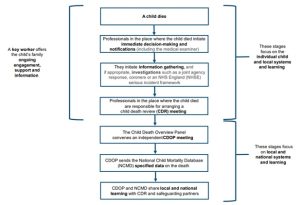
Flowchart showing the steps involved in the Child Death Review process from the point at which a child dies,

2.2 Immediate decision making and notifications

Several decisions need to be made by professionals in the hours immediately following the death of a child. These include:

  • how best to support the family
  • whether the death meets the criteria for a Joint Agency Response
  • whether a death certificate can be issued
  • whether a referral to the coroner is required
  • whether the death meets the criteria for an NHS Patient Safety Incident Reporting Framework (PSIRF) investigation

A number of notifications should also be made: to the child’s GP and other professionals; to the Child Health Information System; and the relevant Child Death Review partners (as a minimum police and social care) and the Child Death Overview Panel (CDOP).

 Investigation and information gathering

Following the notification of a child death, a number of investigations may then follow. These include:

  • Coronial investigation
  • Joint Agency Response
  • NHS Patient Safety Incident Reporting Framework (PSIRF).

Post-mortem examinations may be required in some cases. Which investigations are necessary will vary depending on the circumstances of the individual case. They may run in parallel, and timeframes will vary greatly from case to case.

Child Death Review Meeting (CDRM)

Although investigations following the death of a child will vary, every child’s death should be discussed at a Child Death Review Meeting. This is the multi-professional meeting attended by professionals directly involved in the care of that child during life and those involved in the investigation after death.

The nature of this meeting will vary according to the circumstances of the child’s death and the practitioners involved.

Review of Child Deaths at a Child Death Overview Panel (CDOP)

Child Death Overview Panels (CDOP’s) are responsible for reviewing information on all child deaths. Information from the above investigations is fed into the CDOP for final review. In Buckinghamshire there are two CDOP’s. One operates in Milton Keynes and the other one is a joint Panel between Buckinghamshire and Oxfordshire (as per requirements for the minimum numbers of cases).  The CDOP for Buckinghamshire contains representation from the Integrated Care Board (ICB), Children’s Social Care, Thames Valley Police, the Buckinghamshire Coroner’s Office, Public Health, South Central Ambulance Service, Midwifery and Education. In addition the Paediatric Liaison Nurse and Designated Doctor for Child Death Reviews in Buckinghamshire also attend.

Child death review processes have been mandatory since April 2008.

Support for the family

Supporting and engaging the family who have lost a child is of prime importance throughout the whole child death review process. Recognizing the complexity of the process, and the different emotional responses that bereavement can bring, families should be given a single, named point of contact, i.e. the “key worker”, for information on the processes following their child’s death, and who can signpost them to sources of support.

2.3 Immediate actions

Multiagency discussion and planning are required within the first few hours following notification of a child’s death. Necessary discussions may be face-to-face or by telephone and should engage the following professionals:

  • The Medical Examiner
  • Other professionals as appropriate; for example:
    • the on-call paediatrician
    • police
    • duty social worker

Information about the circumstances of the child’s death and medical and social background should be sought to aid with the following:

  1. Identifying how best to support the family
  2. Issuing a Medical Cause of Death Certificate (MCCD). If this is not possible, consider whether the death should be referred to the coroner (see, Section 2.4 Issuing a MCCD referral to the coroner)
  3. Deciding whether a Joint Agency Response is required (see Section 3.2, Joint Agency Response)
  4. Identifying issues relating to health care or service delivery
  5. Determining actions to ensure the health and safety of others (e.g. family or community members, other patients and staff)
  6. In all deaths, these discussions should be recorded on a relevant proforma (see Appendix 1).

The outcome of these discussions should also be fed back to the family.

2.4 Issuing a MCCD referral to the coroner

  •  The cause of death for most children is known, and an MCCD can be issued shortly after death. See Medical certificate of cause of death (MCCD): guidance for medical practitioners (gov.uk).
    • Two versions of the death certificate exist
      • a neonatal certificate (up to 28 days)
      • the standard certificate.
    • In deaths of children with pre-existing complex medical conditions, correct wording of the death certificate may need to be discussed with the specialist team.
    • If it is not possible to sign the MCCD then the case should be referred to the coroner.
    • The Chief coroner has issued guidance on which deaths should be reported to the coroner (see Section 3.1 Coronial investigation). If there is any uncertainty over whether a referral is necessary, the attending doctor should contact the coroner’s office to discuss.

2.5 The Post-Mortem Examination

A post-mortem examination is sometimes required as part of a coronial investigation. If a coroner requires a post-mortem examination parental consent is not required and parents cannot refuse the examination.

In cases where a death certificate can be issued a hospital post-mortem examination (PM) may still provide important information as to why a child has died. It is therefore important to explore the issue with the family at the time of death, even in cases where the coroner does not require a PM.

2.6 Informing the Child Death Overview Panel

This should be completed electronically filling out a notification form within 24 hours of the death (or next working day). This is done via the Oxfordshire Buckinghamshire eCDOP website login using the “Submit Notification form A”:

Image shows the log on page of the Oxfordshire Buckinghamshire eCDOP system

For all deaths essential information regarding demographics, circumstances of death and background medical history should be submitted to CDOP via the reporting form (previously Form B).

2.7 Other notifications

The following people should also be notified within 24 hours (or the next working day) of the child’s death:

  • General Practitioner – inform the GP of the fact and circumstances of the death, so that the GP can support the family
  • Other professionals, as appropriate – community midwives, health visitor, school nurse, hospital/community medical team.

3. Investigating and Information Gathering

The nature of the investigation(s) varies with individual circumstances. They may include:

  • A Coronial Investigation
  • A Joint Agency Response
  • A NHS Patient Safety Incident Reporting Framework (PSIRF)
  • A Local Child Safeguarding Practice Review (LCSPR)

For all deaths essential information regarding demographics, circumstances of death and background medical history should be submitted to CDOP via the Notification Reporting Form A process. Oxfordshire/Buckinghamshire eCDOP website log-in.

3.1 Coronial investigation

Informing the coroner

The coroner’s office must be informed of all ‘unexpected’ deaths via 01494 475505 (call Thames Valley Police on 101 out of hours). Once the death has been declared, the coroner assumes immediate responsibility for the body. Samples may be taken post-mortem as outlined in the BHT Policy.

Anyone can refer a death to the coroner for investigation. Reasons for referral are as follows:

  • the cause of death is unknown
  • the deceased was not seen by the certifying doctor either after death or within 14 days before death
  • the death was violent or suspicious
  • the death was unnatural
  • the death may be due to an accident (whenever it occurred)
  • the death may be due to self-neglect or neglect by others
  • the death may be due to an abortion
  • the death occurred during an operation or before recovery from the effects of an anaesthetic
  • the death may be a suicide
  • the death occurred during or shortly after detention in police or prison custody
  • the death occurred while the deceased was subject to compulsory detention under the Mental Health Act or a Deprivation of Liberty Safeguards authorisation (DoLS)
  • Deaths that may be lined to medical treatment, surgery or anaesthetic
  • for any other concerning feature.

They may order a post-mortem (PM) examination, if necessary. Following the PM, the body of the child is usually promptly released back to their family for the death to be registered and funeral arrangements to be made. Release may however be later if organs or tissues have been taken for analysis, or if a second independent post-mortem examination is required.

Not all deaths reported to the coroner proceed to inquest although most unexplained deaths of children do. The inquest aims to determine the identity of the person that died and how, when and where they came by their death. The coroner will examine the evidence and, commonly without a jury, record the answers to the questions listed on a public document called the Record of Inquest. The details of the coroner’s findings are forwarded to the local registrar.

All agencies holding pertinent information are under a duty to disclose such information.

The family should be informed early on of the coroner’s involvement, and the need for and timing of a post-mortem examination, their right to be represented at the examination should they so wish, whether an investigation or inquest has been opened so that they may attend the inquest opening and the dates of any investigation reviews, pre-inquest reviews and the inquest itself.

Once the jurisdiction of the coroner is engaged, the coroner’s officer is the main point of contact with the family for matters relating to the coronial process.

3.2 Joint Agency Response (JAR)

All deceased children that meet the criteria for a JAR should be transferred to the nearest appropriate Emergency Department (ED) to enable the JAR to be triggered.

A Joint Agency Response should be triggered if a child’s death:

  • is or could be due to external causes
  • is sudden and there is no immediately apparent cause
    • (including Sudden Unexplained Death in Infancy/Childhood);
  • occurs in custody, or where the child was detained under the Mental Health Act
  • suspicion of unnatural causes
  • in the case of a stillbirth with no healthcare professional in attendance

In any of these circumstances, the on-call paediatrician at Stoke Mandeville Hospital, (pager 593), police investigator, and duty social worker should be contacted immediately to initiate the Joint Agency Response.

A Joint Agency Response should also be triggered if such children are brought to hospital near death, are successfully resuscitated, but are expected to die in the following days. This enables an accurate history of events to be taken and, if necessary, a ‘scene of collapse’ visit to occur. Appropriate clinical investigations should also be performed in such cases.

A lead health professional should be assigned. This will usually be the on-call paediatrician. This person will ensure that all health responses are implemented and be responsible for on-going liaison with the police and other agencies.

Flowchart setting out the sequence of events that should unfold in a Joint Agency Response. A Joint Agency Response can be divided into three separate phases:
 

At each stage in the process, explicit consideration must be given as to whether child abuse / neglect may have been a contributory factor.

Immediate response (within a few hours)

    1. Caring for the Family
    2. Initial History taking
    3. Initial examination
    4. Initial laboratory investigations/samples
    5. Immediate Information sharing/planning
  1. Early Response (within a few days) NHS Patient Safety Incident Reporting Framework (PSIRF)
    1. Ongoing information gathering
    2. Home visit by police
    3. Initial Case Discussion Meeting
    4. Post-mortem examination
  2. Late Response
    1. Child Death Review Meeting (See Section 4)

Immediate response

Normally following an unexpected death, a child will be transferred by the ambulance service to Stoke Mandeville Hospital. The emergency providers attending the scene should assess the child and, unless it is clearly inappropriate, should attempt resuscitation and transfer the child and family to hospital. The child should never be taken straight to the mortuary unless directed by the police in consultation with the coroner. In such cases the police are responsible for notifying the consultant paediatrician on-call.

On arrival at hospital, a member of the nursing staff will be allocated to the family. On arrival at the A&E department the consultant paediatrician and/or senior doctor in A&E should be informed. Immediate responsibility for informing and providing appropriate care and support of the family rests with the on-call paediatric team. Resuscitation should continue as appropriate and any decision to stop will be made by an experienced medical practitioner with input from other members of the resuscitation team and in consultation with the family. As soon as practicable after arrival at a hospital, the child should be examined by the consultant paediatrician or delegated senior paediatrician on-call.

When the child is pronounced dead, the paediatric or A&E consultant or delegated senior clinician should inform the parents, having first reviewed all the available information.  S/he/they should explain future police and coronial involvement, including the coroner’s authority to order a post-mortem examination.  This may involve taking tissue blocks and slides to ascertain the cause of death.

Caring for the family

Initial bereavement support will be provided by hospital staff. This is a difficult time for everyone. The time spent with the family may be brief, but actions will greatly influence how the family deals with the bereavement for a long time afterwards. Remember that families are in the first stages of grief. They may be shocked, numb, withdrawn, angry or hysterical. Every effort should be made to conduct discussions in a private and sympathetic environment away from interruptions.

Communication should be clear, sensitive and honest. Parents should be treated with compassion, respect and dignity.

Where parents do not understand and/or speak English well, an independent interpreter should be called – one can be arranged via switchboard. The interpreter should not normally be a family member. However, urgent information about the child could be sought from a family member whilst awaiting an interpreter to arrive.

Staff caring for families after a child’s death should be offered support through a formal debrief system and counselling via the Workplace Health Department, as appropriate.

Ongoing bereavement care is available from a range of agencies. Further details can be found in Appendix 2.

For lactating mothers please consider liaising with the medical team involved for the purposes of possible prescription to supress lactation.

Initial history taking

Most of the medical and social history will be obtained during the initial discussion with the parents in the A&E Department. This is supplemented by information obtained at the home visit. All professionals should record history and background information given by parents/carers in as much detail as possible.

It is crucial that under no circumstances should professionals challenge or make comment on the history given by a parent/carer – if challenged or a comment is made parents/carers may form the impression that their account is not believed and may subsequently change their story. This could hinder any police investigation.

If there are other children, enquire about their whereabouts and who is caring for them. A surviving twin should automatically be offered admission for monitoring and investigation.

Immediate information sharing / planning

A Joint Agency Response meeting for children who normally reside within Bucks and who die in Bucks will be coordinated by the on-call paediatric team at Stoke Mandeville Hospital. These deaths should be notified to the on-call paediatrician by telephone. The consultant paediatrician on-call is responsible for instigating the Joint Agency Response and must ensure that police, social care and other appropriate agencies have been notified.

For children who reside in Buckinghamshire who have died at the John Radcliffe hospital in Oxford the paediatric team at Stoke Mandeville Hospital will coordinate the Joint Agency Response. These deaths should be notified in the first instance to the on-call paediatrician at Stoke Mandeville Hospital, who will then liaise with the Designated Doctor for Child Death Reviews (or in their absence the Named Doctor for Safeguarding).

For children who reside in Buckinghamshire who have died at a tertiary centre other than Oxford (e.g. GOSH, Birmingham etc), the initial response should be dealt with by the team within that centre. The paediatricians at Stoke Mandeville do not coordinate the investigation but may be called upon to attend meetings (e.g. case discussion/case review meetings) at the tertiary centre. They may also be called upon to submit a “Reporting form B” about the child to the Bucks CDOP.

For children dying within Buckinghamshire who normally reside elsewhere, the paediatric team will coordinate a Joint Agency Response as for a Buckinghamshire child, submitting information to the child’s local CDOP as appropriate. The exception to this would be a child from Oxfordshire. These cases should be notified to the SUDIC Paediatrician at the John Radcliffe or to the CDOP administrator for Oxfordshire (both available via the John Radcliffe Switchboard).

If there is any uncertainty about whether a Joint Agency Response is required, or who should convene one, it is imperative that it be discussed with the SUDIC paediatrician as a matter of urgency. If the SUDIC paediatrician is on leave then this should be discussed with the Named Doctor for Child Protection.

Early contact and discussion between key agencies is essential. Discussion should focus on whether the death may have been caused by abuse or neglect. In such cases the safety of siblings must be considered. Consideration should be given to securing the scene where the child died. Discussion about the need for a home/scene visit should take place early on between the police officer and the on-call paediatrician, enabling the prompt recovery of evidence that otherwise could be lost. A home visit will almost always be required in deaths under the age of 2 years. Paediatricians do not currently participate in home visits. The photographs from home visits can be shared and discussed by the team during the Joint Agency Response meeting.

Contact with police and social work should be clearly documented in the notes. No professional should assume they have been contacted. Repeated calls are better than none at all. If the death is suspicious or significant concerns are raised at any stage about the possibility of abuse or neglect, a decision will be taken for the police to become the lead agency and take primacy in the investigation.

On receiving notification of an unexpected child death, a senior police officer will be designated as the Senior Investigating Officer (SIO). It is important to stress to the family that the involvement of the police is routine and does not assume suspicion. However, staff need to be aware that on occasions, in suspicious circumstances, the early arrest of the parents/carers may be essential to secure and preserve evidence as part of an investigation.

Early response (within a few days)

The home or scene visit

For all children less than 2 years of age who have died suddenly and unexpectedly, a home visit should be undertaken within 24 hours (usually the same day). For older children the need for a home visit should be discussed between the police and the paediatric team. The home visit is usually conducted by the police. The home visit provides an opportunity to take a more careful history, to inspect the death scene and to try and alleviate some of the family’s concerns.

The purposes of the home or scene visit are to:

  1. Review the history taken in ED
  2. Evaluate the environment where the child died
  3. Support the family
  4. Update the family on the investigation. The discussion with parents about the details of the post-mortem examination should be done in conjunction with coroner’s officers.

Where the location of the death is different to the home address of the child, an additional visit to the home address may be arranged if deemed necessary. Consideration should be given as to which professionals should attend the visit. Normally this will be the senior investigating officer. Where possible a member of the primary care team, or some other professional known to the family may also attend. There may be situations where, for pragmatic reasons, or because of the nature of the death a joint visit is not possible or appropriate, or where the police need to visit the scene of death early to gather forensic evidence.

Ongoing Information Sharing

Further information will need to be gathered to support the investigation into the cause and circumstances of death. All practitioners play a role in this and must be prepared to share information with other members of the multi-agency team.

The senior investigating officer (SIO) and on-call paediatrician should agree who will take the lead for collating information and sharing this with the coroner. Information will be gathered through a process of history taking, which may require more than one interview with the parents.

As far as possible, repeated questioning by different professionals should be avoided and parents interviewed jointly by police and health staff where appropriate. Information should be gathered from the primary care team and all other professionals who may know the child or family, including The Midwife, Health Visitor, School Nurse, social care and education where appropriate. All relevant records should be retrieved and reviewed by a lead professional in each agency.

The Post-Mortem Examination

Generally, most post-mortem examinations will be performed at the John Radcliffe Hospital in Oxford. If any concerns have been raised about the possibility of neglect or abuse having contributed to the child’s death, or the pathologist becomes concerned about such a possibility during the post-mortem examination, the paediatric pathologist should be accompanied by a forensic pathologist and a joint post-mortem examination protocol should be followed with the attendance of a senior investigating police officer.

Prior to commencing the post-mortem examination, the pathologist should be given a full written briefing on the history and the physical findings at presentation, and the findings of the death scene investigation. The senior investigating officer will ensure child’s ‘red book’ is secured and shared with the pathologist.

Any photographs or video recordings of the child or the scene should be made available to the pathologist. The pathologist should also be provided with a report and/or images from the radiographer for any radiological investigations. If required, skeletal surveys are performed at the time of the post-mortem examination.

The coroner should be provided with a copy of the history proforma. Where possible there should be an information sharing discussion between the consultant paediatrician and the pathologist before the post-mortem examination to identify outstanding issues and to ensure accurate understanding of information.

If the paediatrician has arranged any laboratory investigations before death, the pathologist and the coroner should be informed prior to the post-mortem examination, and the results made available as soon as possible.

Following the post-mortem examination, there should be a further discussion between the paediatrician, the pathologist, the senior investigating officer (SIO), a lead representative from children’s social care and the coroner’s officer to review any preliminary findings and decide on any further investigations required. If initial post-mortem examination findings are shared with the family, this MUST be done with the coroner’s consent.

The final report of the post-mortem examination should be sent to the coroner immediately once the final result is known. With the prior consent of the coroner, a copy of the post-mortem examination report will also be sent simultaneously to the responsible paediatrician.  The post-mortem report will also be shared with Buckinghamshire CDOP (WTSC 23 p.149).

The Joint Agency Response (JAR) Meeting

The on-call Paediatrician or a deputy will convene a Joint Agency Response Meeting. This meeting will take place within 2 working days of an unexpected death. It must be convened prior to a post-mortem taking place so that information gathered at this meeting can be shared with the coroner to aid his investigation.

In cases where the process is interrupted by a weekend it may be necessary to hold this meeting early in the following week. This is in order that agencies which may hold information about the child (e.g. GP, Health Visitor, community midwife, ambulance crew, etc) will be able to attend. In these instances, it is critical that police, social work and the on-call paediatrician share information over the weekend period so that any information which comes to light over the weekend can be acted upon promptly. In other words, the JAR Meeting should not be viewed as the first opportunity to share information and if an agency becomes concerned it should share those concerns immediately.

The Joint Agency Response Meeting may include representation from:

  • Health
    • The on-call Paediatrician/SUDC Paediatrician
    • Senior members of the children’s nursing team
    • Ambulance service/A&E staff/Intensive care/Anaesthetists
    • The named health visitor, children’s community nurse or school nurse
    • The community midwife
    • The general practitioner
    • Children’s/Adult (for parents) Mental Health teams
  • Social Work – The children’s social care team manager or appropriate deputy
  • Police – The Senior Investigating Officer or an appropriate deputy
  • Other contributors
    • coroner’s officer
    • Education (where the child was attending school or nursery)
    • The named professionals for Child Protection
    • Mental health professionals (CPN or consultant psychiatrist)
    • Any other agency known to the child/family e.g. drug/alcohol services.

The meeting should be minuted by one of the paediatric secretaries. A draft agenda for the meeting including specific areas to be covered in the discussion can be found as per the relevant health provider documentation ordinarily used.

The purposes of this meeting are:

  • Information Sharing and Analysis
    • Each agency will share information regarding circumstances of the child’s death and any background information they hold
    • Consider any evidence of child abuse, neglect or poor parental care/supervision.
    • To collate all relevant information to share with the pathologist.
    • To identify factors which may have contributed to the child’s death
  • Investigation Planning
    • To determine which professional/agency will lead the multi-agency investigation.
    • To plan and determine the process of the investigation. Each of the following questions must be asked and their answers recorded.
      • Is the death suspicious, requiring a police investigation?
      • Does the death constitute a serious untoward incident?
      • Is consideration of a Local Child Safeguarding Practice Review required?
    • Management Planning
      • To ensure a coordinated bereavement care plan for the family. This should include nominating a professional to share the results of the post- mortem examination.
      • To enable consideration of any child safeguarding risks to siblings/any other children living in the household and to consider the potential need for child protection procedures.
      • To discuss any need for action in respect of other children in the wider household or family (e.g. health overview).

If child protection concerns are identified when the information is shared, a Strategy Meeting will be convened by Children’s Social Care as per child protection procedures, and the Director of Children’s Social Care or equivalent will be notified.

Approved minutes will be shared with each of the attendees, the coroner’s office, the SUDC paediatrician and the Child Death Overview Panel as per Social Care CDOP Reporting Form B returns. They should be distributed within 1 week of the meeting for comments/amendment. The minutes should then be saved as part of the child’s medical record.

Parental consent is not required for this information to be passed to the designated paediatrician and CDOP. However it should only be shared with those who need to know governed by the Caldicott Principles, the Data Protection Act and Working Together.

Agency Report Form (Previously Form B)

Following the JAR meeting it is the responsibility of the on-call paediatrician to ensure that an Agency Report Form is submitted to Buckinghamshire CDOP and that any professionals who have not contributed to the JAR Meeting are identified. They should be invited to complete an independent agency report form on CDOP. This can be coordinated through the Buckinghamshire CDOP admin team. The Buckinghamshire CDOP admin team will send an invitation to fill out the reporting form via email. The reporting form should be completed online within 28 days of the child’s death.

DATIX and Serious Incidents

All unexpected deaths should be reported via internal agency reporting systems for managerial consideration.  The lead handler for these incidents in BHT is the SUDC paediatrician. It is the responsibility of the consultant paediatrician to ensure that this happens.

The Healthcare Safety Investigations Branch

Healthcare Safety Investigations Branch (HSIB) carries out independent investigations into safety concerns within NHS funded care in England. It aims to be thorough, independent and impartial in its approach without apportioning blame or liability.

Separately, HSIB investigate NHS Serious Incident Investigation cases of

  • intrapartum stillbirth
  • early neonatal deaths
  • severe brain injuries from 37 weeks gestation

These investigations will continue to be characterized by a focus on learning and not attributing blame, and the involvement of the family is a key priority.

Co-ordination across investigations

It is easy for families to become lost in the parallel investigations following their child’s death. Effective co-ordination and good communication are vital to avoid additional distress to bereaved parents.

A “key worker” should be assigned to every bereaved family, to act as a single point of contact in relation to the child death review process.

In deaths where there is more than one investigation, NHS trusts should appoint a “case manager” to have oversight of procedures: ensuring that those involved are objective e.g. through engaging the Patient Advice and Liaison Service (PALS), have an understanding of statutory requirements, follow appropriate timescales, ensure parents have an opportunity to input into the process and establish how they would like to receive feedback. This is distinct from the key worker, who acts as an ongoing single point of contact for families.

4. The Child Death Review Meeting

4.1 Introduction

The CDRM is a multi-professional meeting where all matters relating to an individual child’s death are discussed by the professionals directly involved in the care of that child during life and their investigation after death. It was previously known as a final case discussion meeting

The nature of this meeting will vary according to the circumstances of the child’s death and the practitioners involved.

Circumstances of death CDRM format
Sudden unexpected death Final case discussion involving health, police and social care
Expected death in PICU Morbidity and mortality meeting in PICU with input from local team if appropriate
Expected death in Neonatal Unit Perinatal mortality (PMRT) review meeting
Expected death for child with life limiting illness Morbidity and mortality meeting

The CDRM should be:

  • flexible and proportionate
  • focused on local learning
  • undertaken for all Deaths (expected and unexpected)

It may be appropriate for the review to be quite brief or for the meeting to discuss one child or several children. In every case, the CDR Analysis Form C is drafted after all Form B’s are received and consolidated. Learning identified and actions points are confirmed by the Designated Dr for child death and discussed at the CDOP meeting.

4.2 Aims

In all cases, the aims of the CDRM are to:

  • review the background history, treatment, and outcomes of investigations, to determine, as far as is possible, the likely cause of death
  • ascertain contributory and modifiable factors in the following areas
    • service delivery
    • child
    • social and physical environment
  • describe learning arising from the death and associated actions
  • review the support provided to the family
  • ensure that the family are provided with
    • the outcomes of any investigation into their child’s death
    • an explanation of why their child died along with any learning from the review meeting. If the family’s first language is not English this may require a face-to- face meeting with a translator.
  • ensure that CDOP and, where appropriate, the coroner is informed of the outcomes of any investigation into the child’s death
  • review the support provided to staff involved in the care of the child.

4.3 Attendees and chair

It is the responsibility of the organisation responsible for the declaration of death to arrange the CDRM. The exception to this is when a Joint Agency Response has occurred, in which case responsibility defaults to the lead health professional.

Each child’s death requires unique consideration and where possible, should engage professionals across the pathway of care. The following professionals may be invited, depending on their ability to contribute meaningfully to a discussion on the circumstances of the child’s death:

  • hospital or community healthcare staff involved with the child at the end of his/her life, and those known to the family prior to this event
  • pathologist, if a post-mortem examination has taken place
  • other professional peers from relevant hospital departments and community services
  • patient safety team if a serious incident investigation has taken place
  • coroner’s officer, if the case has been referred to the coroner
  • senior investigating police officer, if there is a Joint Agency Response; or
  • other practitioners for example social work, ambulance and fire services, primary care clinicians, school nurse, head teacher, representatives from voluntary organisations.

NHS Trusts should note that, where practically possible, children’s deaths should be discussed at an individualized meeting, and that matters of morbidity should be considered separately. It is only through such a comprehensive approach that the contributory factors to death can be understood. (See case examples at Appendix 1 for further illustration).  If certain professionals are unable to attend, they might be invited to submit a report to the meeting.

The CDRM should be chaired by the designated doctor for child death reviews, unless he/she/they was/were directly involved in the case. At the beginning of each meeting the Chair should inquire as to conflicts of interest among the attendees. In rare cases, it may be necessary to seek a chair external to the organisation; for example, when trust has broken down between the family and health care team in the organisation where death was declared. The designated doctor for child deaths might advise in such circumstances.

4.4 Location and timing

In general, children who die in hospital should be discussed within the department where the child died and considered an integral part of wider clinical governance processes.

Children who die in the community might be discussed at the local GP surgery, and children who die in a hospice discussed in that centre. However, the location of the meeting might also be informed by practical considerations relating to where most of the child’s treatment took place.

CDRMs require planning and co-ordination. Organisations should ensure that those responsible for reviewing child deaths have the proper resources to ensure that meetings are held in a timely and coordinated fashion.

The meeting should take place once investigations have concluded, and reports from agencies and professionals unable to attend the meeting have been received.

The meeting should take place as soon as is practicable, ideally within three months, although serious incident investigations and the length of time it takes to receive the final post-mortem report will often cause delay.

In order to best capture the views of those directly involved, it may be beneficial to start the process as soon as possible, prior to the formal CDRM.

The CDRM should occur before any coroner’s inquest, and before the CDOP meets.

The CDRM may proceed in the context of a criminal investigation, or prosecution, in consultation with the senior investigating police officer. The meeting cannot take place if the criminal investigation is directed at professionals involved in the care of the child, when prior group discussion might prejudice testimony in court.

4.5 Family engagement

The CDRM is a meeting for professionals. This allows full candour among those attending, and any difficult issues relating to the care of the child can be discussed without fear of misunderstanding. Parents should not attend this meeting. However, parents should be informed of the meeting by their key worker and have an opportunity to contribute information and questions through their key worker or another professional.

At the meeting’s conclusion, there should be a clear description of what follow-up meetings have already occurred with the parents, and who is responsible for reporting the meeting’s conclusions to the family. This would generally be the child’s paediatrician, or in the case of a neonatal death, obstetrician/neonatologist. In a coroner’s investigation, such liaison should take place in conjunction with the coroner’s officers.

5. Child Death Overview Panel

5.1 Introduction

Buckinghamshire CDOP review the deaths of all children normally resident within the relevant local authority area. The Panel ordinarily meets five times a year and has representation from health (primary and secondary care), the Integrated Care Board, police, education, social care, the local safeguarding partnership and public health.

CDOP’s should conduct an anonymised secondary review of each death where the identifying details of the child and treating professionals are redacted. This review should be informed by a standardised output, the draft Panel Analysis Form C, from the CDRM.

5.2 Panel responsibilities

The functions of CDOP include:

  • collation of information about each child death
  • analysis of this information to
    • confirm or clarify the cause of death
    • determine any contributory factors
    • identify learning arising that may prevent future child deaths
  • to make recommendations to all relevant organisations which may prevent future child deaths
  • to notify the local Safeguarding Partners in cases involving abuse or neglect
  • to provide data to the National Child Mortality Database
  • to produce an annual report for CDR partners outlining
    • patterns and trends in child deaths
    • lessons learnt and actions taken
    • effectiveness of the wider child death review process; and
  • to contribute to local, regional and national initiatives to improve child death reviews.

6. Family Engagement and Bereavement Support

Families have the right to have their child’s death reviewed to

  • identify the cause of death
  • learn lessons to prevent further children’s deaths

Parents and carers should be informed about and involved in the review process

Appendix 2 includes contact details for national organisations offering bereavement support.

Professionals in all agencies have a duty to support bereaved parents. When there are issues with the quality of care healthcare organisations have a “duty of candour” to explain what has happened, to apologise as appropriate, and to identify lessons to reduce the likelihood of a repeat incident.

Whether the child’s death is sudden or follows a long illness, the requirement for the following roles is universal:

  • A key worker
  • A medical lead

6.1 The team around the family

The ‘key worker’

All bereaved families should be given a single, named point of contact to whom they can turn for information on the child death review process, and who can signpost them to sources of support.

It is the responsibility of the organisation where the child was certified dead to identify a key worker for the family.

The role could be taken by a range of practitioners. For example:

Circumstances of child death Possible key worker
Sudden unexpected death Paediatric matron or member of bereavement support team
Expected death in child with life limiting illness Team leader of children’s community nursing team or hospice team
Child with long term condition e.g. oncology patient Clinical nurse specialist
Death of baby in Neonatal Unit Matron for NNU / bereavement lead for NNU
Child who dies in community, not known to hospital team e.g. a suicide Coroner’s office, family liaison officer (police)

Regardless of professional background this person should:

  • be readily accessible point of contact for the family after the death
  • help co-ordinate meetings between the family and professionals as required
  • be able to provide information on the child death review process and the course of any investigations pertaining to the child
  • liaise as required with the coroner’s officer and police family liaison officer
  • represent the ‘voice’ of the parents at professional meetings, ensure that their questions are effectively addressed, and to provide feedback to the family afterwards; and
  • signpost to expert bereavement support if required.

An appropriate consultant neonatologist or paediatrician should also be identified after every child’s death to support the family.

This is distinct from the key worker, and might either be the doctor that the family had most involvement with while the child was alive or the designated professional on-duty at the time of death. This individual should liaise closely with the family’s key worker and arrange:

  • follow-up meetings at locations and times convenient to the family; and
  • clinical expertise (via other professionals if necessary) to be able to:
  1. answer questions relating to the medical, nursing or midwifery care of the child
  2. explain the findings, where relevant, of the post-mortem examination and/or other investigations and
  • report back the outcome from the CDRM.

Other professionals

At the time of a child’s death, other professionals may also provide vital support to the family; these include (but are not limited to) the GP, clinical psychologist, social worker, school, family support worker, midwife, health visitor or school nurse, palliative care team, chaplaincy and pastoral support team.

In all cases, it is the duty of the key worker to ensure that there is clarity regarding each professional’s role; that the family does not receive mixed messages; and that communication is clear.

6.2 What can bereaved families expect when their child dies?

It should be remembered that bereaved parents may be in state of extreme shock when their child has died. They may not be able to process or retain information and it is common that information needs to be repeated over time. Information pertaining to the statutory process to be followed should be available in an accessible format to all bereaved families or carers (When a Child Dies – A Guide for Parents and Carers.)

Providers should be familiar with its contents in order to ensure that bereaved families and carers receive the best support possible. Staff involved with the care of a child should also be offered appropriate support.

When their child dies, bereaved parents or carers should:

  • have the opportunity to spend time with the child’s body in a quiet and private environment
  • have the opportunity to make memories including taking photographs, hand and footprints and a lock of hair
  • expect a member of staff to remain with them, to provide comfort, and to ensure their basic needs are met. In cases where there are suspicious circumstances it will be necessary to have a staff member with the body of the child when the parents are present.
  • be given the contact details of their key worker and the identity of their medical lead, be informed who will be contacting them and when they will be contacted after they leave the hospital or hospice (and what to do should they have any questions in the meantime)
  • know how to make arrangements to view their child’s body
  • be given information on death registration and the coronial process (if applicable)
  • understand why a post-mortem examination may be indicated and, if so, where it is taking place, and when the results might be expected. In the event of a coroner’s case this responsibility falls to the coroner’s officer
  • be supported to understand the child death review process and how they are able to contribute to it
  • be given practical advice in respect to organising the child’s funeral
  • have the key worker accompany them to meetings to provide practical and emotional support
  • be able to access expert bereavement support if required (see Appendix 2).

6.3 Planning prior to death for life-limiting conditions

Children with life-limiting conditions sometimes die following prolonged illnesses. In these situations, “parallel planning” means planning for the end-of-life care, even while active treatment is still being pursued. It often involves a palliative care team. It may involve:

  • identifying a ‘team around the family’
  • writing an advance care plan
  • giving thought to cultural and religious requirements

For detailed guidance relating to the planning and management of end-of-life care in children with life-limiting conditions see:

6.4 When a child dies in the emergency department (ED)

  • When children die or are certified dead in the emergency department (ED) there will usually be a Joint Agency Response (see Section 3.2, Joint Agency Response). In such circumstances, the same expectations apply relating to identifying a ‘team around the family’.
  • Responsibility for ensuring that appropriate care is provided to the family falls to the organisation in which the child is certified dead. Detailed guidance relating to support for the family in such situations is provided in the SUDI/C Guidelines.

6.5 When a child dies and a Patient Safety Incident Response Framework (PSIRF) is instigated

  • Where concerns about service delivery have been raised a PSIRF investigation may be required. Parents can provide vital insight into the circumstances of the death and quality of care received.
  • In such cases, a “case manager” will support the key worker in having oversight of the various processes, tracking timelines, and ensuring commitments to the family are met.

6.6 Support for parents, families and carers

Appendix 2 includes contact details for national charities who offer bereavement support for families. Local NHS services and CDOP’s may also offer specific bereavement services. The key worker should be able direct families to the most appropriate support service.

Appendices

Appendix 1 – Immediate decision making proforma (opens in Word)

Appendix 2 – Sources of family support (opens as a PDF)

Appendix 3 – Joint Agency Response Agenda (opens as a PDF)


Was this helpful?
Yes
No
Thanks for your feedback!