
RELATED CHAPTERS
Provision of Support and Services for Children in Need
RELATED GUIDANCE
Working Together to Safeguard Children (Department for Education)
May 2026: This procedure has been updated throughout to reflect the revised Working Together to Safeguard Children and Families First Programme Guide. Updates include clarifying that assessments will be carried out by a lead practitioner, which can be held by a range of people, including social workers. Additional detail has been added into Section 9, The Contribution of the Child and Family. Section 21, Family Group Decision Making is new.
CONTENTS
1. Introduction
Each child who has been referred to Children’s Social Care, where the threshold is met for statutory intervention, will have an individual assessment to identify the support needs required. If the referral meets threshold for Family Help (under targeted Early Help services) intervention, a family assessment will be completed.
All agencies and professionals involved with the child, and the family, have a responsibility to contribute to the assessment process. This might take the form of providing information in a timely manner and/or direct or joint work.
The assessment will involve drawing together and analysing available information from a range of sources, including any previous history with services, existing records, obtaining information from professionals in relevant agencies and others in contact with the child and family. Where an Early Help Assessment has already been completed this information should be used to inform the assessment. The child and family’s lived experience, and history should be understood to inform support offered.
Where a child is involved in other assessment processes, it is important that these are coordinated so that the child does not become lost between the different agencies involved and the different procedures. Where there are multiple plans, these should be joined up and developed together so that the child and family experience a single assessment and planning process, which shares a focus on the outcomes for the child.
2. Assessments under the Children Act 1989
Under the Children Act 1989, local authorities have a duty to undertake assessments of the needs of individual children to determine what services to provide and action to take. Section 22(3) of the Children Act 1989 sets out the general duty of the local authority looking after a child to safeguard and promote the welfare of the child. This duty underpins all activity by the local authority in relation to looked after children.
2.1 Section 17
A Child in Need is defined under the Children Act 1989 as:
a child who is unlikely to achieve or maintain a satisfactory level of health or development, or their health and development will be significantly impaired, without the provision of services; or a child who is disabled.
In these cases, assessments are carried out under Section 17 of the Children Act 1989. Children in Need may be assessed under Section 17 of the Children Act 1989, in relation to their Special Educational Needs, disabilities, or as a carer, or because they have committed a crime. The process for assessment should also be used for children whose parents are in prison and for asylum seeking children.
When assessing Children in Need and providing services, specialist assessments may be required. Where possible, this should be coordinated so that the child and family experience a coherent process and a single plan of action.
2.2 Section 47
Concerns about maltreatment may be the reason for a referral to local authority children’s social care or concerns may arise during the course of providing services to the child and family. In these circumstances, local authority Children’s Social Care must initiate enquiries to find out what is happening to the child and whether protective action is required.
Local authorities, with the help of other organisations as appropriate, also have a duty to make enquiries under Section 47 of the Children Act 1989 if they have reasonable cause to suspect that a child is suffering, or is likely to suffer, significant harm to enable them to decide whether they should take any action to safeguard and promote the child’s welfare. There may be a need for immediate protection whilst the assessment is carried out.
2.2 Section 20
Some Children in Need may require accommodation because there is no one who has Parental Responsibility for them, or because they are alone or abandoned. Under Section 20 of the Children Act 1989, the local authority has a duty to accommodate such Children in Need in their area. Following an application under Section 31A, where a child is the subject of a Care Order, the Local authority, as a Corporate Parent, must assess the child’s needs and draw up a Care Plan which sets out the services which will be provided to meet the child’s identified needs.
3. Purpose of Assessment
Whatever legislation the child is assessed under, the purpose of the assessment is always:
- To gather important information about a child and family;
- To analyse their needs and/or the nature and level of any risk and harm being suffered by the child including any factors that may indicate that the child is or has been trafficked or a victim of compulsory labour, servitude and slavery;
- To decide whether the child is a Child in Need (Section 17) and/or is suffering or likely to suffer Significant Harm (Section 47);
- To provide support to address those needs to improve the child’s outcomes to make them safe;
- Identify support from within the family network.
4. Process of Assessment
The assessment process will be led by the lead practitioner. The lead practitioner role can be held by a range of people, including social workers. When allocating the lead practitioner, local authorities and their partners should consider the needs of the child and their family to ensure the lead practitioner has the time required to undertake the role. The lead practitioner should have the skills, knowledge, competence, and experience to work effectively with the child and their family.
Where there are child protection enquiries and the lead practitioner is not a social worker, a social work qualified practice supervisor or team manager should lead the section 47 investigation. Where the decision is taken that the child will become the subject of a child protection plan, the lead practitioner should always be a social worker.
The date of the commencement of the assessment will be recorded in the electronic database; Liquidlogic Children’s System (LCS).
The lead practitioner should carefully plan that the following are carried out:
- See/interview the child;
- Interview the parents and any other relevant family members;
- Consider whether to see the child with the parents;
- The child should be seen by the lead practitioner without their caregivers when appropriate and this should be recorded in the assessment record;
- Determine what the parents should be told of any concerns;
- Consult with and consider contributions from all relevant agencies, including agencies covering previous addresses in the UK and abroad.
If it is determined that a child should not be seen as part of the assessment, this should be recorded by the manager with the reasons.
Parents or carers should usually be informed before discussing a referral about them with other agencies, unless this may place the child at risk of significant harm, in which case the manager should authorise the discussion of the referral with other agencies without parental knowledge or consent. The authorisation should be recorded with reasons.
If during the course of the assessment, it is discovered that a school age child is not attending an educational establishment, the lead practitioner should contact the Local Education service to establish a reason for this.
If there is suspicion that a crime may have been committed including sexual or physical assault or neglect of the child, the Police must be notified immediately.
5. Communication
In planning the assessment and in providing the parent and child with feedback, the lead practitioner will need to consider and address any communication needs, including whether interpreters or BSL signers are required for example.
Where a child or parent speaks a language other than that spoken by the lead practitioner, an interpreter should be provided. Any decision not to use an interpreter in such circumstances must be approved by the Team Manager and recorded.
Where a child or parent with disabilities has communication difficulties it may be necessary to use alternatives to speech. In communicating with a child with such an impairment, it may be particularly useful to involve a person who knows the child well and is familiar with the child’s communication methods. However, caution should be given in using family members to facilitate communication. Where the child has had a communication assessment, its conclusions and recommendations should be observed.
6. Focus on the Child
Children should be seen and listened to and included throughout the assessment process. Their ways of communicating should be understood in the context of their lived experiences within their family, community as well as their behaviour and developmental stage.
All professionals should be aware that children may not feel ready or know how to tell someone that they are being abused, exploited, or neglected, and/or they may not recognise their experiences as harmful. For example, children may feel embarrassed, humiliated, or being threatened.
Assessments, service provision and decision making should regularly review the impact of the assessment process and the services provided on the child so that the best outcomes for the child can be achieved. Any services provided should be based on a clear analysis of the child’s needs, and the changes that are required to improve the outcomes for the child.
Children should be actively involved in all parts of the process based upon their age, developmental stage and identity. Direct work with the child and family should include observations of the interactions between the child and the parents/care givers.
All agencies involved with the child, the parents and the wider family have a duty to collaborate and share information to safeguard and promote the welfare of the child.
7. Planning
All assessments should be planned and coordinated by the lead practitioner and the purpose of the assessment should be transparent, understood and agreed by all participants. There should be an agreed statement setting out the aims of the assessment process.
Planning should identify the different elements of the assessment including who should be involved. It is good practice to hold a planning meeting to clarify roles and timescales as well as services to be provided during the assessment where there are a number of family members and agencies likely to play a part in the process.
Questions to be considered in planning assessments include:
- Who will undertake the assessment and what resources will be needed?
- Who in the family will be included and how will they be involved (including absent or wider family and others significant to the child)?
- In what grouping will the child and family members be seen and in what order and where?
- What services are to be provided during the assessment?
- Are there communication needs? If so, what are the specific needs and how they will be met?
- How will the assessment take into account the particular issues faced by black and minority ethnic children and their families, and disabled children and their families?
- What method of collecting information will be used? Are there any tools / questionnaires available?
- What information is already available?
- What other sources of knowledge about the child and family are available and how will other agencies and professionals who know the family be informed and involved?
- How will the consent of family members be obtained?
- What will be the timescales?
- How will the information be recorded?
- How will it be analysed and who will be involved?
- When will the outcomes be discussed and service planning take place.
The assessment process can be summarised as follows:
- Gathering relevant information;
- Analysing the information and reaching professional conclusions;
- Making decisions and planning interventions;
- Intervening, service delivery and/or further assessment;
- Evaluating and reviewing progress.
Assessment should be a dynamic process, which analyses and responds to the changing nature and level of need and/or risk faced by the child. A good assessment will monitor and record the impact of any services delivered to the child and family and review the help being delivered. Whilst services may be delivered to a parent or carer, the assessment should be focused on the needs of the child and on the impact any services are having on the child.
8. Developing a Clear Analysis
Research has demonstrated that taking a systematic approach to assessments using a conceptual model is the best way to deliver a comprehensive assessment for all children, including unborn children where there are concerns. A good assessment is one which investigates the following three domains as set out in the assessment Framework Triangle:
- the child’s developmental needs;
- the capacity of parents or carers (resident and non-resident) and any other adults living in the household to respond to those needs;
- the impact and influence of the family network and any other adults and children living in the household as well as community and environmental circumstances
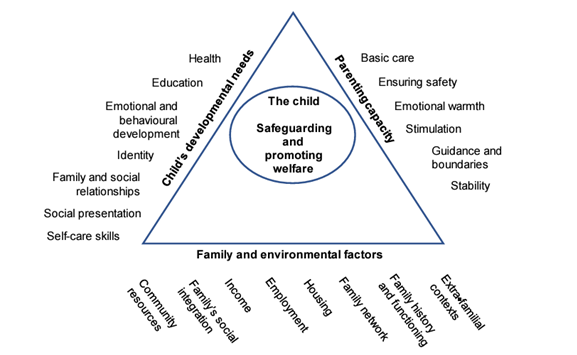
The interaction of these domains requires careful investigation during the assessment. The aim is to reach an informed decision about the nature and level of needs and/or risks that the child may be facing within their family.
An assessment should establish:
- The nature of the concern and the impact this has had on the child
- An analysis of their needs and/or the nature and level of any risk and harm being suffered by the child
- How and why the concerns have arisen
- What the child’s and the family’s needs appear to be and whether the child is a Child in Need
- Whether the concern involves abuse or neglect
- Whether there is any need for any urgent action to protect the child, or any other children in the household or community.
Where a child is involved in other assessment processes, it is important that these are coordinated so that the child does not become lost between the different agencies involved and their different procedures. All plans for the child developed by the various agencies and individual professionals should be joined up so that the child and family experience a single assessment and planning process, which shares a focus on the outcomes for the child.
The lead practitioner should analyse all the information gathered from the enquiry stage of the assessment to decide the nature and level of the child’s needs and the level of risk, if any, they may be facing. A manager should provide regular supervision, space for reflection and challenge any assumptions with the lead practitioner as part of this process. An informed decision should be taken on the nature of any action required and which services should be provided. Lead practitioners, their managers and other professionals should be mindful of the requirement to understand the level of need and risk in a family from the child’s perspective and ensure action or commission services which will have maximum positive impact on the child’s life.
When new information comes to light or circumstances change the child’s needs, any previous conclusions should be updated and critically reviewed to ensure that the child is not overlooked as noted in many lessons from Child Safeguarding Practice Reviews.
9. Contribution of the Child and Family
9.1 The child
The pace of the assessment needs to acknowledge the pace at which the child can contribute. However, this should not be a reason for delay in taking protective action. It is important to understand the resilience of the individual child in their family and community context when planning appropriate services.
Every assessment should be child centred. Where there is a conflict between the needs of the child and their parents/carers, decisions should always be made in the child’s best interests. The parents should be involved at the earliest opportunity unless to do so would prejudice the safety of the child.
9.2 The parents
The parents’ involvement in the assessment will be central to its success. At the outset they need to understand how they can contribute to the process and what change is expected of them in order to improve the outcomes for the child. The assessment process must be open and transparent with the parents. However, the process should also challenge parents’ statements and behaviour where it is evidenced that there are inconsistencies, questions or obstacles to progress. All parents or care givers should be involved equally in the assessment and should be supported to participate whilst the welfare of the child must not be overshadowed by parental needs. There may be exceptions to the involvement in cases of sexual abuse or domestic abuse for example, where the plan for the assessment must consider the safety of an adult as well as that of the child.
Assessments should be child-centred and responsive to the voice of the child. This means decisions should be made in the child’s best interests, rooted in child development, age-appropriate, sensitive to the impact of adversity and trauma and informed by evidence. Observation can be an important way to get the perspective of babies, infants, and non-verbal children. In the case of disabled children, practitioners should consider whether any specialist communication support is required and consider how advocacy services can support the child to communicate their views.
In addition, assessments should:
- be focused on action and outcomes for children;
- be multi-agency and multi-disciplinary, based on information gathered from relevant practitioners and agencies, and drawing in the relevant expertise;
- be discussed with the child and their parents or carers, as appropriate;
- build a full picture of all aspects of a child’s and their family’s life, including their strengths and interests as well as any previous referrals and interventions;
- be holistic in approach and address presenting and underlying issues and each of the child’s needs, giving sufficient recognition and priority to the specific needs of disabled children and young carers and to any risks the child faces within or outside the home;
- explore the needs of all members of the family as individuals and consider how their needs impact on one another as well as how the family network could support and help de-escalate issues;
- be a dynamic process, not an event, analysing and responding to the changing nature and level of need and/or risk faced by the child from within and outside their family;
- recognise and respect the individual and protected characteristics of families, including the ways in which these can overlap and intersect, ensuring support reflects their diversity of needs and experiences;
- lead to action, including the provision of services, the impact of which is reviewed on an ongoing basis;
- recognise a child’s entitlement to a full-time education and the positive impact attendance at school has on personal development and attainment.
Where there are concerns that a child may be at risk of, or experiencing harm outside the home, assessments should include work with the child, parents, carers, family networks and partners to determine:
- the nature and duration of the harm;
- where risk is located and understand the context in which harm is or may be happening, including online;
- the level of risk associated with each concern and context identified;
- whether further referrals to other statutory or non-statutory services are required, including for children who are potential victims of criminal or sexual exploitation, modern slavery or human trafficking.
For suspected child sexual abuse, assessment should include a health representative with experience of working with children who have been sexually abused. It will be important that, where possible, a practitioner who knows the child well and can communicate with them effectively undertakes the assessment, taking into account any needs relating to disability, ethnicity, language and culture. Practitioners should communicate clearly with children and protective parents when someone in the family is known or suspected to have sexually abused a child. Practitioners should feel confident and supported to talk to children and parents about concerns about child sexual abuse.
For babies, assessments should reflect their unique vulnerability and dependence on their parent or carer, including how harm experienced outside the home by parents or carers may affect a baby’s safety and the care they receive.
Assessments should consider how a child’s experience within their family and networks, including their friends and peer groups, and extra-familial contexts, such as the places and spaces where they spend their time, interplay with the risk of harm outside of the home. See also Supporting Children Suffering or Likely to Suffer Harm Outside the Home chapter.
Where the child has links to a foreign country, the lead practitioner may also need to work with embassies and colleagues abroad.
The lead practitioner should meet families and go on home visits as needed, when undertaking assessments. The social work qualified practice supervisor or manager
Where a child becomes looked after, the assessment will be the baseline for work with the family. Assessment by a social worker is also required before a looked after child under a care order returns home. This will provide evidence of whether the necessary improvements have been made to ensure the child’s safety when they return home. Following an assessment, appropriate support – including through Family Help – should be provided for children returning home, including where that return home is unplanned, to ensure that children continue to be adequately safeguarded. See also Children Looked After Returning Home to their Families chapter.
10. Contribution of Agencies Involved with the Child and Family
All agencies and professionals involved with the child, and the family, have a responsibility to contribute to the assessment process. This might take the form of providing information in a timely manner and direct or joint work. Differences of opinion between professionals should be resolved speedily but where this is not possible, the local arrangements for resolving professional disagreements should be implemented (see Escalation Challenge and Conflict Resolution Procedure).
It is possible that professionals have different experiences of the child and family and understanding these differences will actively contribute to the understanding of the child / family.
The professionals should be involved from the outset and through the agreed, regular process of review.
The lead practitioner’s supervisor will have a key role in supporting the practitioner to ensure all relevant agencies are involved.
Agencies providing services to adults, who are parents, carers or who have regular contact with children must consider the impact on the child of the particular needs of the adult in question.
11. Actions and Outcomes
Every assessment should be focused on outcomes, deciding which services and support to provide to deliver improved welfare for the child and reflect the child’s best interests. In the course of the assessment, the lead practitioner and their manager should determine:
- Is this a Child in Need? (Section 17 Children Act 1989)
- Is there reasonable cause to suspect that this child is suffering, or is likely to suffer, Significant Harm? (Section 47 Children Act 1989)
- Is this a child in need of accommodation? (Section 20 or Section 31A Children Act 1989)
The possible outcomes of the assessment should be decided on by the lead practitioner and the manager, who should agree a plan of action setting out the services to be delivered how and by whom in discussion with the child and family and the professionals involved.
The outcomes may be as follows:
- No Further Action (NFA)
- Additional support which can be provided through universal services and single service provision; Family Support Service
- The development of a multi-agency Child in Need plan for the provision of Child in Need services to promote the child’s health and development
- Specialist assessment for a more in-depth understanding of the child’s needs and circumstances
- Undertaking a Strategy Discussion/Meeting, a Section 47 child protection enquiry
- Emergency action to protect a child.
12. Timescales
The maximum time frame for the assessment to conclude, such that it is possible to reach a decision on next steps, should be no longer than 45 working days from the point of referral. No assessment should be open longer than 30 days without the permission of the Locality Service Manager or Head of Service. If, in discussion with a child and their family and other professionals, an assessment exceeds 45 working days, the lead practitioner and professionals involved should record the reasons for exceeding the time limit on the child’s file. In some cases, the needs of the child will mean that a quick assessment will be required. In all cases, as practitioners identify needs during the assessment, they do not need to wait until the assessment concludes before providing support or commissioning services to support the child and their family.
13. Regular Review
The assessment plan must set out timescales for the actions to be met and stages of the assessment to progress, which should include regular points to review the assessment. The work with the child and family should ensure that the agreed points are achieved through regular reviews. Where delays or obstacles occur these must be acted on and the assessment plan must be reviewed if any circumstances change for the child.
The lead practitioner’s line manager (or other nominated Team Manager) must review the assessment plan regularly with the lead practitioner and ensure that actions such as those below have been met:
- There has been direct communication with the child alone and their views and wishes have been recorded and taken into account when providing services
- All the children in the household have been seen and their needs considered
- The child’s home address has been visited and the child’s bedroom has been seen
- The parents have been seen and their views and wishes have been recorded and taken into account
- The analysis and evaluation has been completed
- The assessment provides clear evidence for decisions on what types of services are needed to provide good outcomes for the child and family.
A useful comment from ‘Working Together to Safeguard Children’ to bear in mind for all professionals when reviewing progress:
“The plan should be reviewed regularly to analyse whether sufficient progress has been made to meet the child’s needs. This will be important for neglect cases where parents and carers can make small improvements. In such cases, the test should be whether any improvements in adult behaviour are sufficient and sustained. Practitioners should consider the need for further action and record their decisions. The review points should be agreed with other practitioners supporting the child, including the social work qualified practice supervisor or manager, and focus on any change to their welfare.”
14. Recording
Recording by all professionals should include information on the child’s development so that progress can be monitored to ensure their outcomes are improving. This is particularly significant in circumstances where neglect is an issue.
Records should be kept of the progress of the assessment on the individual child’s record and in their Chronology to monitor any patterns of concerns.
Assessment plans and action points arising from plans and meetings should be circulated to the participants including the child, if appropriate, and the parents.
The recording should be such that a child, requesting to access their records, could easily understand the process taking place and the reasons for decisions and actions taken.
Supervision records should clearly reflect the reasoning for decisions and actions taken.
15. Principles for a Good Assessment
The assessment triangle in Working Together to Safeguard Children provides a model, which should be used to examine how the different aspects of the child’s life and context interact and impact on the child. It notes that quality assessments should:
- Be child-centred and responsive to the voice of the child. This means decisions should be made in the child’s best interests, rooted in child development, age-appropriate, sensitive to the impact of adversity and trauma and informed by evidence
- Be focused on action and outcomes for children
- Be multi-agency and multi-disciplinary, based on information gathered from relevant practitioners and agencies, and drawing in the relevant expertise
- Be discussed with the child and their parents or carers, as appropriate
- Build a full picture of all aspects of a child’s and their family’s life, including their strengths and interests as well as any previous referrals and interventions
- Be holistic in approach and address presenting and underlying issues and each of the child’s needs, giving sufficient recognition and priority to the specific needs of disabled children and young carers and to any risks the child faces within or outside the home, including online
- Explore the needs of all members of the family as individuals and consider how their needs impact on one another as well as how the family network could support and help de-escalate issues
- Be a dynamic process, not an event, analysing and responding to the changing nature and level of need and/or risk faced by the child from within and outside their family
- Recognise and respect the individual and protected characteristics of families, including the ways in which these can overlap and intersect, ensuring support reflects their diversity of needs and experiences
- Lead to action, including the provision of services, the impact of which is reviewed on an ongoing basis
- Recognise a child’s entitlement to a full-time education and the positive impact attendance at school has on personal development and attainment
- Should consider how a child’s experience within their family and networks, including their friends and peer groups, and extra-familial contexts, such as the places and spaces where they spend their time, interplay with the risk of harm outside of the home.
16. Assessing Family Abroad
Cases which involve families from abroad, may require assessments of / information from family members in other countries. However, UK social workers should not routinely travel overseas to undertake assessments in countries where they have no knowledge of legislative frameworks, cultural expectations or resources available to a child placed there.
CFAB and relevant embassies should be contacted for advice.
See also Child protection: working with foreign authorities (Department for Education).
17. Assessment of Disabled Children and their Carers
When undertaking an assessment of a disabled child, it must also be considered whether it is necessary to provide support under Section 2 of the Chronically Sick and Disabled Persons Act (CSDPA) 1970, and that support must be provided where necessary.
When assessing the needs of a disabled child, it may also be necessary to undertake an assessment of the ability of their carer to provide care for the child.
If a parent carer of a disabled child has support needs, an assessment must be carried out under section 17ZD of the Children Act 1989. Such an assessment must consider whether it is appropriate for the parent carer to provide, or continue to provide, care for the disabled child, in light of the parent carer’s needs and wishes.
18. Assessment of Young Carers
If a young carer has support needs, an assessment under section 17ZA of the Children Act 1989 should be carried out.
Such an assessment must consider whether it is appropriate or excessive for the young carer to provide care for the person in question, in light of the young carer’s needs and wishes. The Young Carers’ (Needs Assessment) Regulations 2015 require Local Authorities to look at the needs of the whole family when carrying out a young carer’s needs assessment.
Young carers’ assessments can be combined with assessments of adults in the household, with the agreement of the young carer and adults concerned.
19. Assessment of Children in Secure Youth Establishments
Any assessment of children in secure youth establishments should take account of their specific needs. In all cases, the local authority in which a secure youth establishment is located is responsible for the safety and welfare of the children in that establishment.
The host local authority should work with the governor, director, manager or principal of the secure youth establishment and the child’s home local authority, their relevant Youth Offending Team and, where appropriate, the Youth Custody Service to ensure that the child has a single, comprehensive support plan.
Where a child becomes looked-after, as a result of being remanded to Youth Detention Accommodation (YDA), the child’s needs must be assessed before taking a decision. This information must be used to prepare a Detention Placement Plan (DPP), which must set out how the YDA and other practitioners will meet the child’s needs whilst the child remains remanded. The DPP must be reviewed in the same way as a care plan for any other looked-after child.
20. Supporting Children Suffering or at Risk of Suffering Harm Outside the Home
Working Together to Safeguard Children also details the support required for children that may be experiencing abuse and exploitation outside the family home. This is often referred to as “extra-familial harm”
Forms of extra-familial harm include exploitation by criminal and organised crime groups and individuals (such as county lines and financial exploitation), serious violence, modern slavery and trafficking, online harm, sexual exploitation, teenage relationship abuse, and the influences of extremism which could lead to radicalisation.
Working Together to Safeguard Children outlines where children may be experiencing extra-familial harm, Children’s Social Care assessments should determine whether a child is in need under section 17 of the Children Act 1989 or whether to make enquires under Section 47 of the same Act, following concerns that the child is suffering or likely to suffer significant harm.
Working Together to Safeguard Children outlines that a good assessment where extra-familial harm is identified should:
- Build an understanding of the child’s strengths, interests, identity, and culture
- Respond to each of the vulnerabilities and/or challenges that the child may be facing, including any within the home
- Gather information on past experiences of trauma and how this may impact on the child’s current experience of harm and on how they interact with practitioners
- Explore how the child’s experiences within their families and networks, including their friends and peer groups, interplay with the risk of harm outside of the home and identify what needs to change
- Support parents, carers, and family networks to understand what is happening to the child, working with them to ensure they can best meet the child’s needs and play an active part in the solutions and processes to help create safety for the child
- Understand the risk of extra-familial harm for siblings, for example, where older children are exploited, younger siblings may also be at risk of being targeted.
Where there are concerns that more than one child may be experiencing harm in an extra-familial context, practitioners should consider the individual needs of each child as well as work with the group. Practitioners will need to build an understanding of the context in which the harm is occurring and draw on relevant knowledge and information from the children and wider partners in order to decide on the most appropriate interventions.
Practitioners should consider the influence of groups or individuals perpetrating harm, including where this takes place online, and identify patterns of harm, risk and protective factors in these contexts. This may include working across safeguarding and community safety partnerships to agree a plan for keeping children safe.
21. Family Group Decision Making
See also Supporting Family Networks chapter.
Practitioners should consider if a family group decision-making forum is appropriate to determine the help and support the family network can provide for the child. Local authorities should consider referring the family to a family group decision-making service if they believe there is a possibility the child may not be able to remain with their parents or carers, or in any event before a child becomes looked after, unless this would be a risk to the child. If family group decision-making cannot be conducted at this point, the local authority should still consider this as an option later, including as a route to reunification with the birth parents or family network where appropriate.
Family group decision-making, including the family group conference model, promotes the involvement of the family network in decision-making about a child’s safety or wellbeing. Family group decision-making forums offer a way of ensuring that all resources within the family’s wider networks have been engaged for the benefit of the child and empower family networks to come to a decision on how this can be done. Family group decision-making is an umbrella term for voluntary, family-led decision-making forums in which a child’s family network has all the resources, adequate preparation, relevant information and a safe and appropriate environment to make a plan in response to concerns about a child’s safety or wellbeing, working alongside skilled practitioners. At pre-proceedings stage, practitioners should consider the use of an independent coordinator and families should be offered “private family time”, unless there are safeguarding concerns which would mean this might be considered inappropriate or unsafe.
Local partnerships should consider the strong evidence for the family group conference model. In both domestic and international studies, family group conferences have been shown to be highly effective in supporting families, improving decision-making processes and diverting children from care. The Families First Programme Guide sets out that meaningful engagement of family networks is the golden thread that should run through the system of help, support and protection – from universal services through to interaction with care. Key to this will be engaging family networks through Family Group Decision Making and Family Network Support Packages from the earliest stage, to allow families to harness their strengths and prioritise their own solutions.
Preventive support is not limited to the earliest parts of the system. Local areas should also consider using the FFP programme as a way to provide whole-family support where a child becomes looked after by the local authority. This includes supporting birth parents whose children are at risk of removal and supporting children to return safely to their parents or wider family network from care. Continuing the Family Help model of lead practitioner led support can have a significant impact on supporting birth parents overcome challenges that are impacting on their ability to provide a stable, loving home. Similarly, Family Help and supporting family networks can play a crucial role in supporting reunification by enabling families to develop sustainable plans that facilitate a child’s safe return home.
Foster care is also a key component of a whole-family approach within the system of help, support and protection system for children who are unable to be with their birth families. Foster carers play an important role by providing stability, maintaining family relationships and helping to ensure that children remain connected to their parents and wider networks where this is safe to do so. Local authorities should ensure that fostering services are closely aligned with Family Help, Family Group Decision Making and wider multi-agency support. This includes enabling foster carers to contribute to assessment and planning and involving them in early whole-family discussions where appropriate. Strengthening collaboration between fostering teams, Family Help practitioners and wider support services can improve placement stability and support smoother transitions for children returning to their families or moving into long‑term foster care.
Local partnerships should understand their data on reunification and consider how Family Help supports robust preparation, planning and support for all children. The Care Planning, Placement and Case Review regulations and guidance already provide clear direction for local authorities regarding their duty to return a looked after child to their family unless this is not consistent with safeguarding and promoting the child’s welfare. The rollout of Family Help provides an opportunity to strengthen practice and improve outcomes for these children and their families. It is important that local support services are accessible for all children and young people, including looked after children who may be accessing the same services as families in Family Help.
